
Language Modeling from Scratch Overview and Tokenization
1. Course Philosophy and Motivation: The “Build It from Scratch” Ethos
- Philosophy: “To understand it, you have to build it.”
- Problem: Increasing abstraction in AI research disconnects researchers from the underlying systems.
- Goal: Combat abstraction crisis by re-engaging with foundational tech and rethinking the full ML stack.
🔑 Key Takeaways
- Deep Understanding Through Implementation: Not just using models—building them from scratch.
- Abstraction Crisis: High-level APIs obscure critical behaviors.
- Enabling Fundamental Research: Students will learn to redesign and co-optimize data, systems, and models.
2. The Challenges of Industrialization and Scale
- Industrial-Scale Models: GPT-4 rumored at 1.8T params, $100M+ training cost.
- Private Clusters: Companies like XAI with 200,000 H100s.
- Lack of Transparency: Competitive pressures limit public documentation.
⚠️ Challenges
- Prohibitive Costs: Academic replication is infeasible.
- Black Box Models: No insight into how closed models are built.
- Scale Mismatch: Small-scale behaviors may mislead; emergent phenomena only visible at scale.
3. Three Types of Knowledge: Mechanics, Mindset, Intuitions
- Mechanics: How components work (fully teachable).
- Mindset: Efficiency-obsessed attitude (culture pioneered by OpenAI).
- Intuitions: Knowing what decisions matter—partially teachable.
🎯 Key Point
- Course emphasizes mechanics and scaling mindset, but acknowledges intuitions require experience at scale.
4. The “Bitter Lesson” Reinterpreted: Algorithms at Scale Matter
- Clarification: Not “scale over algorithms,” but “algorithms at scale.”
- Efficiency is Everything: Improvements > Moore’s law (e.g., 44x ImageNet training efficiency).
💡 Core Principle
“What is the best model one can build given a certain compute and data budget?”
5. Historical Context and Current Landscape of Language Models
🕰️ Historical Milestones
- Shannon: Language modeling roots in information theory.
- 2000s: N-gram models trained on trillions of tokens.
- 2010s: Deep learning stack matures (Bengio, seq2seq, Adam, Transformer).
- 2018–Now: Foundation Models (Elmo, BERT, T5, GPT series).
Today’s frontier models
- OpenAI’s o3: https://openai.com/index/openai-o3-mini/
- Anthropic’s Claude Sonnet 3.7: https://www.anthropic.com/news/claude-3-7-sonnet
- xAI’s Grok 3: https://x.ai/news/grok-3
- Google’s Gemini 2.5: https://blog.google/technology/google-deepmind/gemini-model-thinking-updates-march-2025/
- Meta’s Llama 3.3: https://ai.meta.com/blog/meta-llama-3/
- DeepSeek’s r1: https://arxiv.org/pdf/2501.12948
- Alibaba’s Qwen 2.5 Max: https://qwenlm.github.io/blog/qwen2.5-max/
- Tencent’s Hunyuan-T1: https://tencent.github.io/llm.hunyuan.T1/README_EN.html
🔍 Open vs. Closed Models
- Closed: API-only (e.g., GPT-4).
- Open Weight: Weights + partial info (e.g., LLaMA).
- Open Source: Full transparency (Meta, DeepSeek, AI2, etc.).
6. Course Logistics and Expectations
- Format: 5-unit intensive course.
- Audience: For those with a “need to understand to the atoms.”
- Assignments: No scaffolding, full implementations from scratch.
- Cluster: Use H100 GPUs (Together AI); start early to avoid congestion.
- AI Tools: Use at your own risk.
7. Course Structure: The Five Pillars of Efficiency
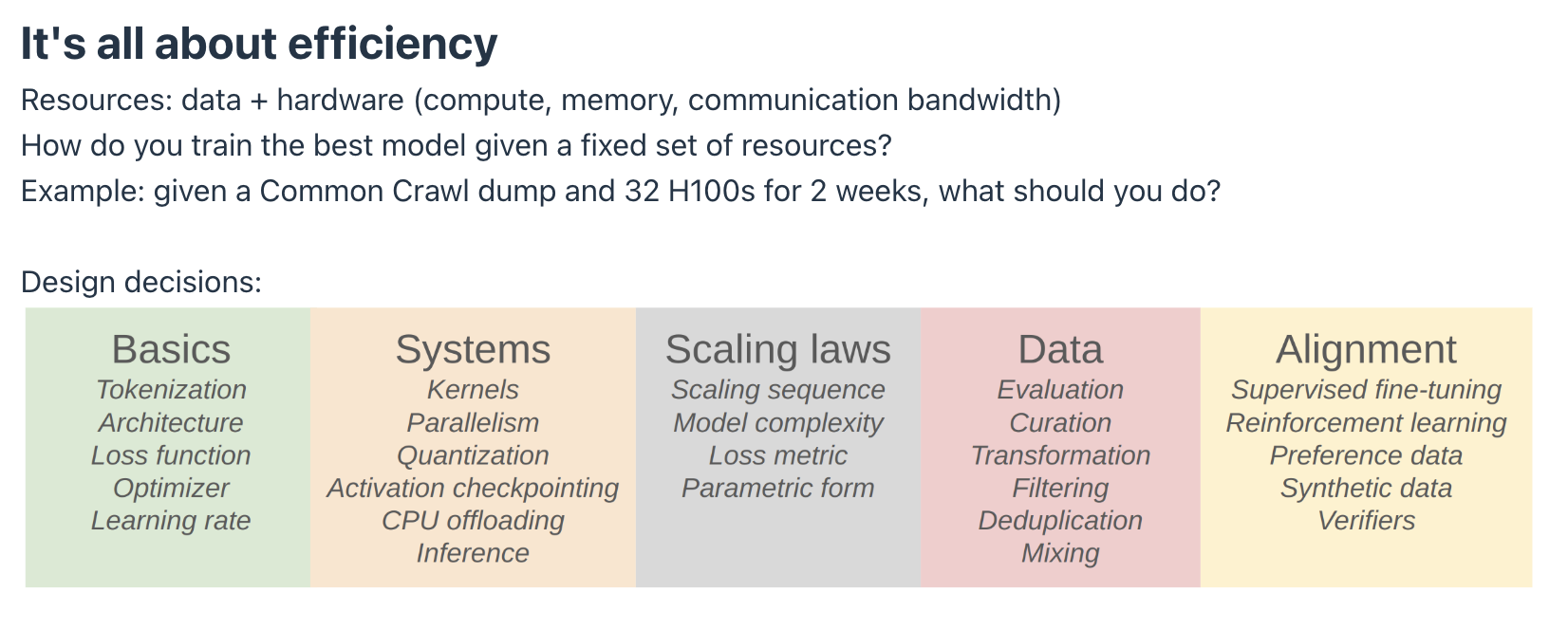
🧱 1. Basics
- Tokenizer: Byte Pair Encoding (BPE), some tokenizer-free exploration.
- Model: Transformer, with variants (SwiGLU, RoPE, Mixture of Experts).
- Activation functions: ReLU, SwiGLU
- Positional encodings: sinusoidal, RoPE
- Normalization: LayerNorm, RMSNorm
- Placement of normalization: pre-norm versus post-norm
- MLP: dense, mixture of experts
- Attention: full, sliding window, linear
- Lower-dimensional attention: group-query attention (GQA), multi-head latent attention (MLA)
- State-space models: Hyena
- Training: AdamW, learning rate schedules, batch size, regularization.
- Optimizer (e.g., AdamW, Muon, SOAP)
- Learning rate schedule (e.g., cosine, WSD)
- Batch size (e..g, critical batch size)
- Regularization (e.g., dropout, weight decay)
- Hyperparameters (number of heads, hidden dimension): grid search
🧪 Assignment 1:
Implement tokenizer, Transformer, cross-entropy loss, AdamW. Leaderboard: perplexity on OpenWebText.
⚙️ 2. Systems
- Kernels: GPU internals, Triton for tiling and fusion.
- Parallelism: Data, tensor, model parallelism (FSDP).
- Inference: Optimize prefill vs. decode. Inference now dominates compute cost.
🧪 Assignment 2:
Implement Triton kernel, parallelism; benchmark and profile constantly.
📈 3. Scaling Laws
- Chinchilla Optimal: Given flops, there’s an optimal model size and data quantity.
- Linear Fit: Scaling laws plot reveals nearly linear relationships.
🧪 Assignment 3:
Fit a scaling law via API queries; minimize loss within a flops budget. Leaderboard-based.
🧹 4. Data
- Core Idea: “The model does what the data tells it to.”
- Curation: Crawl → Parse → Clean → Filter → Deduplicate → Select.
- Evaluation: Perplexity, MMLU, instruction-following, agent evaluations.
🧪 Assignment 4:
Process Common Crawl data; deduplicate, classify, filter. Leaderboard: minimize perplexity under token budget.
🤖 5. Alignment
- Goal: Make model useful, safe, instruction-following.
- Techniques:
- SFT (e.g., 1000 examples can bootstrap instruction-following)
- DPO (Direct Preference Optimization)
- GRPO (Group Relative Preference Optimization)
🧪 Assignment 5:
Implement SFT, DPO, GRPO; evaluate alignment effectiveness.
8. Efficiency as the Overarching Principle
💡 Why Efficiency?
- Tokenization: Avoid byte-level inefficiency.
- Architecture: All tweaks aim to reduce compute-to-accuracy ratio.
- Training: One-epoch = maximize useful exposure per token.
- Data: Curated to avoid wasting GPU time.
- Alignment: Well-aligned small models can outperform unaligned large ones.
🔮 Forward Looking
- Shift from “compute constrained” → “data constrained” frontier labs.
- Re-thinking multi-epoch training and architecture design as data becomes scarcer than flops.
9. Tokenization in Language Modeling
Tokenization is a fundamental process in language modeling, serving as the initial step to convert raw text into a format suitable for computational models.
🧾 Definition and Purpose
- Tokenization is the process of converting raw text (Unicode strings) into a sequence of integers, where each integer represents a token.
- It includes:
- Encoding: string → tokens.
- Decoding: tokens → string.
- The vocabulary size is the number of unique token integers.
- The goal is to segment the string and map each part to an integer, forming a fixed-length input to the model.
- Ideally, tokenization is reversible, allowing perfect reconstruction of the original string.
🧪 Tokenization Approaches and Their Limitations
A. Character-Based Tokenization
- Each Unicode character → integer code point.
- Problems:
- Huge vocabulary (e.g., 😄 has code point 127,757).
- Inefficient vocabulary usage.
- Compression ratio: ~1.5 bytes/token (not optimal).
B. Byte-Based Tokenization
- Converts Unicode strings into byte sequences (e.g., via UTF-8), then maps bytes (0–255) to tokens.
- Pros: Very small vocabulary (256).
- Cons:
- Sequence lengths explode.
- Terrible for model efficiency due to quadratic scaling in attention layers.
C. Word-Based Tokenization
- Splits text by word boundaries (e.g., via regex).
- Problems:
- Vocabulary can be unbounded.
- Struggles with “UNK” tokens (unseen words).
- Difficulties in computing perplexity accurately.
🔗 Byte Pair Encoding (BPE)
🧠 Background
- Invented by Philip Gage in 1994 for data compression.
- Introduced to NLP in neural machine translation.
- Adopted by GPT-2for efficient and robust tokenization.
💡 Core Idea
- Learns merges from data instead of hard-coded token boundaries.
- Common substrings become single tokens; rare substrings split into smaller units.
⚙️ BPE Algorithm Steps
- Convert input string into a byte sequence.
- Repeatedly merge the most common adjacent token pair in the training corpus.
- Add new tokens to the vocabulary with each merge.
- The sequence shortens, improving the compression ratio.
- Example:
- Input: “cat and hat”
- Common pair:
('t', 'h')(116, 104) → new token: 256 - Now, “th” → 256, saving tokens.
🔁 Encoding / Decoding
- Encoding: Convert to bytes, then apply learned merges in order.
- Decoding: Reverse the merges to reconstruct the original string.
⚠️ Efficiency Notes
- The naïve BPE encoding process can be inefficient.
- Optimizations involve restricting merges to relevant tokens during encoding.
🔍 Practical Observations and Design Notes
- Space Handling:
- Spaces often prefix tokens.
"hello"≠" hello"→ treated as distinct tokens.
- Numbers:
- Often split into non-semantic tokens: e.g.,
"123"→"1", "2", "3"or"12", "3".
- Often split into non-semantic tokens: e.g.,
- Compression Ratio:
- Metric of efficiency: bytes per token.
- GPT-2 BPE achieves ~1.6 bytes/token (vs. 1.0 for byte-based).
- Tokenizer-Free Methods:
- Approaches starting from raw bytes exist but haven’t scaled to frontier models yet.
📊 Comparison of Tokenization Methods
| Tokenization Method | Description | Pros | Cons | Typical Vocabulary Size | Compression Ratio (bytes/token) | Sequence Length Efficiency |
|---|---|---|---|---|---|---|
| Character-based | Maps each Unicode character to a token | - Simple - Reversible |
- Huge vocab due to rare Unicode chars - Inefficient use of vocab - Long sequences |
Very large (~100k+) | ~1.5 | Poor |
| Byte-based | Converts text into bytes (e.g., UTF-8), maps each byte (0–255) to a token | - Small fixed vocab (256) - Language-agnostic - Fully reversible |
- Very long sequences - Poor model efficiency (quadratic attention cost) |
256 | 1.0 | Very poor |
| Word-based | Splits text into words using regex or spaces | - Easy to interpret - Short sequences for natural languages |
- Unbounded vocab - “UNK” tokens for out-of-vocab words - Not robust across languages |
Huge (can be >1M) | ~1.3–2.0 | Good (if vocab fits well) |
| Subword-based (BPE) | Learns frequent char pairs from data and merges them recursively | - Balance of vocab size and sequence length - No “UNK” tokens - Language-agnostic |
- Encoding can be slow - Doesn’t understand meaning - Token boundaries not semantic |
Medium (30k–50k typical) | ~1.5–1.6 | Good |
| Unigram LM | Learns a probabilistic model over subwords and selects best segmentation | - Can model multiple segmentations - Often better for morphologically rich languages |
- More complex training - Similar tokenization time to BPE |
Medium (~30k) | ~1.5–1.6 | Good |
| Byte-level BPE | Applies BPE on raw bytes instead of Unicode chars | - No Unicode normalization needed - Compact - Robust |
- Long sequences - Compression not as good as char-level BPE |
Medium (~50k) | ~1.2–1.3 | Moderate |
| Tokenizer-free (raw) | Operates directly on raw bytes or characters (no explicit tokenizer) | - Simplifies pipeline - Fully reversible - Great for multi-modal |
- Still experimental - Not efficient with current models - Long sequences |
N/A | 1.0 | Poor (currently) |
Notes:
- Compression Ratio = average number of bytes per token (lower is better).
- Sequence Length Efficiency = shorter sequences generally lead to lower memory and compute costs (especially in Transformers).
- BPE = Byte Pair Encoding widely used in models like GPT-2 and GPT-3.
- Unigram LM is used in SentencePiece.
- Tokenizer-free methods are explored in some state-space models and remain an open research area.
📚 Relevance to Stanford CS336
- Unit 1 (Basics) includes implementing a BPE tokenizer.
- Assignment 1: Students must build the tokenizer from scratch.
- Emphasizes efficiency-driven design:
- Tokenization helps avoid wasting compute on poor-quality data.
- Aggressive data filtering and tokenization both serve efficiency.
⚠️ The instructors note: “Hopefully in the future, we’ll get rid of this lecture entirely when models can just learn directly from bytes.”