
📚 Common Abstractions for Neural Network Computations
This document reviews the main themes and key takeaways from Deep Learning Systems: Algorithms and Implementation** at Carnegie Mellon University, taught by J. Zico Kolter and Tianqi Chen.
📚 Introduction to Neural Network Library Abstractions
I. Introduction to Neural Network Library Abstractions
- Briefly reviews deep learning models (e.g., multilayer perceptrons) and automatic differentiation algorithms.
- Introduces the concept of composing these elements into an end-to-end deep learning library.
🕰 II. Programming Abstractions: A Historical Perspective
- Explores different programming abstractions for building machine learning models.
- Reviews the evolution of deep learning frameworks, highlighting key design choices.
🔍 III. Case Studies: Caffe 1.0, TensorFlow 1.0, and PyTorch
A. Caffe 1.0: The Layer Abstraction
- Introduces the Layer as the core abstraction, defining forward and backward functions for computation and gradient propagation.
- Discusses the advantages and limitations of this in-place backpropagation approach.
B. TensorFlow 1.0: Computational Graph and Declarative Programming
- Introduces the concept of computational graphs for describing forward computations and extending them for gradient calculations.
- Highlights the advantages of declarative programming:
- 📈 Optimization opportunities.
- 🧩 Separation of declaration and execution.
C. PyTorch: Imperative Automatic Differentiation and Dynamic Computation Graphs
- Presents the imperative programming style, where computations are executed as the computational graph is constructed.
- Discusses the benefits of this approach:
- 🔄 Dynamic graph construction.
- ⚡ Flexibility in mixing Python control flow.
- 🐞 Ease of debugging.
- Compares and contrasts PyTorch’s approach with TensorFlow’s declarative style, considering optimization and flexibility trade-offs.
📊 Comparison of Caffe 1.0, TensorFlow 1.0, and PyTorch
| Framework | Execution Example | Pros | Cons |
|---|---|---|---|
| Caffe 1.0 | python<br>class Layer: <br> def forward(bottom, top): ... <br> def backward(top, propagate_down, bottom): ...This snippet demonstrates the layer interface in Caffe 1.0. The forward function propagates data from input (bottom) to output (top), while backward handles gradient calculations. |
- Natural backpropagation: The layer abstraction aligns well with forward and backward passes, making implementation intuitive. - Fast execution due to efficient C++ backend. |
- Coupled gradient computation and module composition: Defining complex modules like ResNet can be challenging. - Limited flexibility for dynamic or non-layer-based models. |
| TensorFlow 1.0 | python<br>v1 = tf.Variable()<br>v2 = tf.exp(v1)<br>v3 = v2 + 1<br>v4 = v2 * v3<br>sess = tf.Session()<br>value4 = sess.run(v4, feed_dict={v1: numpy.array()})This example illustrates TensorFlow’s declarative programming style. The computational graph is defined first, followed by execution within a session. |
- Optimization opportunities: Analyzing the complete graph enables optimizations like code elimination and distributed execution. - Scalable computations: Separation of declaration and execution allows running on remote hardware for large-scale tasks. |
- Less flexible: Integrating Python control flow requires special nodes (tf.if, tf.while_loop).- Difficult debugging: Inspecting intermediate values requires running the entire graph, making interactive debugging cumbersome. |
| PyTorch | python<br>v1 = ndl.Tensor()<br>v2 = ndl.exp(v1)<br>v3 = v2 + 1<br>v4 = v2 * v3<br>if v4.numpy() > 0.5:<br> v5 = v4 * 2<br>else:<br> v5 = v4<br>v5.backward()This code exemplifies PyTorch’s imperative programming style. Computations are executed immediately, enabling dynamic graph construction based on runtime values. |
- Flexibility and ease of use: Dynamic graph construction and direct tensor interaction make it user-friendly. - Dynamic computational graphs: Beneficial for tasks with variable input sizes like NLP or reinforcement learning. - Easier debugging with native Python support for control flow and interactive tools. |
- Fewer optimization opportunities: Eager execution may hinder optimizations that benefit from a static graph. - Higher memory usage in certain cases compared to static graph frameworks. |
🔑 Key Insights:
-
Caffe 1.0:
Offers a natural way to implement backpropagation through its layer-based approach, but managing complex architectures like ResNet can be cumbersome. -
TensorFlow 1.0:
Facilitates optimization and scalability with a declarative style, making it suitable for large-scale production systems. However, it sacrifices flexibility and ease of use. -
PyTorch:
Provides flexibility and a user-friendly experience with dynamic graph construction, making it ideal for research and development. However, it may miss certain optimization opportunities available in static graph frameworks.
💡 Framework Selection:
-
For Research and Development:
PyTorch is often preferred due to its flexibility, dynamic graph support, and ease of debugging. -
For Production Environments:
TensorFlow 1.0 is more suitable when scalability, optimization, and deployment on distributed systems are crucial. -
Legacy Usage:
While Caffe 1.0 is still used in some niche cases, it has largely been superseded by newer frameworks like PyTorch and TensorFlow.
🛠 IV. Modularity in Deep Learning: From Concepts to Code
- Emphasizes the inherent modularity of machine learning, encompassing:
- 📊 Hypothesis class.
- 🧮 Loss function.
- 🚀 Optimization method.
- Explains how this modularity translates into modular components in code, enhancing flexibility and customization.
🏗 V. Composing Deep Learning Models: The Power of nn.Module
A. Recursive Decomposition: Breaking Down Complex Models
- Demonstrates the process of decomposing a complex model (e.g., ResNet) into smaller, reusable modules:
- 🔹 Linear layers.
- 🔹 ReLU activations.
- 🔹 Residual blocks.
- Highlights the importance of modularity for building and understanding deep learning models.
B. nn.Module: The Building Block for Modularity
- Introduces the
nn.Moduleas a fundamental data structure for representing modules. - Emphasizes the “tensor in, tensor out” principle for composing modules seamlessly.
- Key functionalities of
nn.Module:- 🔑 Managing trainable parameters.
- 🛠 Initialization.
- 🔄 Handling training/inference modes.
🔑 VI. Other Key Modular Components
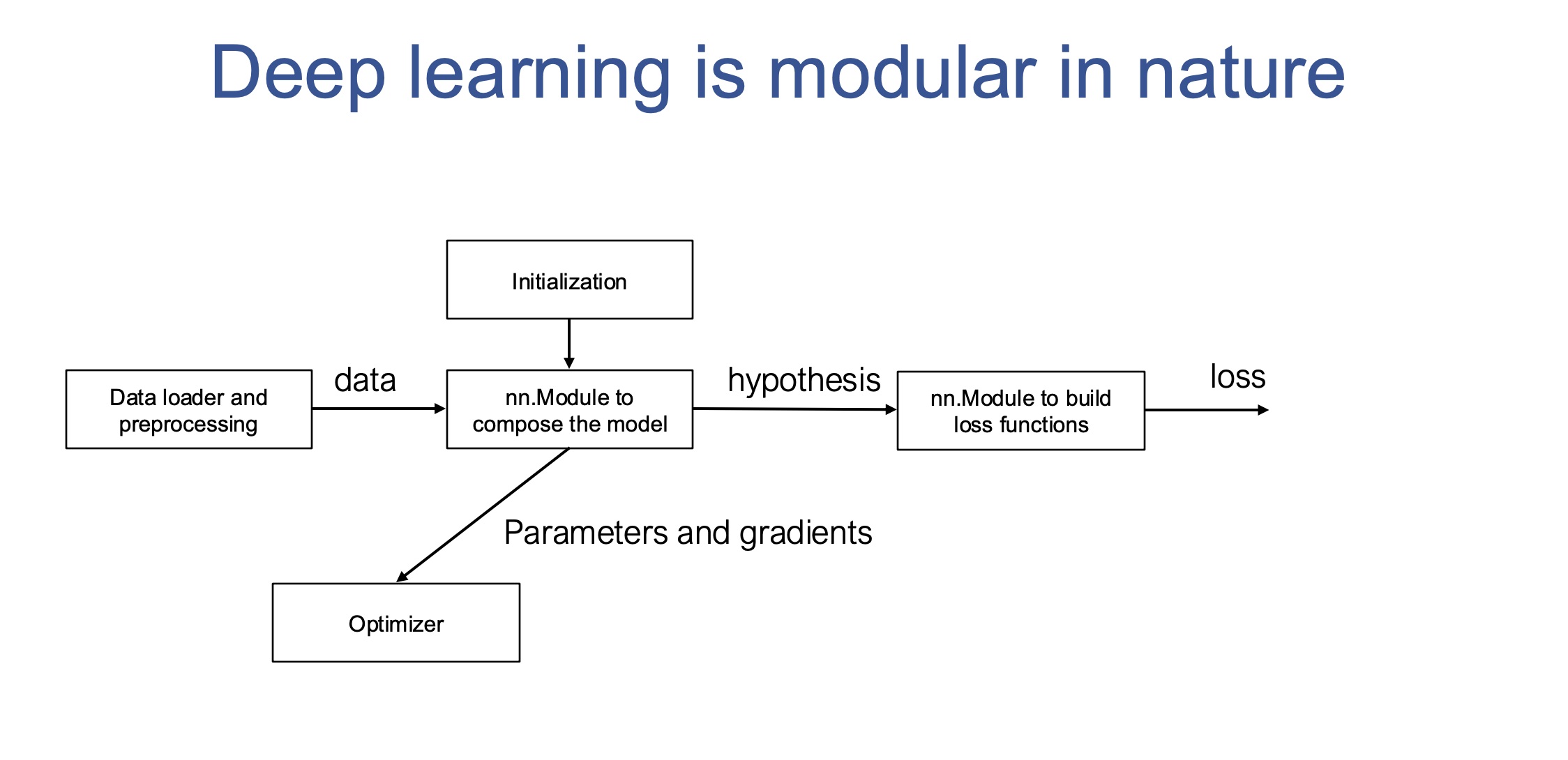
A. Loss Functions
- Special modules for evaluating model performance, following a “tensor in, scalar out” convention.
B. Optimizers
- Modules responsible for updating model weights based on gradients.
- Manage auxiliary states and regularization.
C. Initialization
- Techniques for setting initial parameter values to ensure stable and effective training.
D. Data Loaders and Preprocessing
- Pipelines for loading, augmenting, and preparing data for training.
🚀 VII. Conclusion and Future Directions
- Recap of the modular nature of deep learning and the benefits of composing models from reusable components.
- Encourages reflection on:
- 🔄 The evolution of programming abstractions.
- 🧩 The advantages of separating gradient computation from module composition.
- Suggests exploring additional modular components beyond those discussed.
📚 Glossary of Key Terms
-
Layer
A fundamental building block in neural networks, performing a specific operation on input data, like a linear transformation or an activation function. -
Computational Graph
A directed graph representing mathematical operations and data dependencies in a deep learning model. -
Declarative Programming
A programming paradigm where you specify what you want to compute, and the system determines how to execute it. -
Imperative Programming
A programming paradigm where you provide step-by-step instructions for the computer to execute. -
nn.Module
A base class in PyTorch and similar frameworks for defining modular, reusable components of neural networks. -
Tensor
A multi-dimensional array used to represent data in deep learning frameworks. -
Loss Function
A function that measures the difference between model predictions and the ground truth labels, used to guide model training. -
Optimizer
An algorithm that updates model weights based on the calculated gradients to minimize the loss function. -
Weight Initialization
The process of assigning initial values to the weights of a neural network, which can significantly impact training performance. -
Data Augmentation
Techniques for artificially expanding the training dataset by applying random transformations to the data, improving model robustness and generalization. -
Gradient Computation
The process of calculating the gradients of the loss function with respect to the model parameters, used to guide weight updates. -
Module Composition
The process of combining individual modules to build more complex neural network architectures. -
Learning Rate Scheduler
A component that dynamically adjusts the learning rate during training to improve convergence speed and stability. -
Metric Tracker
A component that monitors and logs various performance metrics during training and evaluation, providing insights into model behavior.