
📚 Sequence Modeling and Recurrent Networks
This document reviews the main themes and key takeaways from Deep Learning Systems: Algorithms and Implementation** at Carnegie Mellon University, taught by J. Zico Kolter and Tianqi Chen.
This lecture covers sequence modeling, RNNs, LSTMs, and their applications in complex prediction tasks. 🚀
🔄 Sequence Modeling
- What Makes Sequence Modeling Unique:
- Deals with ordered input-output pairs where order matters.
- Unlike standard ML problems, pairs are not IID (independent and identically distributed).
- Input-output pairs form a dependent sequence, e.g., $( x_1 \to y_1 \to x_2 \to y_2 )$, etc.
- Examples of Sequence-Dependent Tasks:
- Part-of-Speech Tagging: Predicts part of speech for each word in a sentence using context.
Example: “well” as an adverb vs. a noun. - Speech-to-Text: Translates audio sequences into text, preserving order and temporal relationships.
- Autoregressive Prediction: Predicts the next term in a sequence, e.g., “the quick brown” → “fox.”
- Part-of-Speech Tagging: Predicts part of speech for each word in a sentence using context.
🤖 Recurrent Neural Networks (RNNs)
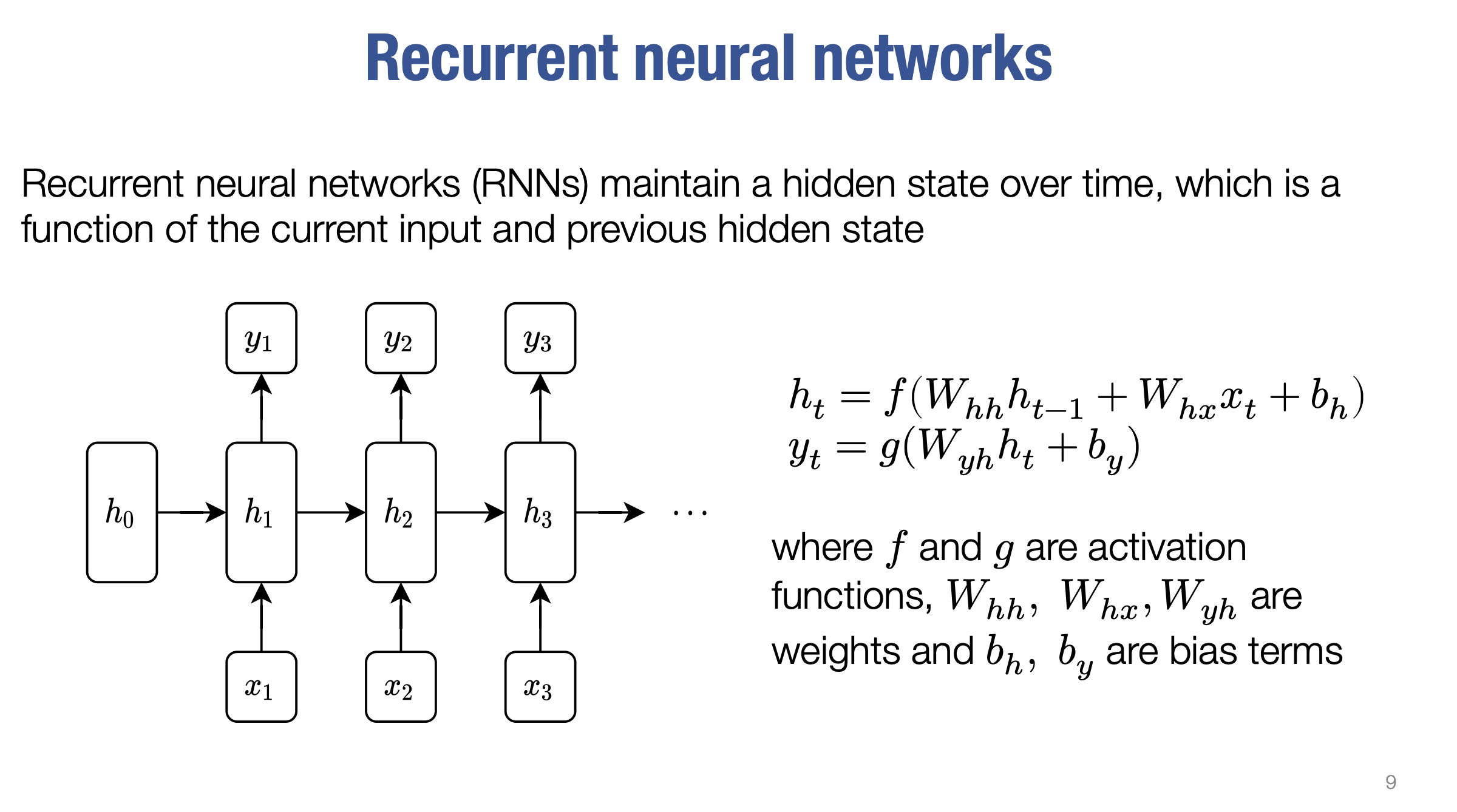
- Core Idea:
- Models temporal structure using a hidden state updated over time.
- At time $( t )$, hidden state $( h_t )$ is a function of:
- Current input $( x_t )$,
- Previous hidden state $( h_{t-1} )$.
- Formulas:
- Hidden state update:
$( h_t = f(W_{hh} \cdot h_{t-1} + W_{hx} \cdot x_t + b_h) )$
($( f )$: non-linear activation, $( W )$: weights, $( b )$: bias). - Output prediction:
$( y_t = g(W_{yh} \cdot h_t + b_y) )$
($( g )$: non-linear activation).
- Hidden state update:
- Hidden State ($( h_t )$): Vector in $( \mathbb{R}^d )$, where $( d )$ is the dimension of the hidden state.
- Input ($( x_t )$): Vector in $( \mathbb{R}^n )$, where $( n )$ is the dimension of the input vector.
- Output ($( y_t )$): Vector in $( \mathbb{F}^k )$, where $( k )$ is the dimension of the output.
- Weight Matrices:
- $( W_{hh} )$: Maps the previous hidden state to the current hidden state ($( d \times d )$).
- $( W_{hx} )$: Maps the input to the hidden state ($( d \times n )$).
- $( W_{yh} )$: Maps the hidden state to the output ($( k \times d )$).
- Bias Terms:
- $( b_h )$: Vector in $( \mathbb{R}^d )$.
- $( b_y )$: Vector in $( \mathbb{R}^k )$.
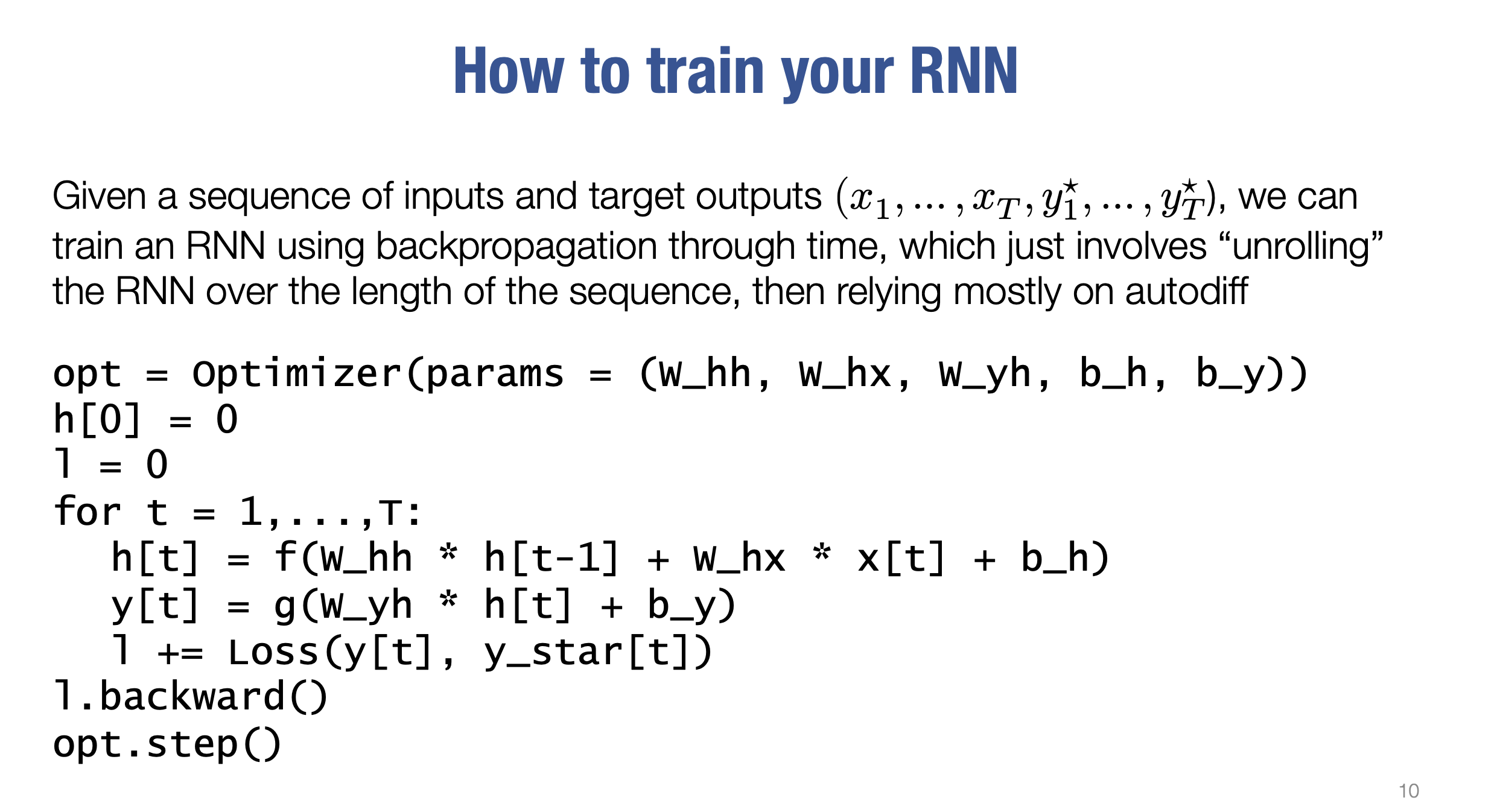
- Training RNNs:
- Adjust parameters ($( W_{hh}, W_{hx}, W_{yh}, b_h, b_y )$) using Backpropagation Through Time (BPTT).
- Gradients computed via automatic differentiation.
- First hidden state $( h_0 )$ initialized to zero.
- Loss computed at each time step, then backpropagated to update weights.
- Deep RNNs:
- RNN layers can be stacked for deeper models, passing outputs from one layer to the next.
⚠️ Challenges in Training RNNs
- Exploding Gradients:
- Weights too large → Gradients grow exponentially → Numerical instability.
- Vanishing Gradients:
- Weights too small → Information decays → Struggles with long-range dependencies.
- Activation Issues:
- ReLU: Can cause exploding or vanishing gradients.
- Sigmoid/Tanh: Saturates, leading to small gradients.
🚨 Exploding Activations/Gradients
- Caused by large weights, leading to exponentially growing activations and gradients.
- Results in numerical instability (e.g., NaN values).
- Example: Initializing $( W_{hh} )$ with variance $( 3/n )$ using ReLU causes rapid growth over time.
🌑 Vanishing Activations/Gradients
- Caused by small weights, leading to decaying information from earlier inputs.
- Example: Initializing $( W_{hh} )$ with variance $( 1.5/n )$ reduces the norm of hidden units over time.
🔍 Why ReLU Can Be Problematic for RNNs
- Effective in other networks but unstable in RNNs:
- Exploding Gradients: Activations can grow without bounds if weights are large.
- Vanishing Gradients: Activations decay when weights are small, especially with incorrect initialization.
🔄 Why Sigmoid and Tanh Improve ReLU but Have Limitations
- Benefits:
- Both activations are bounded:
- Sigmoid: $( [0, 1] )$,
- Tanh: $( [-1, 1] )$.
- Solve the exploding gradient issue.
- Both activations are bounded:
- Limitations:
- Gradients approach zero when activation values are near bounds (e.g., $( 0, 1 )$ for sigmoid or $( -1, 1 )$ for tanh).
- Causes difficulty in learning long-range dependencies.
🧠 Long Short-Term Memory Networks (LSTMs)
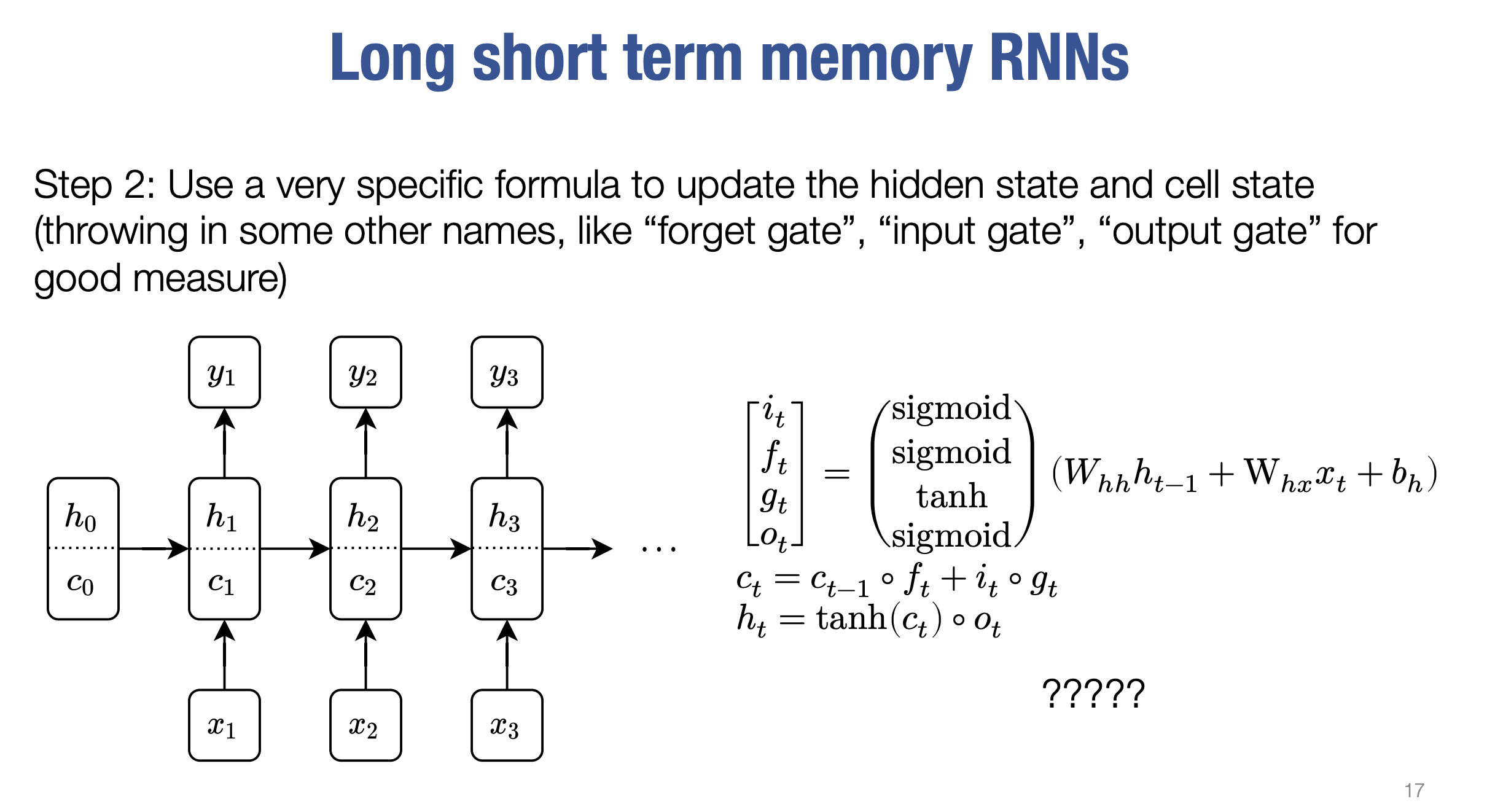
- What Are LSTMs?
- Special RNNs designed to handle vanishing gradient problems.
- Split hidden state into two components:
- Hidden state ($( h_t )$).
- Cell state ($( c_t )$).
- Key Components:
- Forget Gate ($( f_t )$): Retains parts of the previous cell state.
- Input Gate ($( i_t )$) and Cell Gate ($( g_t )$): Add new information to the cell state.
- Output Gate ($( o_t )$): Controls output from the cell state.
- Cell State Update:
- Combines retained information and new terms: $( c_t = f_t \cdot c_{t-1} + i_t \cdot g_t )$.
- Why LSTMs Work:
- Gates use sigmoid activations to control updates, preventing vanishing gradients.
- History:
- Introduced in 1997 by Hochreiter and Schmidhuber.
- Gained popularity after Andrej Karpathy’s 2015 blog post on LSTMs in text generation.
📐 Dimensions in Long Short-Term Memory Networks (LSTMs)
- Hidden and Cell States ($( h_t, c_t )$): Both are vectors in $( \mathbb{R}^d )$.
- Gate Vectors ($( i_t, f_t, g_t, o_t )$): Each has dimension $( d )$.
- Weight Matrices:
- $( W_{hh} )$: Maps hidden state to intermediate states ($( 4d \times d )$).
- $( W_{hx} )$: Maps input to intermediate states ($( 4d \times n )$).
- Bias Terms:
- $( b_h )$: Vector of size $( 4d )$.
- Intermediate States: Vectors $( i, f, g, o )$ in $( \mathbb{R}^d )$.
- Cell State ($( c_t )$): Vector of dimension $( d )$.
🧠 LSTM Formulas and Key Concepts
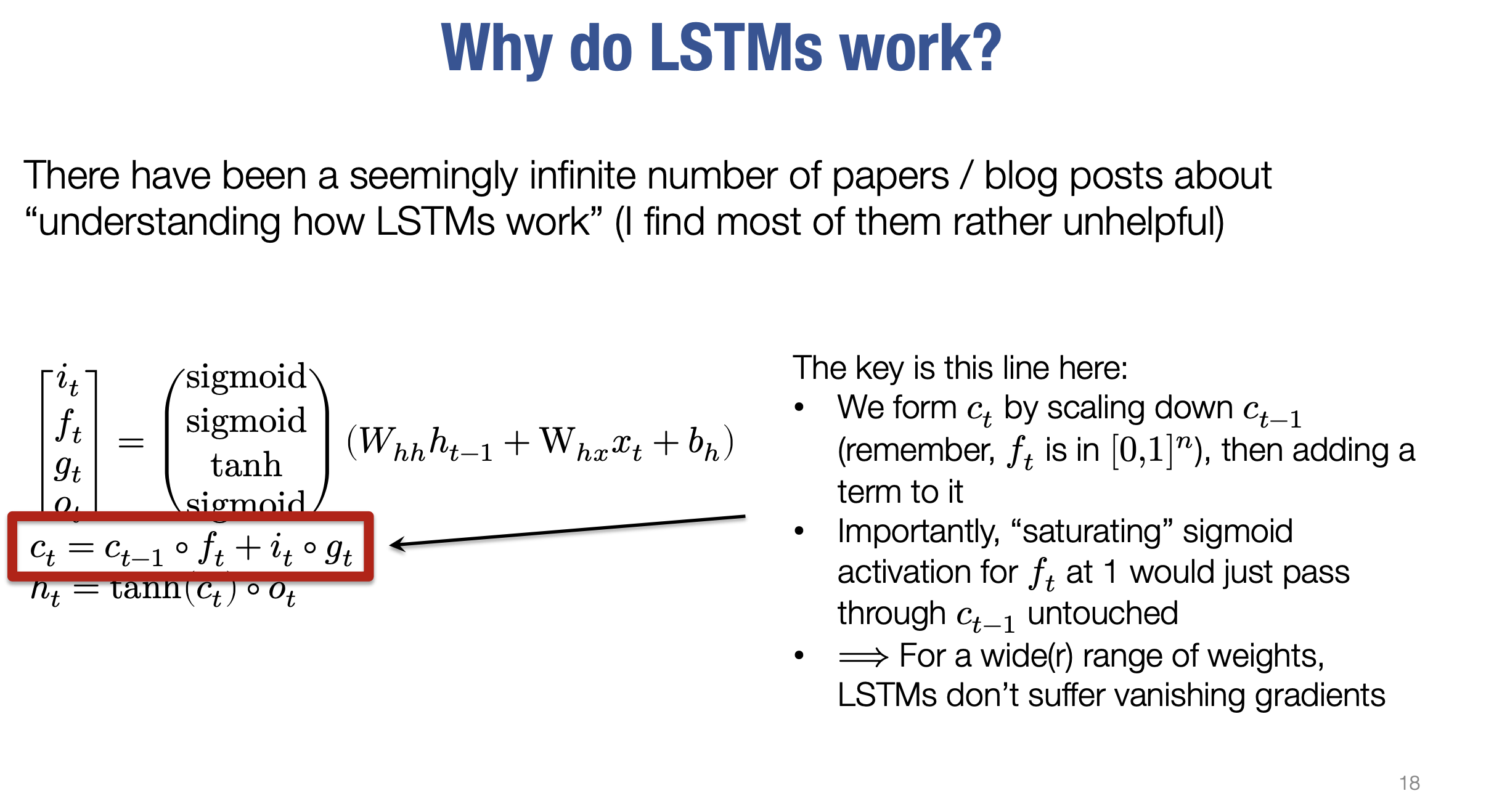
- Cell State Update:
$[
c_t = f_t \odot c_{t-1} + i_t \odot g_t
]$
- $( f_t )$: Forget gate scales $( c_{t-1} )$ ($( [0, 1] )$).
- $( i_t )$: Input gate controls new information.
- $( g_t )$: Cell gate adds bounded new terms ($( [-1, 1] )$).
- Hidden State Update:
$[
h_t = \text{tanh}(c_t) \odot o_t
]$
- Output gate ($( o_t )$) determines visible portions of $( c_t )$.
- Why LSTMs Work:
- Scales past cell states with $( f_t )$ and adds new terms via $( i_t )$.
- Mitigates vanishing gradients by preserving past information.
🔍 Lecturer’s Insights on LSTMs
- Gate names (e.g., input, forget, output) are somewhat arbitrary.
- Other structures can work fine, but LSTM equations are:
- Well-tuned and effective.
- A balance of preserving memory and avoiding vanishing gradients.
🌟 Beyond Simple Sequential Models
- Sequence-to-Sequence Models:
- Encode an input sequence into a hidden state.
- Use another RNN to decode the hidden state into the output sequence.
Example: Language translation.
- Bidirectional RNNs:
- Process input in both forward and backward directions.
- Useful for tasks like translation (not autoregressive tasks).
Example: Stacked forward and backward RNNs.
- Training Complex Models:
- Entire models (e.g., seq2seq or bidirectional RNNs) can be trained end-to-end using automatic differentiation.