
DeepSeek Reasoning Models Series
📌 In Part Two, we focus on DeepSeek’s Reasoning Models.
- DeepSeek-Coder: When the Large Language Model Meets Programming - The Rise of Code Intelligence
- DeepSeek-Coder-V2: Breaking the Barrier of Closed-Source Models in Code Intelligence
- MATH-SHEPHERD: VERIFY AND REINFORCE LLMS STEP-BY-STEP WITHOUT HUMAN ANNOTATIONS
- DeepSeekMath: Pushing the Limits of Mathematical Reasoning in Open Language Models
- DeepSeek-Prover: Advancing Theorem Proving in LLMs through Large-Scale Synthetic Data and
- DeepSeek-Prover-V1.5: Harnessing Proof Assistant Feedback for Reinforcement Learning and Monte-Carlo Tree Search
- DeepSeek-R1: Incentivizing Reasoning Capability in LLMs via Reinforcement Learning
💻 DeepSeek-Coder: When the Large Language Model Meets Programming - The Rise of Code Intelligence
Main Theme:
DeepSeek Coder v1 is one of DeepSeek’s early models, specifically designed for code intelligence. It marked the beginning of DeepSeek’s focus on the reasoning aspect of large language models.
🔍 Breakdown of DeepSeek Coder v1:
-
Model Type:
DeepSeek Coder v1 is a dense model, unlike later MoE-based DeepSeek models. -
Base and Training Data:
Its architecture closely mirrors DeepSeek LLM (a Llama 2 reproduction), but it is primarily trained on code data instead of general text. -
Sizes Available:
Released in sizes ranging from 1.3B to 33B parameters. -
Open-Source:
All versions of DeepSeek Coder v1 were open-source ✅
🌟 Significance and Impact:
- DeepSeek Coder v1 helped build DeepSeek’s early international reputation.
- While their English LLMs faced stiff competition, the code models stood out — especially in the 1.3B–30B range — and became popular with developers due to solid performance.
-
Code models like this are important for real-world productivity and practical applications.
- Relation to DeepSeek Coder v1.5:
DeepSeek Coder v1.5 was developed by continued pre-training of v1, further specializing the model on code.
🧩 Overall, DeepSeek Coder v1 set the stage for a broader trend of developing code-focused LLMs across the industry.
🧠 DeepSeek-Coder-V2: Breaking the Barrier of Closed-Source Models in Code Intelligence
Main Theme:
DeepSeek Coder v2 represents a significant evolution, built specifically for code intelligence using a Mixture-of-Experts (MoE) design.
🔍 Breakdown of DeepSeek Coder v2:
- Model Type and Architecture:
- Transitions from dense (v1) to MoE architecture.
- Built on DeepSeek V2 (general MoE model).
- Trained with an additional 6 trillion tokens of code data.
- Training + Reward Models:
- At the time, DeepSeek still employed reward models for reinforcement learning (RL) in code tasks.
- This contrasts with later approaches (e.g., DeepSeek R1), which moved to rule-based feedback.
- Despite having access to ground-truth unit test feedback (0/1), they opted for reward models due to noisy or incomplete test coverage.
- Experiments showed reward model–based RL outperformed rule-based or no-RL approaches at that time.
🔁 Relation to DeepSeek Coder v1:
- Architecture:
- v1: Dense (like Llama 2)
- v2: MoE (based on DeepSeek V2)
- Training Data:
- v1: Trained primarily on code from scratch
- v2: Continued pre-training from a general MoE base (DeepSeek V2) using more code data
- Impact:
- v1 built DeepSeek’s early code-model reputation, especially among developers.
- v2 continued the focus and evolved the architecture.
🌐 Industry Context:
DeepSeek’s work on Coder v2 fits into the broader LLM trend of releasing code-specialized models — a space where LLMs can directly improve developer productivity.
🧮 MATH-SHEPHERD: VERIFY AND REINFORCE LLMS STEP-BY-STEP WITHOUT HUMAN ANNOTATIONS
DeepSeek Math Shepherd, often referred to by the speaker as “M Shepherd” or “SF,” represents a significant early contribution from DeepSeek in the realm of code and math intelligence, specifically focusing on reasoning. It is distinct from the later “DeepSeek Math” model, which introduced the GRPO algorithm.
🎯 Purpose and Model Type
-
Goal:
DeepSeek Math Shepherd was designed to develop a process-based reward model for multi-step reasoning problems, especially in mathematics. -
Process-Based Judgement:
Unlike models that only evaluate the final answer, this approach evaluates the correctness of each intermediate step in a multi-step solution.
🧠 Key Innovation: Automatic Label Construction
-
A major challenge in process-based models is obtaining step-by-step correctness labels.
-
While OpenAI’s “Let’s Verify Step by Step” paper (e.g., PRM800K with 800k human-labeled math solutions) used human annotation, DeepSeek innovated by generating these labels automatically without human help.
-
How It Works:
If a specific step, when fixed, consistently leads to correct final answers across multiple completions, it is considered correct.
If it leads to incorrect answers, it’s deemed incorrect.
🧪 Improving Accuracy Through Sampling and Selection
-
During inference, instead of generating one solution, the model samples multiple outputs (e.g., 64 solutions per math problem) 🔁
-
The reward model then evaluates each solution to determine their step-by-step or outcome correctness.
-
It selects the best solution based on reward scores — this “best-of-N” strategy boosts final accuracy ✅
-
A graph shows that the process-based model (“SF”) outperforms consistency checks and outcome-based models as the number of sampled solutions increases — a form of early test-time scaling.
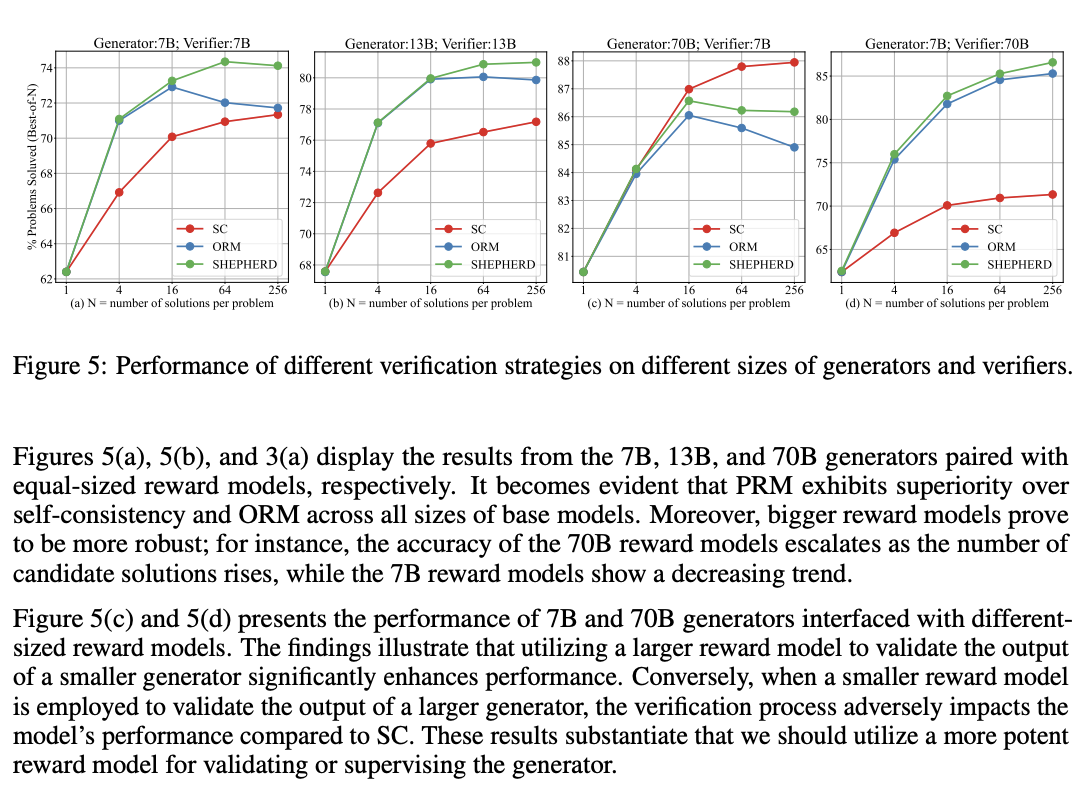
- This strategy — increasing inference-time compute to improve results — is now common in models like O1 and R1.
🌍 Impact and Significance in the Community
-
DeepSeek showed that automatically generated labels perform comparably to human-annotated ones.
-
Their process-based approach outperformed consistency-based and outcome-based models in solution evaluation.
-
First Open-Source Process-Based Model:
DeepSeek Math Shepherd was one of the earliest and only open-source process-based reward models in the field. -
As a result, many researchers used Math Shepherd directly in their own research.
🔄 Context and Evolution
-
At its release (early 2024), the AI community still leaned toward reward models for reinforcement learning — even for tasks like code, despite available rule-based feedback.
-
DeepSeek Coder V2 also used reward models, before later models (like DeepSeek R1) shifted to rule-based feedback.
-
Reward models can suffer from generalization issues (e.g., trained on elementary math, but fails on complex math).
In contrast, rule-based feedback is more robust but sparse. -
DeepSeek Math Shepherd helped refine understanding of when and how to use reward models in reasoning tasks.
-
Its techniques were later reused in models like DeepSeek Math, which adopted Shepherd’s process-based reward model for GRPO training.
🧮 DeepSeekMath: Pushing the Limits of Mathematical Reasoning in Open Language Models
DeepSeek Math, often referred to as “DeepSeek Math” or “dpsm” in the sources, is a significant specialized model from DeepSeek that focuses on mathematical reasoning. It is distinct from the earlier “DeepSeek Math Shepherd” (M Shepherd), although it builds upon some of its concepts, especially regarding process-based supervision for reward models.
🎯 Purpose and Specialization
- DeepSeek Math is a specialized model for mathematics, designed to excel in multi-step reasoning problems in this domain.
- The
dpsm7bmodel was considered the best open-source math base model at its scale for a long time.
💡 Key Innovation: GRPO Algorithm
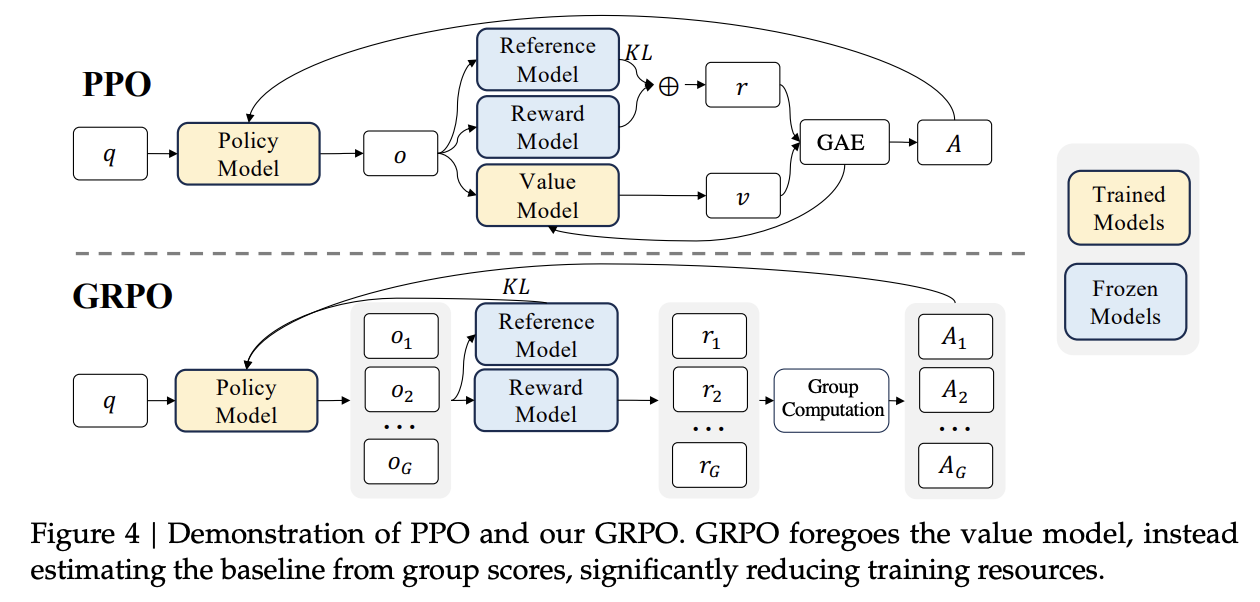
- GRPO stands for Generalized Reinforcement Learning with Policy Optimization.
- It was introduced to replace PPO (Proximal Policy Optimization) due to PPO’s high cost and its requirement for a separate value model.
- GRPO eliminates the value model by:
- Sampling multiple responses for each input
- Assigning rewards to each
- Using the average reward as a baseline to compute policy updates
- GRPO is more efficient, requiring less compute and memory.
- It became the standard RL algorithm for DeepSeek models like V2, V3, and R1, and was widely adopted across open-source RL frameworks.
🔁 Online and Offline Training Strategies
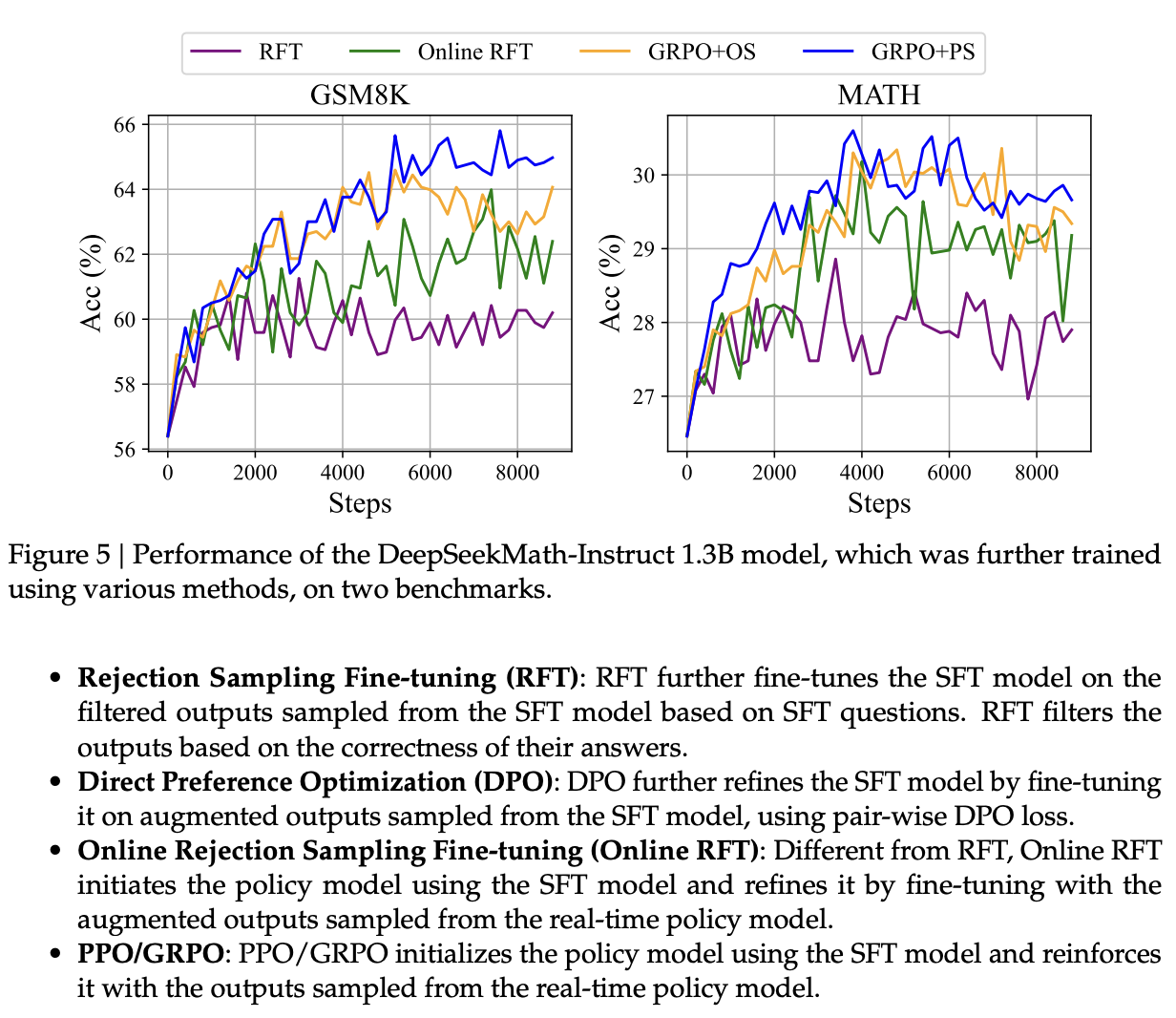
1️⃣ Offline Sampling/Training
- Data is generated once from a fixed supervised fine-tuned (SFT) model.
- Examples: Rejection Sampling Fine-tuning (RFT), Direct Preference Optimization (DPO)
- Pros: Simple and resource-efficient
- Cons: Data doesn’t adapt to the model’s evolving behavior
2️⃣ Online Sampling/Training
- Data is generated in real-time from the currently training model (policy evolves)
- Examples: PPO, GRPO
- Pros: Adapts to recent model behavior, can lead to better performance
- Cons: More resource-intensive, complex to stabilize, higher GPU requirements
DeepSeek acknowledged that online training, though expensive, leads to better generalization and performance — as seen in Math Shepherd and DeepSeek Math.
🧱 Base Model and Training Strategy
- DeepSeek Math (dpsm7b) is a 7B parameter model
- Built via continued pretraining from
deepseek-coder-base-v1.5-7b - Trained with 120 billion math-specific tokens
- Model is open-source, but training data is not
🔁 Evolution of Reward Modeling
- DeepSeek Math continues the process-based reward modeling approach from Math Shepherd
- Focus: Evaluate each step of a solution, not just the final answer
- Used this reward model for GRPO training
- Later, DeepSeek found that rule-based feedback (e.g., correct final answer or unit tests) is more robust for verifiable tasks like math and code
- This led to models like DeepSeek R1 abandoning reward models for rule-based methods
🤔 Why RL Works (and Sometimes Doesn’t)
DeepSeek Math contains a very insightful section analyzing why reinforcement learning works — or doesn’t — for reasoning tasks.
🔍 Key Observations:
- Pass@1 vs Pass@K (PK@1 vs PK@K):
- RL improves PK@1 (most likely answer is correct)
- But when sampling multiple answers (K=8 or 16), the improvement disappears or reverses
- Conclusion:
RL improves ranking of known correct answers, not necessarily generation of new ones - This shows RL might not fundamentally improve reasoning, but helps pick better among what it already knows
🧠 Scientific Rigor:
- DeepSeek was honest and self-critical, acknowledging that RL gains were overstated
- Suggested reward model generalization was a bottleneck
- This led to DeepSeek R1’s shift toward rule-based feedback for verifiable tasks
🚀 Performance and Inference Strategy
- DeepSeek Math 7B outperforms Llama 34B models on many math benchmarks
- At inference:
- Model samples multiple solutions (e.g., 64)
- A reward model (like Math Shepherd) ranks them
- The best solution is selected → improves accuracy
- This is test-time scaling: more compute = better results ✅
🧠 DeepSeek-Prover: Advancing Theorem Proving in LLMs through Large-Scale Synthetic Data and
DeepSeek-Prover-V1.5: Harnessing Proof Assistant Feedback for Reinforcement Learning and Monte-Carlo Tree Search
DeepSeek Prover is a specialized research effort by DeepSeek focused on theorem proving in large language models (LLMs). This task falls under the broader domain of reasoning, a major area of DeepSeek’s innovation beyond base models. While it may not have received the same attention as DeepSeek R1 or foundational models, DeepSeek Prover has played a vital role in shaping DeepSeek’s understanding of reinforcement learning (RL) and reward models for verifiable reasoning tasks.
🎯 Purpose
- DeepSeek Prover aims to advance formal theorem proving capabilities in LLMs.
- Theorem proving differs from general math problems by requiring proofs to be written in a formal, verifiable language (e.g., Lean).
✅ Key Characteristic — Verifiability
- The core feature of theorem proving (similar to coding and math) is that correctness can be objectively verified using external tools.
- For DeepSeek Prover, the Lean proof verifier provides this binary (0/1) feedback.
- This contrasts with open-ended tasks (e.g., writing or summarization) where such rule-based feedback is hard to define.
🔄 Methodology — Self-Improvement and Iteration
- The initial DeepSeek Prover used an iterative self-refinement strategy:
- Generate proofs → check with Lean verifier → keep only correct ones → retrain
- This is similar to distillation and self-improvement.
- The success of this method contributed to DeepSeek’s realization that online, adaptive training (where data evolves with the model) is superior to static, offline datasets — a theme echoed in DeepSeek Math.
🚀 Evolution to DeepSeek Prover V1.5 — Incorporating RL
- Released in August 2024, DeepSeek Prover V1.5 marked the shift to direct reinforcement learning.
- Used GRPO (Group Relative Policy Optimization) — DeepSeek’s efficient online RL algorithm.
- Importantly:
- No learned reward model was used
- Instead, used direct rule-based feedback (from Lean verifier) as the reward signal
- This was a strategic pivot — acknowledging that in verifiable tasks, rule-based feedback is more robust and scalable than neural reward models.
🧭 Exploration of Complex Decoding (MCTS)
- DeepSeek Prover explored Monte-Carlo Tree Search (MCTS) to enhance inference:
- MCTS = simulate multiple proof paths → search for best one
- Though powerful, it added significant complexity
- Later models like DeepSeek R1 would abandon such complexity, adopting the philosophy of “大道至简” (“great simplicity”).
🧩 Significance in DeepSeek’s Research Journey
- Alongside DeepSeek Coder, DeepSeek Prover reflects DeepSeek’s early commitment to reasoning capabilities in LLMs.
- Key milestone in the evolution from:
- Reliance on learned reward models (e.g., in DeepSeek Coder V2, DeepSeek Math)
➡️ To - Realization of the strength of rule-based feedback for verifiable tasks.
- Reliance on learned reward models (e.g., in DeepSeek Coder V2, DeepSeek Math)
- DeepSeek Prover’s insights directly informed the design of DeepSeek R1, which uses only rule-based rewards for training on math and code.
- Though smaller in scope than base model work, DeepSeek Prover represents critical academic rigor and foundational insight into effective RL for reasoning.
🧠 DeepSeek-R1: Incentivizing Reasoning Capability in LLMs via Reinforcement Learning
DeepSeek R1 is a flagship initiative by DeepSeek that aims to enhance the reasoning capabilities of large language models (LLMs) through reinforcement learning (RL), following what is often called the “O1 route”. It marks a major step in DeepSeek’s evolution toward effective RL-based training for tasks such as math and code generation.
🎯 DeepSeek R1: Incentivizing Reasoning Capability
Philosophy: DeepSeek R1 follows the principle of “大道至简” (“great simplicity”) in applying RL, especially in reward mechanisms.
- ✅ Rule-Based Rewards:
- For verifiable tasks like math and coding, DeepSeek R1 does not use a learned reward model.
- Instead, it uses simple rule-based correctness checks:
- ✅ Math: check if the final boxed answer is correct
- ✅ Coding: check if the code passes unit tests using a compiler
- 📉 Departure from Learned Rewards:
- A major shift from earlier methods used in DeepSeek Coder V2 and Math Shepherd, which relied on process-based supervision and neural reward models.
- DeepSeek found that:
- Neural reward models were prone to reward hacking
- They increased training complexity and cost
- Rule-based feedback proved more robust and scalable
- ⚙️ Training Method - GRPO:
- DeepSeek R1 uses GRPO (Group Relative Policy Optimization), a lightweight, online RL algorithm first introduced in DeepSeek Math.
- GRPO eliminates the need for a separate value model, reducing cost and complexity.
- R1’s base is DeepSeek V3, a large Mixture-of-Experts (MoE) model with 671 billion parameters.
- 🧬 Multi-Stage Training with Cold Start:
- Stage 1: Collect long Chain-of-Thought (CoT) examples to fine-tune DeepSeek-V3-Base
- Stage 2: RL training focused on reasoning
- Stage 3: Use rejection sampling to collect new SFT data
- Stage 4: Final RL using prompts from all task domains
- 📈 Performance:
- Math: 79.8% Pass@1 on AIME 2024, 97.3% on MATH-500
- Coding: 96.3% percentile on Codeforces, 2029 Elo
- Strong on MMLU, GPQA Diamond, significantly beating DeepSeek V3
🧪 DeepSeek R1-Zero: Pure RL Without SFT
A foundational variant to test pure reinforcement learning, with no supervised fine-tuning.
- 🔁 Self-Evolution:
- RL is applied directly to the DeepSeek-V3-Base
- Emerges with:
- 🔍 Self-verification
- 💭 Reflection
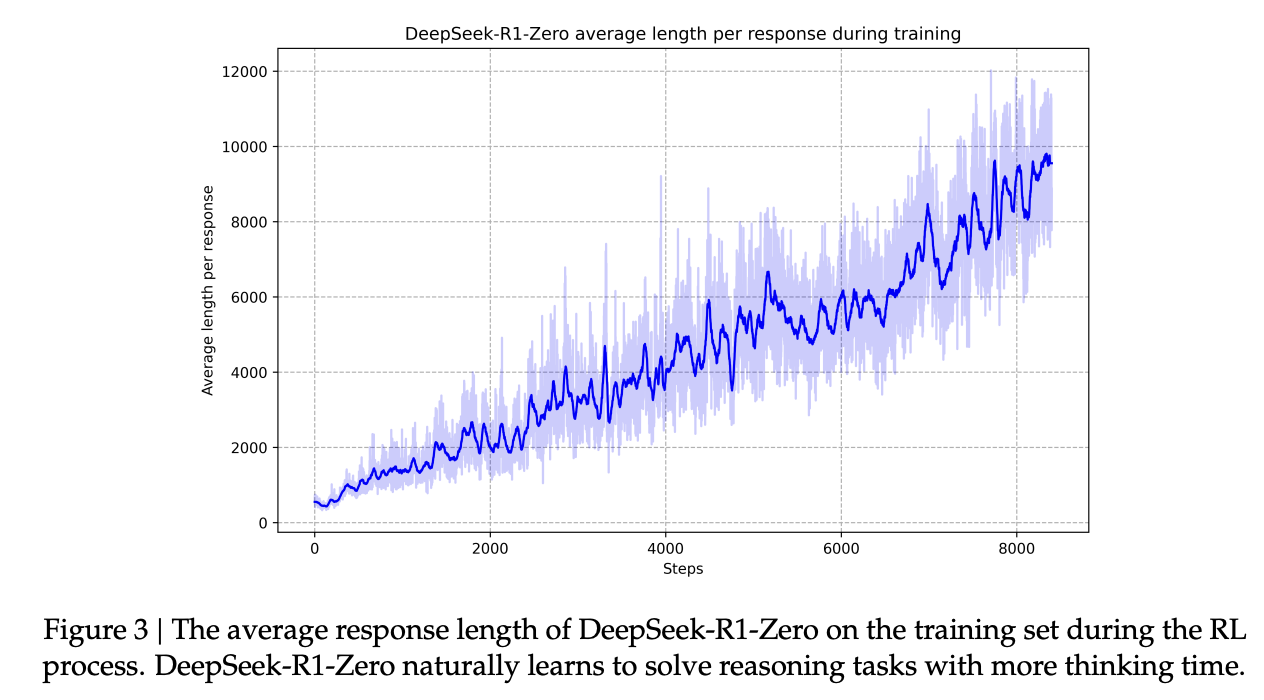
- 🔗 Long Chains of Thought
- 💡 “Aha Moment”:
- Model learns to spend more time thinking, even adopting anthropomorphic language
- Demonstrates LLMs can self-learn problem-solving strategies via RL
- 📊 Performance Gains:
- AIME 2024 Pass@1 jumped from 15.6% → 71.0%, comparable to OpenAI-o1-0912
- 🚫 Drawbacks:
- Poor readability
- Language mixing in reasoning steps
- These led to development of full DeepSeek R1 with cold-start data
🔗 OpenAI O1 and Long Chain-of-Thought (CoT)
OpenAI’s O1 models pioneered the idea of scaling reasoning by increasing CoT length.
- 📊 Comparable Performance:
- DeepSeek R1 matches OpenAI-o1-1217 on many reasoning benchmarks
- 🔗 CoT Importance:
- DeepSeek R1-Zero naturally generates long reasoning chains
- DeepSeek R1’s “cold-start” stage includes specially curated long CoT examples
- Emphasizes longer thinking = better reasoning
- ⚙️ Inference Simplicity:
- Earlier models (e.g., DeepSeek Prover V1.5) used complex decoding like MCTS
- DeepSeek R1 chooses simpler, more efficient decoding, following the “大道至简” philosophy
🧠 Summary
DeepSeek R1 and R1-Zero reflect DeepSeek’s commitment to advancing RL-based LLMs for reasoning by:
- Prioritizing rule-based feedback for verifiable tasks
- Using efficient RL via GRPO
- Encouraging long, emergent Chains of Thought
- Avoiding unnecessary complexity in both training and inference
These models mark a significant step toward scalable, interpretable, and powerful reasoning in open LLMs.