
🤖 Introduction to Robot Learning (CMU 16-831)
I. 📘 Course Overview and Core Concepts
The “16-831: Introduction to Robot Learning” course, taught by Professor Guanya Shi at Carnegie Mellon University (CMU), focuses on the fundamental principles and applications of robot learning.
Theme: “Learning to make sequential decisions in the physical world”
This concept is broken down into three components:
🔍 Learning
- Emphasizes data-driven approaches and continuous improvement through data.
- Contrasts with traditional methods like:
- “Search & planning”
- “Classic control”
- “Optimal control”
- which operate “W/o learning & data”
🔁 Sequential Decisions
- “The current action/decision influences the next state and the next action.”
- Distinguishes from non-sequential problems like:
- “Bandits”
- “Standard supervised learning”
🌍 Physical World
- Requires interaction in the closed-loop — also called embodied intelligence.
- Contrasts with virtual domains (e.g., “RL for games”, “LLMs”) that don’t involve physical interaction.
II. ⚠️ Uniqueness and Challenges of Robot Learning
Robot learning presents unique challenges, especially compared to LLMs/GPTs and DRL in games like AlphaGo.
A. 🧠 Contrasting with LLMs/GPTs
LLMs rely on:
- Architecture: Transformer
- Data: Web text, books, wikis
- Loss: Next-token prediction
- Optimization: SGD
- Generation: Autoregressive
➡️ Challenges in Robot Learning:
- ❓ Where is the data from?
- 📦 How to use physical-world data?
- Data collection is costly, slow, and task-specific.
B. 🎮 Contrasting with DRL in Games (e.g., AlphaGo, DQN)
| Aspect | Games 🕹️ | Robotics 🤖 |
|---|---|---|
| Environment Dynamics | Known & static | Unknown & dynamic |
| Task Scope | One specific task | Many diverse tasks |
| Goal Definition | Clear (reward function) | Often unclear or implicit |
| Learning Mode | Offline suffices | Requires online adaptation |
| Action Speed | Less constrained | Real-time (e.g., 50Hz) |
| Failure Tolerance | Allow failures | Physics doesn’t forgive 💥 |
III. 🎯 Goal and Current State of Robot Learning
A. 🧠 Ultimate Goal: General-Purpose Embodied Intelligence
- “Build general-purpose embodied intelligence by learning to make sequential decisions in the physical world.”
- Vision: Robots that can do “thousands of tasks in thousands of environments”
- Requires synergy in:
- 📊 Algorithm & Data
- 🧮 Computation
- 🦾 Hardware
B. 📉 Current Progress and Gaps
- Progress in domain-specific intelligence
- But “still far from general-purpose embodied intelligence!”
C. ⚙️ Role of Learning vs. Non-Learning Methods
Examples of Non-Learning Success:
- 🚀 Apollo 11: Optimal + Robust Control
- 🦿 Boston Dynamics: Trajectory Optimization + MPC
- 🚜 Offroad Autonomy: Sampling-based MPC
Why Learning is Needed:
- 📉 Modeling is hard
- 🔁 Tasks/environments change
- 🧠 Policy space may be limited
- ❌ Optimizer could be wrong
- 🤯 Assumptions may not hold
Learning = Tightly integrated and adaptive, while traditional = Modular and brittle
IV. 📚 Course Structure and Topics
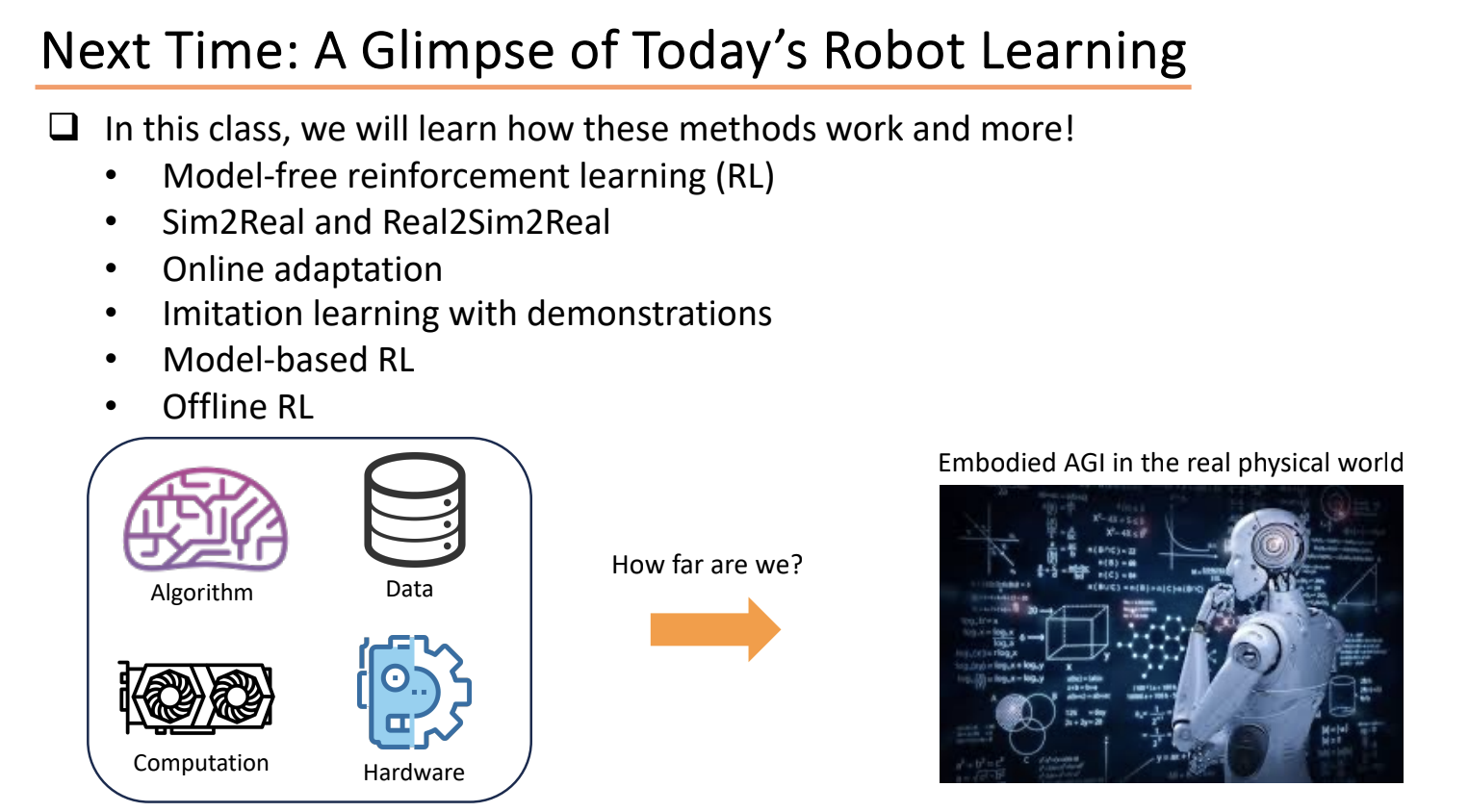
📌 Topics Overview:
- Intro to Robot Learning (Lectures 1–2)
- Machine/Deep Learning Refresher (Lectures 3–4)
- Imitation Learning (Lectures 5–6)
- Model-Free RL (Lectures 7–12)
- Q-Learning, Policy Gradient, etc.
- Model-Based RL (Lectures 13–16)
- Bandits & Exploration (Lectures 17–18)
- Offline RL (Lecture 19)
- Special Topics:
- Inverse RL
- Sim2Real
- Safe RL
- Multi-task & Adaptive RL (Lectures 20, 22–24)
- Challenges & Opportunities (Lecture 25)