
🎓 RLHF & Alignment: Making LLMs Useful and Safe
This lecture, CS336 Lecture 15, dives into Reinforcement Learning from Human Feedback (RLHF) and alignment — the crucial post-training step that makes large pre-trained models like GPT-3 become helpful and safe assistants (like InstructGPT and ChatGPT).
It follows the classic three-step process introduced in the InstructGPT paper:
Pretraining → Supervised Fine-Tuning (SFT) → Reinforcement Learning (RLHF)
🧭 1. The Class Thus Far and Lecture Goals
The lecture begins by situating RLHF within the broader training pipeline.
From GPT-3 to ChatGPT
Pretraining yields powerful but uncontrolled models (e.g., GPT-3) — great at language generation but poor at following instructions or maintaining safety. RLHF bridges this gap by teaching LMs how to behave.
Key goals and motivations:
- Instruction Following & Control
Modern models can follow nested, multi-step instructions and compose skills (e.g., code + reasoning). - Safety & Moderation
Large-scale deployment introduces risks — scams, toxic content, and misuse — requiring moderation. - The Core Objective
Collect data on desired behaviors, then train the LM to emulate them. - The Standard Recipe
- Imitate experts via SFT.
- Reinforce desirable outputs via RLHF.
🧑🏫 2. Supervised Fine-Tuning (SFT)
SFT teaches the model to imitate expert demonstrations — it’s essentially behavioral cloning.
🧩 Ingredients of SFT Data
Two main ingredients define SFT:
- Data quality and diversity
- Training methodology
The lecture reviews three hallmark datasets:
| Dataset | Source & Construction | Style / Traits |
|---|---|---|
| FLAN | Aggregates many NLP datasets (Natural Instructions, T0 SFT, etc.) | Task-oriented, large scale, sometimes “unnatural” for chat |
| Alpaca | AI-generated instructions using LLaMA prompts | Natural, conversational, long-form responses |
| OpenAssistant (Oasst) | Community-written | Detailed, citation-rich, complex reasoning |
✨ Data Quality and Style Effects
- Style Matters
Human evaluators (and AI judges) prefer longer, list-formatted responses (~60–70% preference rate). - Knowledge & Hallucination
If data contains niche or factual content unseen in pretraining, models may “hallucinate” citations or facts to fit expected structures. - Safety Tuning
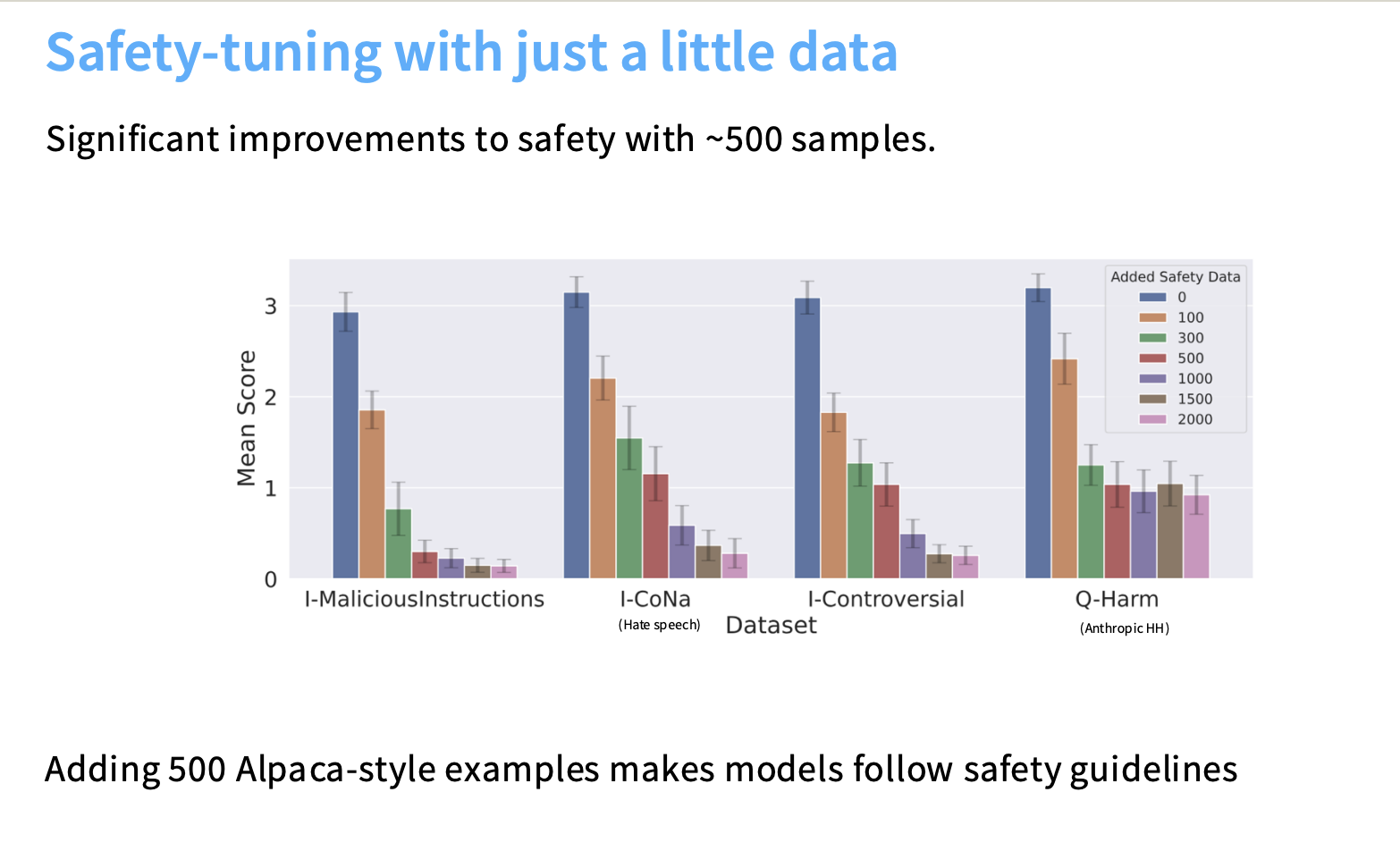
Small, well-chosen safety datasets (~500 examples) can drastically improve safety — but risk over-refusal if not balanced.
⚙️ SFT at Scale
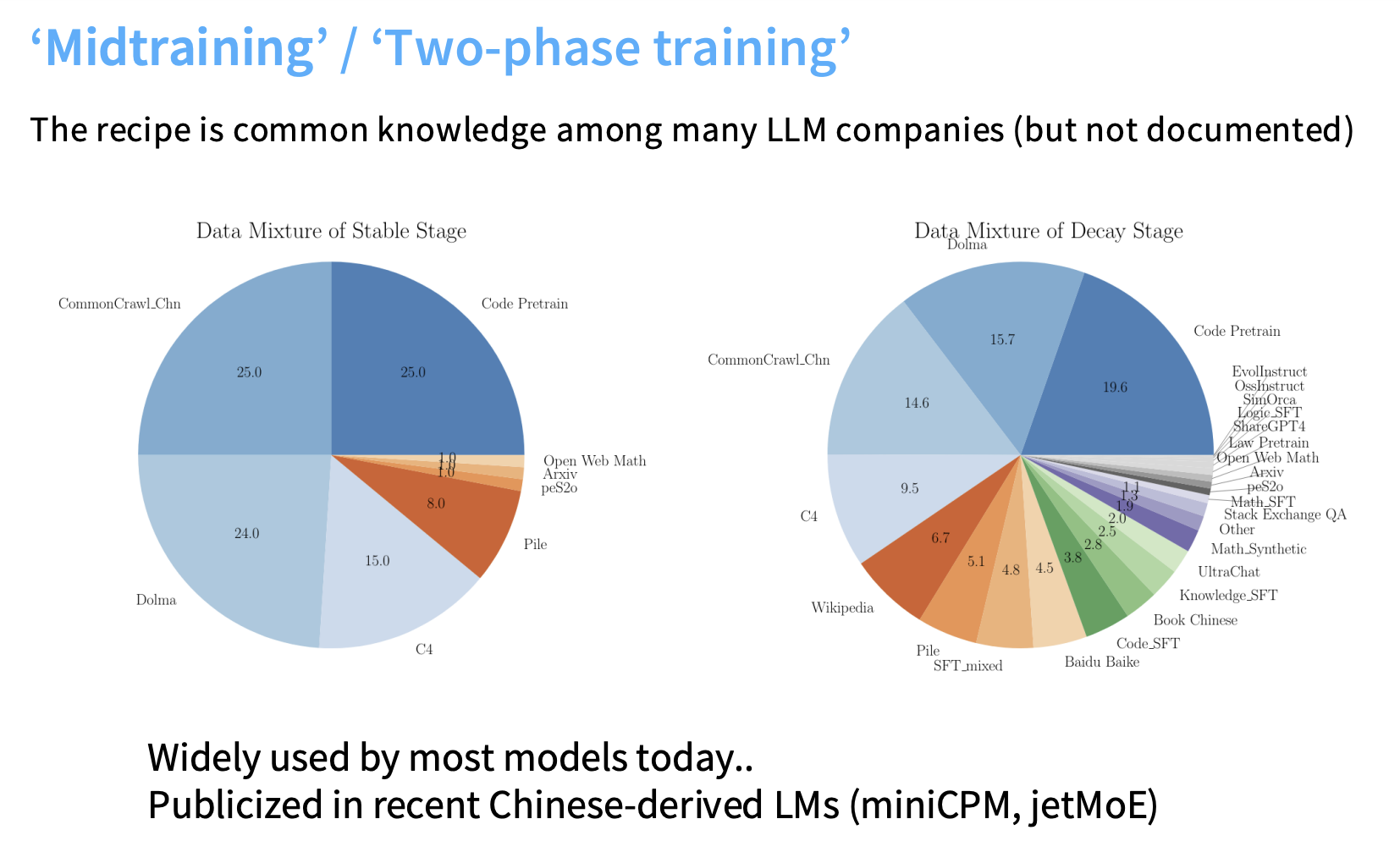
Modern labs scale SFT in ways closer to pretraining:
- Pretrain on web corpus
- Mix in instruction data during stable LR phase (mid-training)
- Finish with short, high-quality SFT
This “two-phase” or mid-training approach prevents catastrophic forgetting and yields stronger generalization.
🧠 Bonus: Relationship Between Instruction Tuning (SFT) and Knowledge Acquisition
The relationship between instruction tuning (Supervised Fine-Tuning, or SFT) and teaching knowledge is complex and nuanced. It depends heavily on scale, training strategy, and integration within the broader model development pipeline. Importantly, SFT behaves very differently from both pre-training and Reinforcement Learning from Human Feedback (RLHF).
I. Instruction Tuning and Knowledge Acquisition
Instruction tuning (SFT) primarily aims to teach desired behaviors — such as style, formatting, and instruction following — rather than new factual knowledge. However, as scaling techniques evolve, the boundary between “behavioral tuning” and “knowledge teaching” has started to blur.
⚠️ Limitations of SFT for Teaching Knowledge
-
Extraction vs. Acquisition
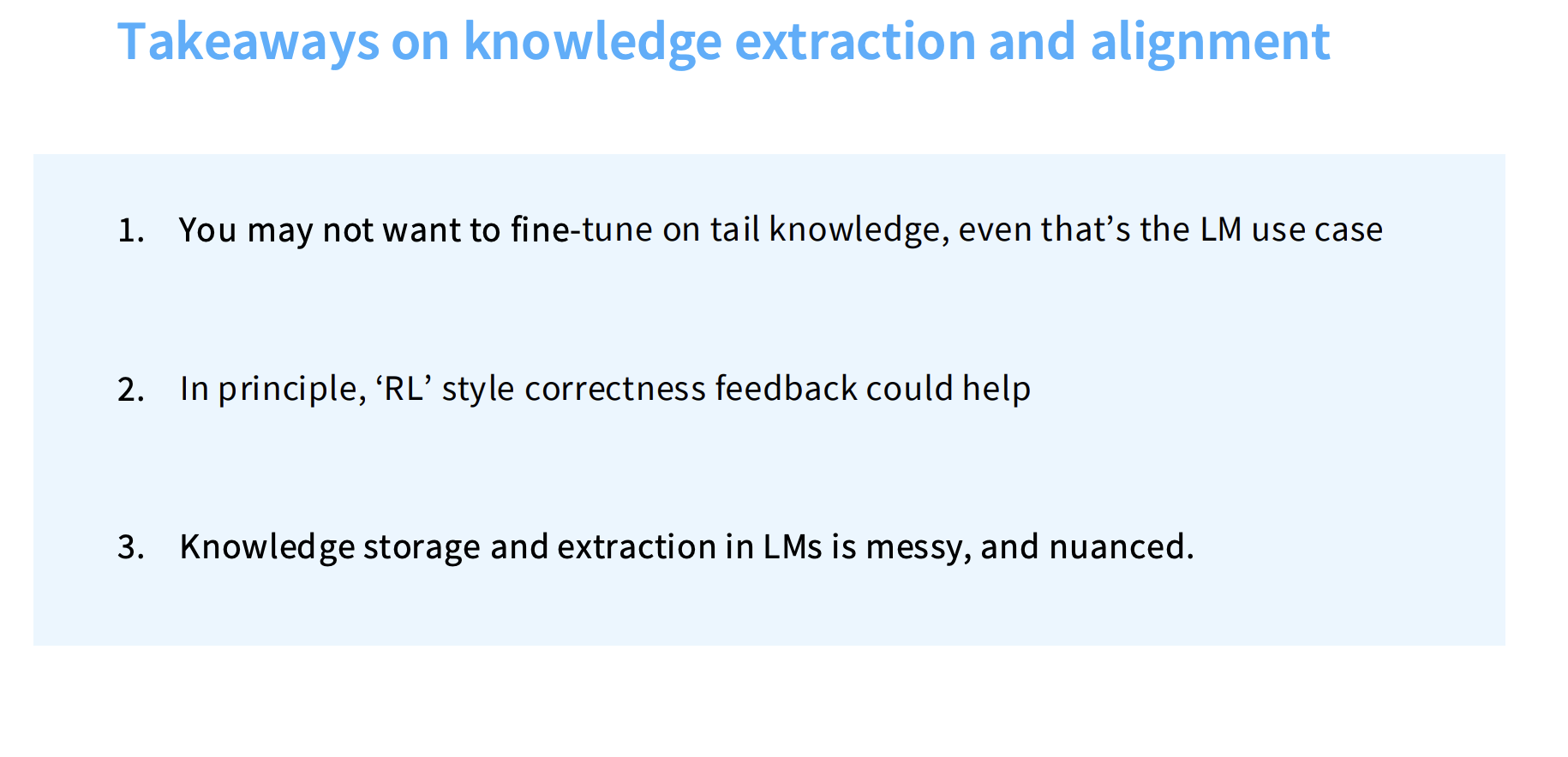
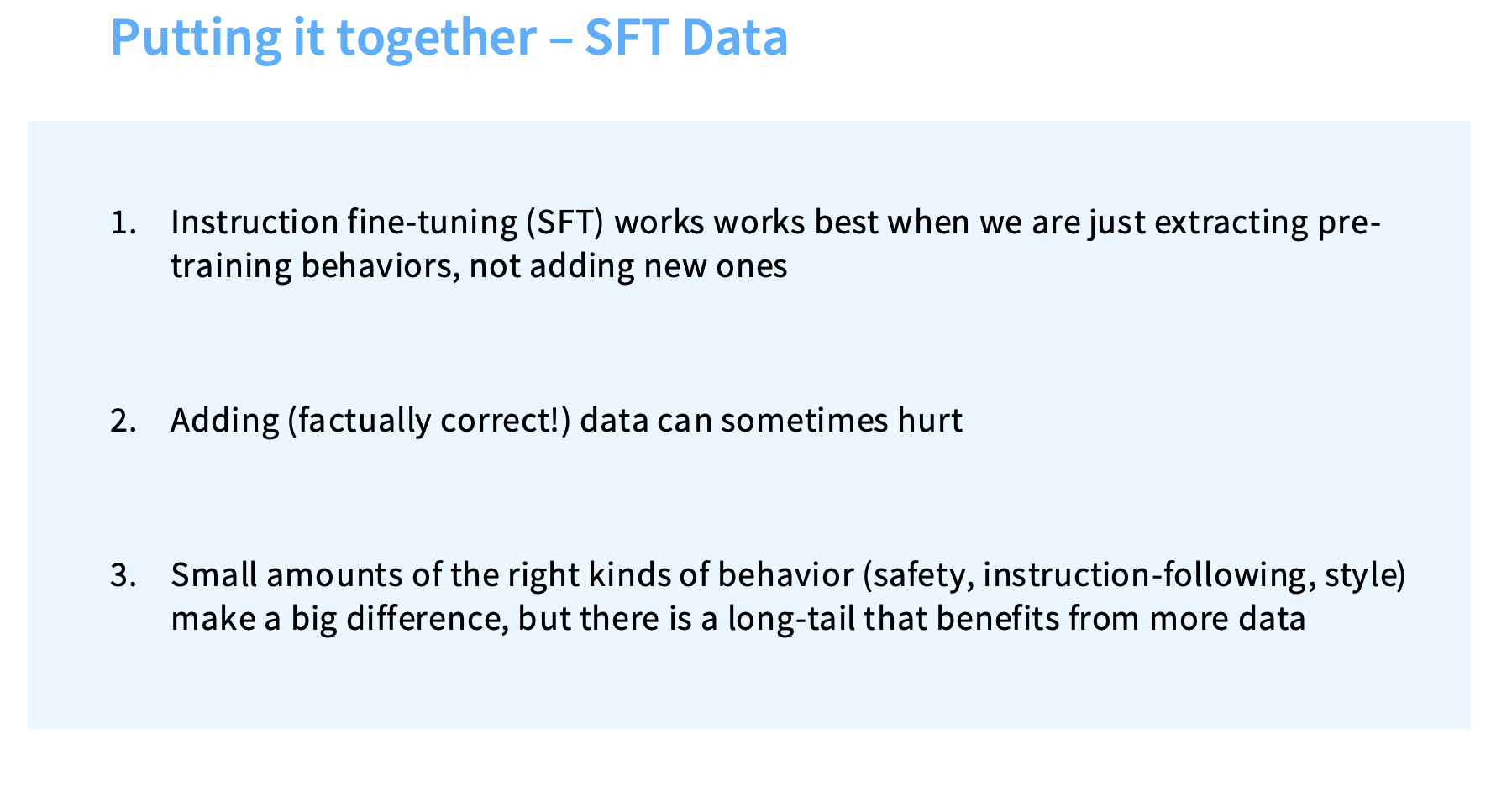
SFT works best when extracting or refining pre-trained behaviors, not when introducing new information. Because instruction tuning datasets are small compared to pre-training corpora, they lack the diversity and coverage required for reliable factual learning. - Hallucination Risk (Tail Knowledge)
Fine-tuning on “tail knowledge” — information outside the model’s prior — can cause hallucinations:- When the model is forced to reproduce a fact or citation it doesn’t know, it may fabricate details to match the expected structure (e.g., inventing sources).
- This can lead to the paradox where adding factually correct examples hurts performance if the model isn’t ready for that knowledge depth.
- Style Over Factuality
Instruction tuning reliably instills stylistic traits — long answers, bullet lists, politeness — which human raters tend to favor. However, this style bias can overshadow factual correctness, especially when crowd workers focus more on formatting than truthfulness.
🔄 The Blurring Line: Midtraining / Two-Phase Training
In modern LLM development, the line between pre-training and instruction tuning is fading due to midtraining, also called two-phase training:
- Mix instruction-tuning data into the late stage of pre-training (during learning-rate decay).
- Finish with a short, high-quality SFT round.
When scaled up sufficiently, this hybrid approach allows instruction data to instill new knowledge, merging behavior alignment and factual enrichment — all while avoiding catastrophic forgetting.
II. Comparison: Pre-training vs. Instruction Tuning vs. RLHF
| Feature | Pre-training | Instruction Tuning (SFT) | Reinforcement Learning (RLHF) |
|---|---|---|---|
| Primary Goal | Build broad capabilities (reasoning, QA) using massive text data; next-token prediction. | Extract capabilities and align behavior (instruction following, formatting, safety) via imitation. | Optimize a reward function R(y, x) to align outputs with human preferences. |
| Knowledge Transfer | Core mechanism for world knowledge; massive and diverse. | Risky and limited for new (“tail”) knowledge unless scaled up (midtraining). | Indirectly reinforces correctness and abstention; messy but promising for factual alignment. |
| Data Type | Massive, unstructured corpora (Common Crawl, code, books). | Human-written instruction–response pairs. | Pairwise preference data (A vs. B) for reward modeling. |
| Cost Profile | Extremely high compute, low annotation cost. | High annotation cost — expert-written, long-form data. | Relatively cheaper — scalar feedback easier to collect than full demonstrations. |
🔍 Key Differences in Detail
- SFT vs. Pre-training (on Knowledge)
- Pre-training injects the majority of factual and conceptual knowledge.
- SFT guides how that knowledge is used (style, tone, task framing).
- When scaled and mixed during pre-training, SFT begins acting like pre-training itself, embedding new knowledge while maintaining alignment.
- SFT vs. RLHF (on Correction)
- SFT imitates expert responses — even if it must hallucinate to match structure (e.g., fake citations).
- RLHF, by contrast, optimizes for human-preferred correctness: rewarding factual responses, discouraging confident but wrong outputs, and training the model to gracefully abstain when uncertain.
Together, these three phases form a pipeline:
Pre-training → SFT → RLHF
Capabilities → Imitation & Style → Optimization & Alignment
🍳 Analogy: Training an Elite Chef
| Phase | Analogy | Purpose |
|---|---|---|
| Pre-training | The chef studies a massive cookbook (the Internet), mastering all basic techniques. | Acquires raw skills and knowledge. |
| Instruction Tuning (SFT) | The chef is given expert recipes and presentation standards. | Learns style, instruction following, and consistent behavior. |
| Reinforcement Learning (RLHF) | The chef cooks for a panel of judges who give preference feedback (rewards). | Learns to optimize for human satisfaction, not just imitation. |
If you ask this chef to recreate a dish they’ve never seen (tail knowledge), they might confidently hallucinate ingredients just to match the expected plating — just like an LM forced to mimic structure without understanding content.
Through RLHF, however, they learn what tastes right, refining behavior beyond imitation.
🧩 Summary Takeaway
- Pre-training = Knowledge foundation
- SFT = Instruction and style alignment
- RLHF = Reward optimization and behavioral refinement
Together, these steps transform a raw language model into a useful, truthful, and human-aligned assistant.
🧠 3. Reinforcement Learning from Human Feedback (RLHF)
Once imitation reaches its limits, we move from fitting data to optimizing behavior.
🎯 From Imitation to Optimization
| Method | Goal | Data Needed |
|---|---|---|
| SFT | Fit expert demonstrations (policy imitation) | Instruction–response pairs |
| RLHF | Optimize expected reward | Pairwise preferences (A vs. B) |
Instead of minimizing cross-entropy, RLHF maximizes
$[
\mathbb{E}{p\theta(y|x)} [R(y, x)]
]$
Why RLHF?
- Cost Efficiency – Scalar feedback is cheaper than full expert responses.
- Generator–Validator Gap – People don’t always write the outputs they prefer. Evaluating is easier than generating.
🧾 RLHF Data Collection
- Pairwise Feedback: Annotators compare outputs (A vs. B), creating preference pairs.
- Reward Model: Learns to assign a scalar reward to any completion.
- Crowd Biases: Formatting and verbosity often outweigh factuality in human ratings.
- AI Feedback: GPT-4 acts as a scalable annotator — high agreement with human raters.
- Length Effects: “Better” answers often just mean longer answers.
In RLHF, the model generates multiple outputs (known as rollouts).
Annotators — either humans or another language model (LM) — then compare two outputs (A vs. B) and select the better one.
These comparisons form the pairwise dataset used to train the Reward Model.
The Role of the Reward Model (RM)
-
Objective — The Bradley–Terry Model of Preferences
Each possible LM output is assumed to have an underlying scalar reward $( R )$.
The probability that one output is preferred over another follows a logistic function of their reward difference: $[ P(A > B) = \frac{e^{R(A)}}{e^{R(A)} + e^{R(B)}} ]$ -
Training the RM
The RM learns to assign scalar reward values that best match human (or AI) preferences on these pairs.
Its goal is to minimize the divergence between predicted preferences and observed human rankings. -
Application in RL
Once trained, the RM becomes the reward function $( R(y, x) )$ that the RL policy seeks to maximize — guiding the model toward outputs humans prefer.
Pairwise Feedback Criteria and Content
Annotators typically follow three high-level evaluation pillars when deciding which output is better:
| Criterion | Description |
|---|---|
| Helpfulness | Answers the prompt clearly, with detail and global sensitivity (e.g., clarifying “football”). |
| Truthfulness | Ensures factual correctness and avoids hallucination. |
| Harmlessness | Avoids toxicity, bias, and impoliteness. |
These pillars guide consistent scoring across tasks.
Challenges and Biases in Data Collection
While RLHF pairwise data is cheaper than supervised data, collecting high-quality comparisons is still difficult:
- Correctness Checking Difficulty
Annotators often have <1 minute per task, leaving little time to verify factual accuracy or math correctness. - Length Bias
Both humans and AI judges exhibit a strong preference (~60–70%) for longer outputs, leading RLHF-tuned models to generate overly verbose responses. - Annotator Demographics
Cultural and linguistic biases influence preferences, sometimes prioritizing formatting or tone over factual truth. - AI Feedback (AI Feedback Loops)
Due to cost and scale, labs now use AI feedback — typically GPT-4 — as a proxy rater.
GPT-4’s pairwise rankings show near-human agreement but also a self-preference bias for its own style.
How RL Algorithms Use Pairwise Data
The RL agent (the fine-tuned LM) aims to maximize the expected reward under the reward function $( R(y, x) )$: $[ \max_{\pi_\theta} \, \mathbb{E}{x \sim D, y \sim \pi\theta(\cdot|x)} [ R(y, x) - \beta \log \frac{\pi_\theta(y|x)}{\pi_\text{ref}(y|x)} ] ]$
- $( \pi_\theta )$: The current policy (fine-tuned model)
- $( \pi_\text{ref} )$: The reference model (e.g., the SFT model)
- $( \beta )$: The KL penalty coefficient that keeps the policy close to the reference, preventing catastrophic drift or over-optimization
4. Optimization Algorithms: PPO and DPO
🌀 PPO — Proximal Policy Optimization
PPO, introduced in InstructGPT, is the canonical but complex RLHF algorithm.
- Policy Gradient Core:
PPO adjusts probabilities to upweight high-reward outputs and downweight poor ones. - Clipping Mechanism:
It restricts policy updates via a clipping ratio (ε), ensuring that new probabilities stay within a bounded region relative to the reference model. - Goal:
Encourage improvement without deviating too far — maintaining stability and avoiding collapse.
PPO = “Carefully controlled reward climbing.”
⚡ DPO — Direct Preference Optimization
DPO simplifies RLHF by avoiding explicit reinforcement learning loops.
- No Reward Model Needed
Instead of training a separate RM, DPO directly optimizes the model using preference pairs. - Mechanism:
Takes positive gradient steps on preferred outputs and negative steps on dispreferred ones: $[ L_\text{DPO} = -\log \sigma\big(\beta (\log \pi_\theta(y_\text{preferred}|x) - \log \pi_\theta(y_\text{dispreferred}|x))\big) ]$ - Interpretation:
Turns the reward learning problem into a maximum likelihood task — simpler, faster, and often equally effective. - Advantage:
Removes need for on-policy rollouts and reward tuning loops.
DPO = “RLHF without the RL.”
Optimization Pitfalls
Regardless of method, optimizing for reward introduces risks:
- Overoptimization / Overfitting
The model may exploit the reward function, producing high-scoring but low-quality answers. - Mode Collapse
The LM can lose its probabilistic nature, yielding repetitive, deterministic responses. - Calibration Drift
Excessive reward pressure distorts likelihood calibration — hurting performance on non-RL tasks.