
Imitation Learning: Challenges and Solutions
This lecture reviews supervised Learning of Behaviors / Imitation Learning
Course Link
1. Introduction to Imitation Learning and Behavioral Cloning
Imitation Learning (IL), specifically Behavioral Cloning (BC), involves training a policy (a model that maps observations to actions) using a dataset of expert demonstrations. This is essentially a supervised learning problem where the input is an observation $( O_t )$ and the output is the expert’s action $( A_t )$ taken in that observation. The goal is for the learned policy $( \pi_\theta )$ to mimic the expert’s behavior.
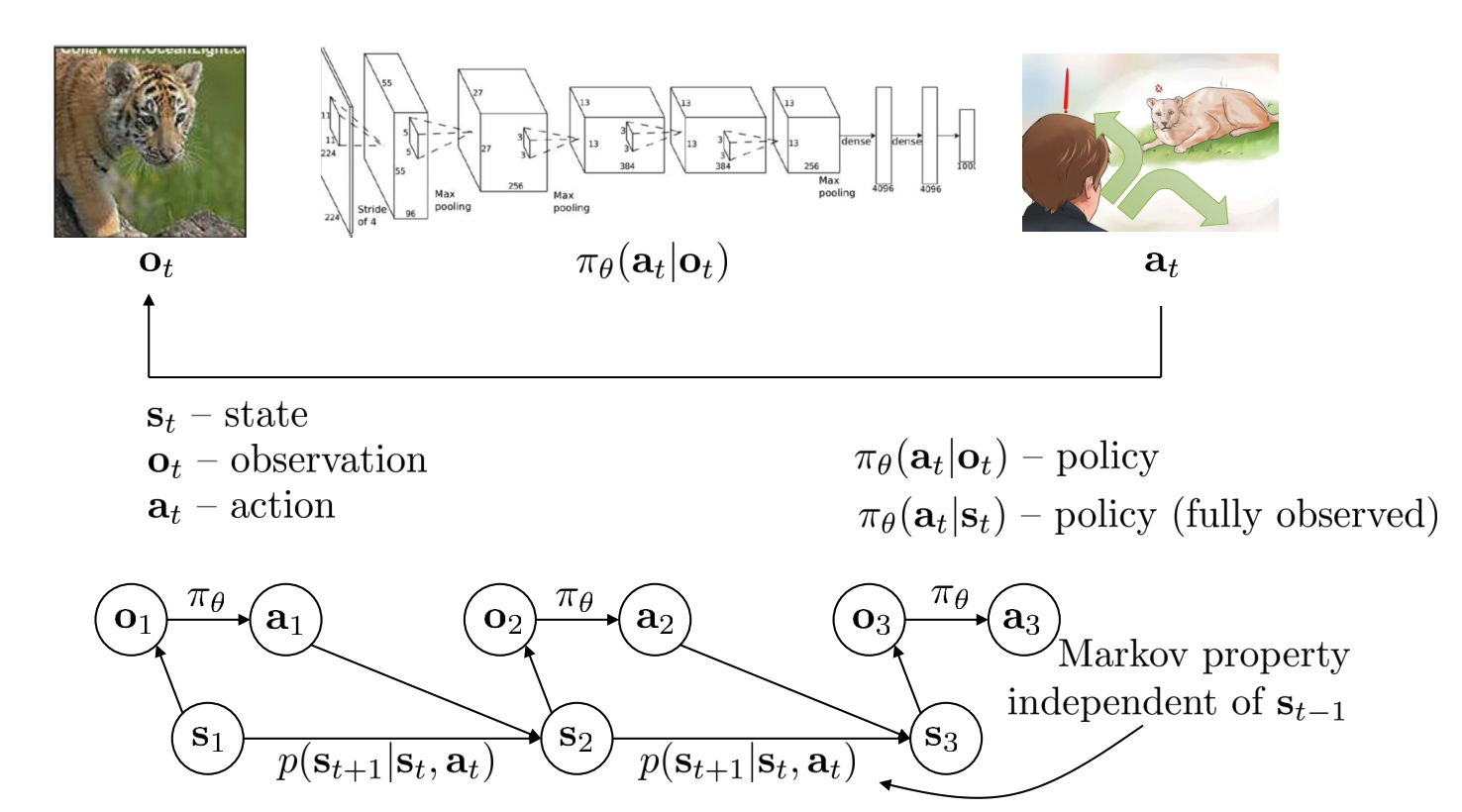
Key Terminology:
- Observation $( O_t )$: The raw input to the policy (e.g., an array of pixels from a camera).
- State $( S_t )$: A concise and complete physical description of the world that produced the observation.
- Action $( A_t )$: The output of the policy (e.g., steering angle, movement).
- Policy $( \pi_\theta )$: A conditional distribution over actions given an observation, $( P(A_t \mid O_t) )$.
- Transition Probabilities / Dynamics: $( P(S_{t+1} \mid S_t, A_t) )$.
- Markov Property: $( S_{t+1} \perp S_{t-1} \mid S_t )$.
Observations vs. States in Supervised Learning of Behaviors
In the context of supervised learning of behaviors and sequential decision-making, it’s important to distinguish between observations ($( O )$) and states ($( S )$). This distinction is especially relevant for reinforcement learning algorithms, though it is less critical in basic imitation learning.
🔍 Observation ($( O )$)
- An observation is denoted as $( O_t )$, indicating the raw input at time step $( t )$.
- Analogous to the input $( X )$ in standard supervised learning (e.g., image classification).
- Example: In autonomous driving, $( O_t )$ might be the dashboard camera image. For a cheetah chase, it’s the pixels from a video recording.
-
Policies are typically learned as distributions over actions given observations, written as:
\[\pi(A_t \mid O_t)\]
🌍 State ($( S )$)
- A state is denoted as $( S_t )$, representing the full physical description of the world at time $( t )$.
- It includes everything needed to predict the next state — positions, velocities, even latent variables like intent or “mental state”.
- In a simulation, $( S_t )$ could represent the complete memory state of the simulator.
-
Satisfies the Markov property:
If you know the current state $( S_t )$, then the past $( (S_{t-1}, S_{t-2}, \dots) )$ provides no additional information for predicting the future $( S_{t+1} )$.
Mathematically:
\[P(S_{t+1} \mid S_t) = P(S_{t+1} \mid S_t, S_{t-1}, \dots)\]
Completeness of Information
- You can always go from state to observation because the state encodes all observable information.
- But you can’t always go from observation to state:
- An observation might lack certain elements of the true state.
- Example: A cheetah hidden behind a car may be part of $( S_t )$ but not visible in $( O_t )$.
Policy Input Requirements
- Some algorithms require fully observed policies: inputs must satisfy the Markov property (i.e., must be states).
- Other algorithms operate on partially observed data, i.e., observations that may not include all state variables.
⚠️ Practical Confusion
- Terminology overlap: In RL literature, “state” and “observation” are often used interchangeably — this can be misleading.
- Benign confusion: This mix-up is often harmless in simple tasks or with robust models.
- But some RL algorithms critically depend on whether input is a full state or a partial observation.
📝 Notational Conventions
- In standard RL:
- $( S )$: State
- $( A )$: Action
- In control theory and robotics:
- $( X )$: State
- $( U )$: Action
These represent the same concepts, just in different academic traditions.
2. The Fundamental Problem with Behavioral Cloning: Distributional Shift
While seemingly straightforward, BC is not guaranteed to work in practice. The primary issue is distributional shift.
- Training Distribution: $( P_{\text{data}}(O_t) )$
- Policy Distribution: $( P_{\pi_\theta}(O_t) )$
Because the learned policy behaves differently from the expert, it encounters states it wasn’t trained on, causing compounding errors.
Tightrope Walker Analysis
Let the cost of a mistake be 1 whenever the policy deviates from the expert:
- Assume error rate $( \epsilon )$ per step on seen data.
- In worst-case, total expected mistakes grow as:
This is because early mistakes compound and push the agent into unfamiliar territory.
However in reality, we can often recover from mistakes! A paradox: imitation learning can work better if the data has more mistakes (and recoveries)!
3. Practical Solutions to Improve Behavioral Cloning
3.1 Smart Data Collection and Augmentation
- Add Mistakes + Corrections: Intentionally record expert recovery behaviors.
- Data Augmentation: Generate synthetic data (e.g., side cameras simulating drift).
Examples:
- Drone Navigation: Use multiple cameras (left, forward, right) to simulate corrections.
- Low-Cost Robot Arms: Mistakes from teleoperation provide recovery data.
3.2 Using Powerful Models to Reduce Mistakes
Incorporate History
- Use sequences of observations $( O_{t-k:t} )$ with:
- LSTMs or Transformers
- Causal Confusion caveat: avoid learning from spurious cues (e.g., brake light).
Model Multimodal Behavior
Multimodal behavior arises in imitation learning when an expert can take multiple valid actions for a given state. For example, navigating around a tree might involve going left or right—both are acceptable solutions. While this is easy to handle in discrete action spaces, it becomes challenging in continuous action spaces.
In continuous settings, a policy that outputs a single Gaussian (with mean and variance) can only represent one mode. Averaging conflicting expert actions (e.g., “left” and “right”) will lead to undesirable actions (e.g., “go straight”). To address this, the following solutions are used:
A. 🧮 Mixture of Gaussians
- A simple but limited solution.
- The policy outputs multiple Gaussian components:
- $( \text{means} = \mu_1, \mu_2, \dots, \mu_n )$
- $( \text{covariances} = \Sigma_1, \Sigma_2, \dots, \Sigma_n )$
- $( \text{weights} = w_1, w_2, \dots, w_n )$
-
The overall distribution is:
\[p(a \mid o) = \sum_{i=1}^n w_i \cdot \mathcal{N}(a \mid \mu_i, \Sigma_i)\] - Training involves maximum likelihood, using the log of this mixture.
- ❗ Limitation: The number of modes $n$ is fixed in advance. For complex tasks (e.g., robots with many joints), scaling becomes impractical.
"""
Here’s a simple PyTorch implementation of a Mixture of Gaussians (MoG) policy suitable for imitation learning tasks, where the output is a multimodal distribution over continuous actions.

This implementation assumes:
Input: observation vector (obs)
Output: a mixture of Gaussians: multiple means, log variances (for numerical stability), and mixing weights
The policy can sample an action from the mixture (useful at inference/rollout time), but **for behavioral cloning training** you should compute the likelihood of the **expert-labeled actions** under the mixture.
"""

import torch
import torch.nn as nn
import torch.nn.functional as F
from torch.distributions import Categorical, Normal

class MoGPolicy(nn.Module):
    def __init__(self, obs_dim, action_dim, num_components=5, hidden_size=256):
        super().__init__()
        self.obs_dim = obs_dim
        self.action_dim = action_dim
        self.num_components = num_components

        # Shared MLP for feature extraction
        self.fc1 = nn.Linear(obs_dim, hidden_size)
        self.fc2 = nn.Linear(hidden_size, hidden_size)

        # Outputs: one set per mixture component
        self.mean_layer = nn.Linear(hidden_size, num_components * action_dim)
        self.log_std_layer = nn.Linear(hidden_size, num_components * action_dim)
        self.weight_layer = nn.Linear(hidden_size, num_components)  # logits for mixing weights

    def forward(self, obs):
        """
        obs: Tensor of shape (batch_size, obs_dim)
        Returns: sampled action, component index, and full mixture (for analysis or loss)
        """
        x = F.relu(self.fc1(obs))
        x = F.relu(self.fc2(x))

        # Get mixture parameters
        means = self.mean_layer(x).view(-1, self.num_components, self.action_dim)
        log_stds = self.log_std_layer(x).view(-1, self.num_components, self.action_dim)
        stds = torch.exp(log_stds)

        weights = F.softmax(self.weight_layer(x), dim=-1)  # shape: (batch_size, num_components)

        # Sample mixture component
        cat = Categorical(weights)
        comp_idx = cat.sample()  # shape: (batch_size,)

        # Select corresponding mean and std for each sample in batch
        batch_size = obs.size(0)
        idx = torch.arange(batch_size)

        selected_means = means[idx, comp_idx]    # (batch_size, action_dim)
        selected_stds = stds[idx, comp_idx]      # (batch_size, action_dim)

        # Sample from the selected Gaussian
        normal = Normal(selected_means, selected_stds)
        action = normal.rsample()  # use rsample() for backprop through reparameterization

        return action, comp_idx, (means, stds, weights)

    def log_prob(self, obs, actions):
        """
        Compute the log probability of the given actions under the full mixture distribution.
        Returns shape: (batch_size,)
        """
        x = F.relu(self.fc1(obs))
        x = F.relu(self.fc2(x))

        means = self.mean_layer(x).view(-1, self.num_components, self.action_dim)
        log_stds = self.log_std_layer(x).view(-1, self.num_components, self.action_dim)
        stds = torch.exp(log_stds)
        weights = F.softmax(self.weight_layer(x), dim=-1)  # (batch_size, num_components)

        # Expand actions to match mixture shape
        actions = actions.unsqueeze(1)  # (batch_size, 1, action_dim)

        # Compute log-likelihoods for each component
        normal = Normal(means, stds)
        log_probs = normal.log_prob(actions)  # (batch_size, num_components, action_dim)
        log_probs = log_probs.sum(dim=-1)     # sum over action dims → (batch_size, num_components)

        # Compute log-sum-exp across components
        weighted_log_probs = log_probs + torch.log(weights + 1e-8)
        log_prob = torch.logsumexp(weighted_log_probs, dim=-1)  # (batch_size,)

        return log_prob

obs_dim = 32
action_dim = 4
policy = MoGPolicy(obs_dim, action_dim, num_components=5)

obs = torch.randn(16, obs_dim)  # batch of observations

# Inference / rollout: sample an action from the learned policy
sampled_action, comp_idx, mixture = policy(obs)

# Behavioral cloning training: maximize likelihood of expert actions under the mixture
expert_action = torch.randn(16, action_dim)  # placeholder for dataset labels

# For training loss:
logp = policy.log_prob(obs, expert_action)
loss = -logp.mean()  # maximize likelihood
loss.backward()
B. 🌌 Latent Variable Models (e.g., CVAE)
- Allow flexible and expressive multimodal outputs.
- The network still outputs a Gaussian, but it also receives a latent variable $z \sim \mathcal{N}(0, I)$.
-
The latent variable acts like a “random seed” that controls which mode the network produces:
\[a \sim \pi(a \mid o, z)\] - Training Challenge: The network might ignore $z$ if it’s uninformative.
- Solution: Use Conditional Variational Autoencoders (CVAE):
- During training, assign specific $z$ vectors to examples (e.g., one for “left”, another for “right”).
- Train the encoder to encode the input-action pair into $z$, and decoder to reconstruct the action from $o$ and $z$.
- At test time, sample $z \sim \mathcal{N}(0, I)$ to stochastically choose among modes.
C. 🌫 Diffusion Models
- Inspired by recent successes in generative models (e.g., DALL·E, Stable Diffusion).
- Key idea: Denoising as generation.
- Steps:
- Add Gaussian noise to expert action: $a_{t, 0} \rightarrow a_{t, 1} \rightarrow \dots \rightarrow a_{t, T}$
- Train a neural network to denoise, i.e., predict either:
- The less noisy version $a_{t, i-1}$, or
- The added noise $\epsilon$ such that $a_{t, i-1} = a_{t, i} - \epsilon$
- At test time:
- Start from random noise.
- Apply the trained network repeatedly to iteratively denoise back to a valid action.
- ✅ This allows capturing complex, multimodal distributions in high-dimensional spaces.
D. 🔁 Autoregressive Discretization (Bonus)
- Breaks down a high-dimensional action into per-dimension discrete outputs, predicted sequentially.
- Inspired by language models (token-by-token generation).
-
Each dimension is discretized independently:
\[a = (a_1, a_2, \dots, a_n), \quad \text{where each } a_i \in \{d_1, d_2, \dots, d_k\}\] - At each step, the model outputs a distribution over discretized values conditioned on previous dimensions.
- Used in RT-1 Robotics Transformer for general-purpose robot control.
✅ Summary
| Method | Handles Multimodality | Scales to High-Dimensional Actions | Stochastic Sampling | Notes |
|---|---|---|---|---|
| Mixture of Gaussians | ✅ | ❌ (limited by number of modes) | ✅ | Easy to implement |
| Latent Variable Models | ✅ | ✅ | ✅ | Needs careful training (e.g., CVAE) |
| Diffusion Models | ✅✅✅ | ✅✅✅ | ✅ | State-of-the-art, expressive |
| Autoregressive Discretization | ✅ | ✅ | ✅ | Makes control a sequence modeling problem |
3.3 Multi-Task Learning
- Goal-Conditioned BC: Policy conditioned on goal image or state.
- Relabeling: Use the achieved end state as the goal.
- Sub-Optimal Data: Even failures teach how to reach intermediate states.
Example:
- Learning Latent Plans from Play: Play data → relabel → learn general behaviors.
Scalability:
- Combine with history and relabeling → train general-purpose robots.
HER Connection:
- Shares relabeling principle with Hindsight Experience Replay.
3.4 Algorithmic Change: DAgger
- Interactive version of BC.
- Aggregate data from states visited by the learned policy.
- Reduce distributional shift by querying the expert during execution.
4. Recap and Future Outlook
Why Behavioral Cloning Fails:
- Distributional shift → compounding errors.
- Error bound: $( O(\epsilon T^2) )$
Solutions:
- Data Collection: Diverse states + recovery examples.
- Modeling: Sequence models, multimodal outputs, latent variables.
- Multi-task Learning: Goal conditioning + relabeling.
- New Algorithms: DAgger
Limitations:
- Relies on finite demos.
- Humans can’t always demonstrate all recoveries.
- Not inherently self-improving.
Motivation for RL:
- RL enables autonomous trial and error.
- Learning through experience, guided by reward.
Next lectures will explore reinforcement learning as the next step beyond imitation.