
Q-Functions in Reinforcement Learning
Lecture 8 is about making Q-learning work in practice.
Lecture 7 gave the value-function theory.
Lecture 8 focuses on practical stability tricks used in deep RL systems:
- replay buffers
- target networks
- double Q-learning
- multi-step targets
- handling continuous actions
1. Recap: Fitted Q-Iteration and Online Q-Learning
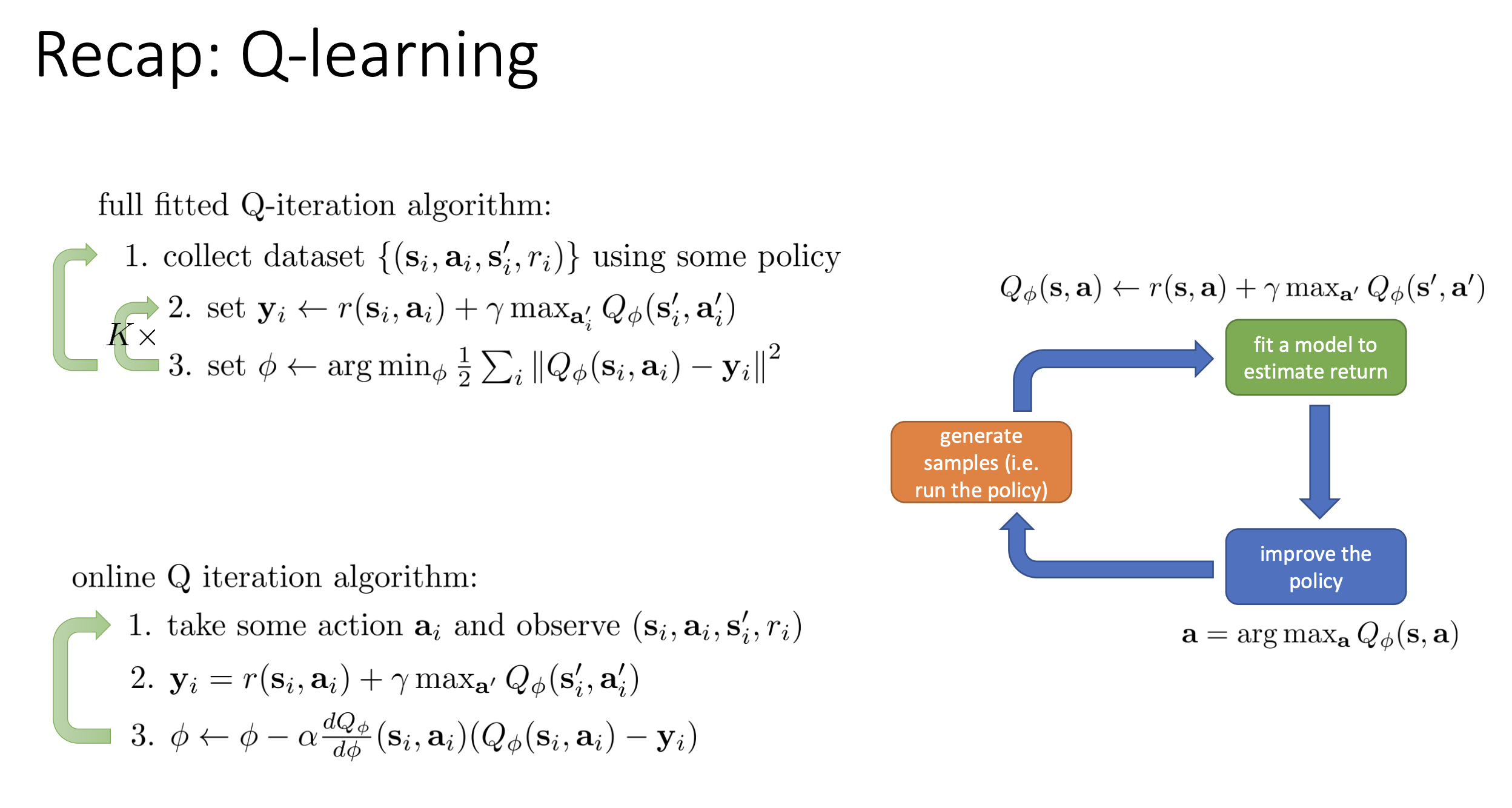
Fitted Q-Iteration (FQI) uses data tuples:
\[(s_i,a_i,r_i,s'_i)\]and Bellman targets:
\[y_i = r_i + \gamma \max_{a'} Q_\phi(s'_i,a')\]Then it fits:
\[\min_\phi \frac{1}{2}\sum_i\left(Q_\phi(s_i,a_i)-y_i\right)^2\]Online Q-learning is the one-transition-at-a-time special case.
Fitted Q-Iteration vs Online Q-Learning (Direct Comparison)
They use the same Bellman target idea, but the update schedule is different.
| Aspect | Fitted Q-Iteration (FQI) | Online Q-Learning |
|---|---|---|
| Data usage | Uses a batch dataset (often replay buffer) | Uses the newest transition immediately |
| Update frequency | Usually many SGD steps per collected chunk | Typically one SGD step per new step |
| Sample correlation | Lower (random batch sampling) | Higher (sequential trajectory data) |
| Stability | Usually more stable | Usually less stable without tricks |
| Typical view | Batch/off-policy regression loop | Streaming/off-policy TD loop |
FQI-style loop:
- Collect many transitions.
- Build targets for a sampled batch.
- Run one or multiple regression updates.
- Repeat.
Online Q-learning loop:
- Take one action, observe one transition.
- Build one target from that transition.
- Run one update.
- Repeat immediately.
Step-by-step example: FQI loop (batch style)
Assume:
- replay dataset currently has 3 transitions:
- $(s_1,a_1,r=1,s’_1)$
- $(s_2,a_2,r=0,s’_2)$
- $(s_3,a_1,r=2,s’_3)$
- discount $\gamma=0.9$
- current target-network estimates:
- $\max_{a’}Q(s’_1,a’)=4.0$
- $\max_{a’}Q(s’_2,a’)=1.5$
- $\max_{a’}Q(s’_3,a’)=3.0$
Step 1 (collect): use these 3 transitions as one mini-batch. Step 2 (targets):
\[y_1=1+0.9\cdot4.0=4.6,\quad y_2=0+0.9\cdot1.5=1.35,\quad y_3=2+0.9\cdot3.0=4.7\]Step 3 (regression): run SGD on
\[\sum_{i=1}^3\left(Q_\phi(s_i,a_i)-y_i\right)^2\]What is $Q_\phi(s_i,a_i)$ here?
- It is the network’s current prediction for the current state-action pair from data.
- Define:
- prediction $q_i = Q_\phi(s_i,a_i)$
- target (target-network version):
- target (no target network):
\(y_i = r_i + \gamma \max_{a_{\text{next}}} Q_{\phi}(s_{\text{next},i}, a_{\text{next}})\)
- The update minimizes $(q_i-y_i)^2$, so the TD-style error is:
So, in one sample:
- Current pair $(s_i,a_i)$ is used for the fitted prediction term.
- Next state $s_{\text{next},i}$ is used inside the bootstrap target term.
- In vanilla Q-learning/FQI, we do max over next actions $a_{\text{next}}$, not the actually sampled next action.
- $(q_i-y_i)$ is not usually 0 during training; if it were exactly 0 for all samples, learning would stop.
Step 4: optionally do multiple SGD passes on this batch (or other sampled batches) before collecting more data.
Step-by-step example: Online Q-learning loop (streaming style)
Assume:
- one new transition arrives: $(s,a,r=1,s’)$
- $\gamma=0.9$
- current estimates at $s’$:
- $Q(s’,a_1)=2.0$
- $Q(s’,a_2)=3.0$
- current prediction for sampled pair: $Q(s,a)=2.5$
- learning rate $\alpha=0.5$
Step 1 (observe one transition): got $(s,a,1,s’)$. Step 2 (target):
\[y=1+0.9\cdot\max(2.0,3.0)=3.7\]Step 3 (one update):
\[Q_{\text{new}}(s,a)=Q(s,a)+\alpha\left(y-Q(s,a)\right) =2.5+0.5(3.7-2.5)=3.1\]Step 4: immediately move to the next environment step and repeat with the next single transition.
In short: Online Q-learning is the fast, streaming limit of FQI.
Same formula, different optimization regime.
2. Why Naive Online Q-Learning Is Unstable
Slides highlight two core issues.
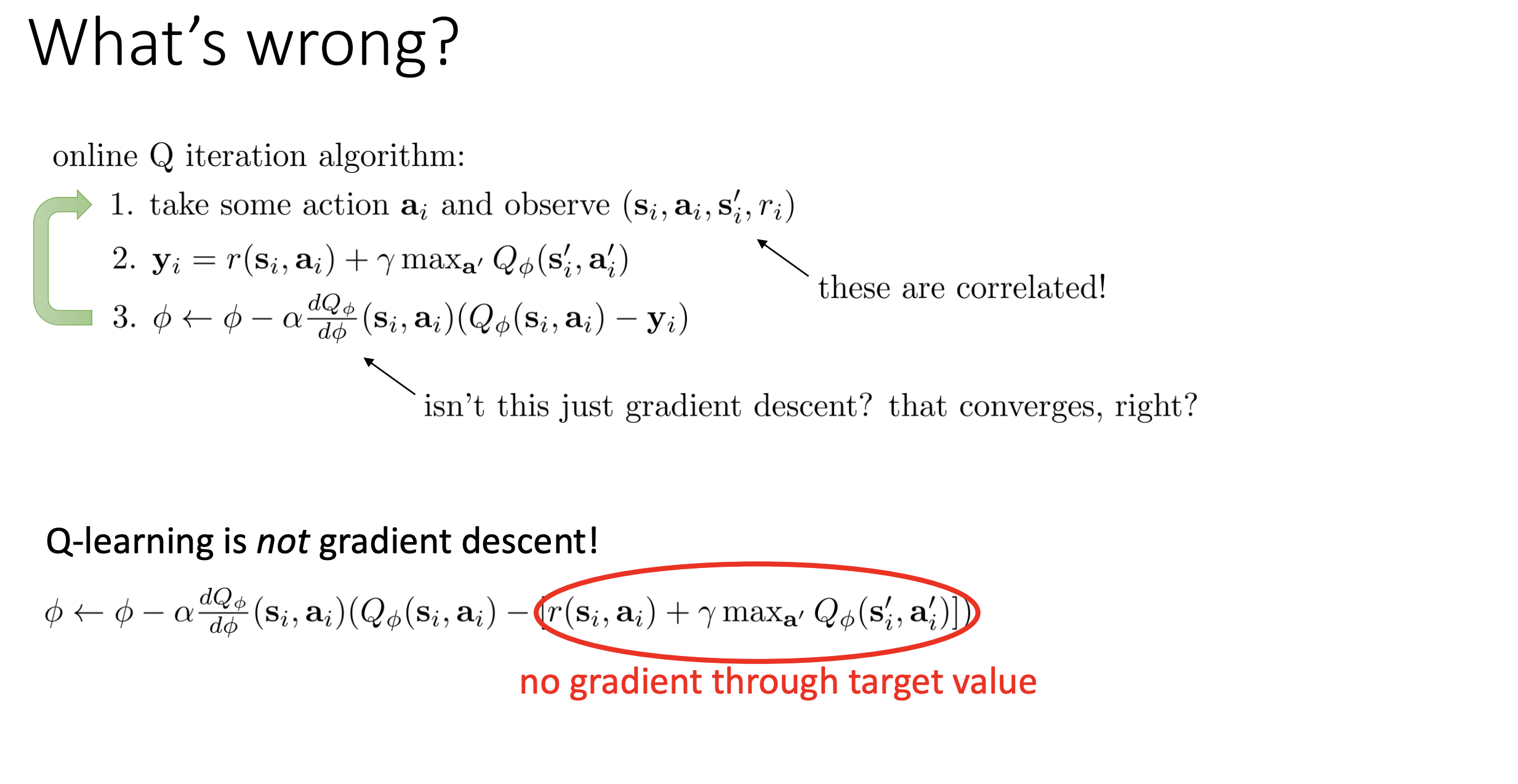
2.1 It is not full gradient descent
The target depends on the same parameters:
\[y_i=r_i+\gamma\max_{a'}Q_\phi(s'_i,a')\]If we write the loss for one sample as
\[L_i(\phi)=\frac{1}{2}\left(Q_\phi(s_i,a_i)-y_i(\phi)\right)^2,\]then both terms depend on $\phi$:
- prediction term: $Q_\phi(s_i,a_i)$
- target term: $y_i(\phi)=r_i+\gamma\max_{a’}Q_\phi(s’_i,a’)$
In full gradient descent, chain rule would differentiate through both dependencies. Standard Q-learning does not backprop through the target branch; it treats $y_i$ as fixed inside each update.
So practical Q-learning uses a semi-gradient:
\[\nabla_\phi L_i \approx \left(Q_\phi(s_i,a_i)-y_i\right)\nabla_\phi Q_\phi(s_i,a_i)\]This approximation often works well, but it is not true gradient descent on a stationary objective.
What "semi-gradient" means in practice
In implementation, each update usually does:
- Compute target with current (or target-network) parameters: \(y_i = r_i + \gamma\max_{a'}Q(s'_i,a')\)
- Freeze $y_i$ as a number for this update step.
- Update $\phi$ using gradient through $Q_\phi(s_i,a_i)$ only.
- Recompute targets again in the next step/iteration.
Important distinction:
- Semi-gradient = optimization detail (do we differentiate through the target?).
- Off-policy = data-collection detail (can data come from a different behavior policy?).
Q-learning is both:
- off-policy (can learn from replay/older behavior policies), and
- semi-gradient (ignores gradient through target during each update).
Quick numeric intuition
Suppose for one sample:
- $Q_\phi(s_i,a_i)=2.0$
- $y_i=3.0$
Then error is $-1.0$, so update pushes $Q_\phi(s_i,a_i)$ upward. But after parameters change, $y_i$ also changes (because it uses $Q_\phi$ at next state), so the target itself moves while you optimize.
2.2 Samples are highly correlated
Without replay, updates use consecutive transitions from one trajectory:
\[(s_t,a_t,r_t,s_{t+1}),\ (s_{t+1},a_{t+1},r_{t+1},s_{t+2}),\ldots\]These samples are very similar (same episode, nearby states), so they are not i.i.d. That breaks the usual SGD assumption that each mini-batch is a roughly independent draw from the data distribution.
Why this hurts:
- gradients point in very similar directions for many steps
- network can overfit to the current local region of state space
- when trajectory context changes, value estimates can swing back
Concrete intuition
Imagine a driving agent on one highway segment for 300 steps:
- many transitions are almost identical
- updates repeatedly emphasize that narrow region
- values for other road types (intersections, ramps) are not trained enough
Result: training looks unstable and generalization is weak. Replay buffers fix this by mixing transitions from many times/episodes before each update.
2.3 Moving target effect
As soon as $\phi$ changes, many targets change too, because targets are built from Q-values.
For one sample:
\[y_i = r_i + \gamma\max_{a'}Q_\phi(s'_i,a')\]If you update $\phi$ to fit sample A, then $Q_\phi$ at many next states changes. That immediately changes target values for samples B, C, D, … even before training on them.
So the learner is not just fitting a noisy label; it is fitting a label that keeps moving.
This is closely related to 2.1:
- 2.1 is the mathematical view (semi-gradient vs full gradient).
- 2.3 is the optimization view (labels drift during training).
Step-by-step instability example
Fix $r=1,\gamma=0.9$ for one transition, but next-state estimate changes during training:
- Iteration A: max next-Q = 3.0, target $y=3.7$
- Iteration B: max next-Q = 4.0, target $y=4.6$
- Iteration C: max next-Q = 2.5, target $y=3.25$
Same sample, different targets over time. This is why training can oscillate.
Two-sample example (why one update perturbs another sample’s target)
Suppose we have two transitions:
- sample A: $(s_A,a_A,r_A=1,s’_A)$
- sample B: $(s_B,a_B,r_B=0,s’_B)$
Current next-state estimates:
- $\max_{a’}Q_\phi(s’_A,a’)=3.0 \Rightarrow y_A=1+0.9\cdot3.0=3.7$
- $\max_{a’}Q_\phi(s’_B,a’)=2.0 \Rightarrow y_B=0+0.9\cdot2.0=1.8$
Now do one SGD update mostly driven by sample A. After that update, suppose estimates become:
- $\max_{a’}Q_\phi(s’_A,a’)=3.4 \Rightarrow y_A=4.06$
- $\max_{a’}Q_\phi(s’_B,a’)=2.6 \Rightarrow y_B=2.34$
Notice: we did not directly train on sample B in this step, but B’s target still moved from 1.8 to 2.34.
This is the "chasing a moving target" problem. Target networks reduce this by using slower-changing parameters in the target term.
2.4 Parallelization Solution
Parallelization is another way to reduce correlation in online Q-learning. The core idea is simple: collect data from many environments/workers at once, so updates are not dominated by one trajectory.
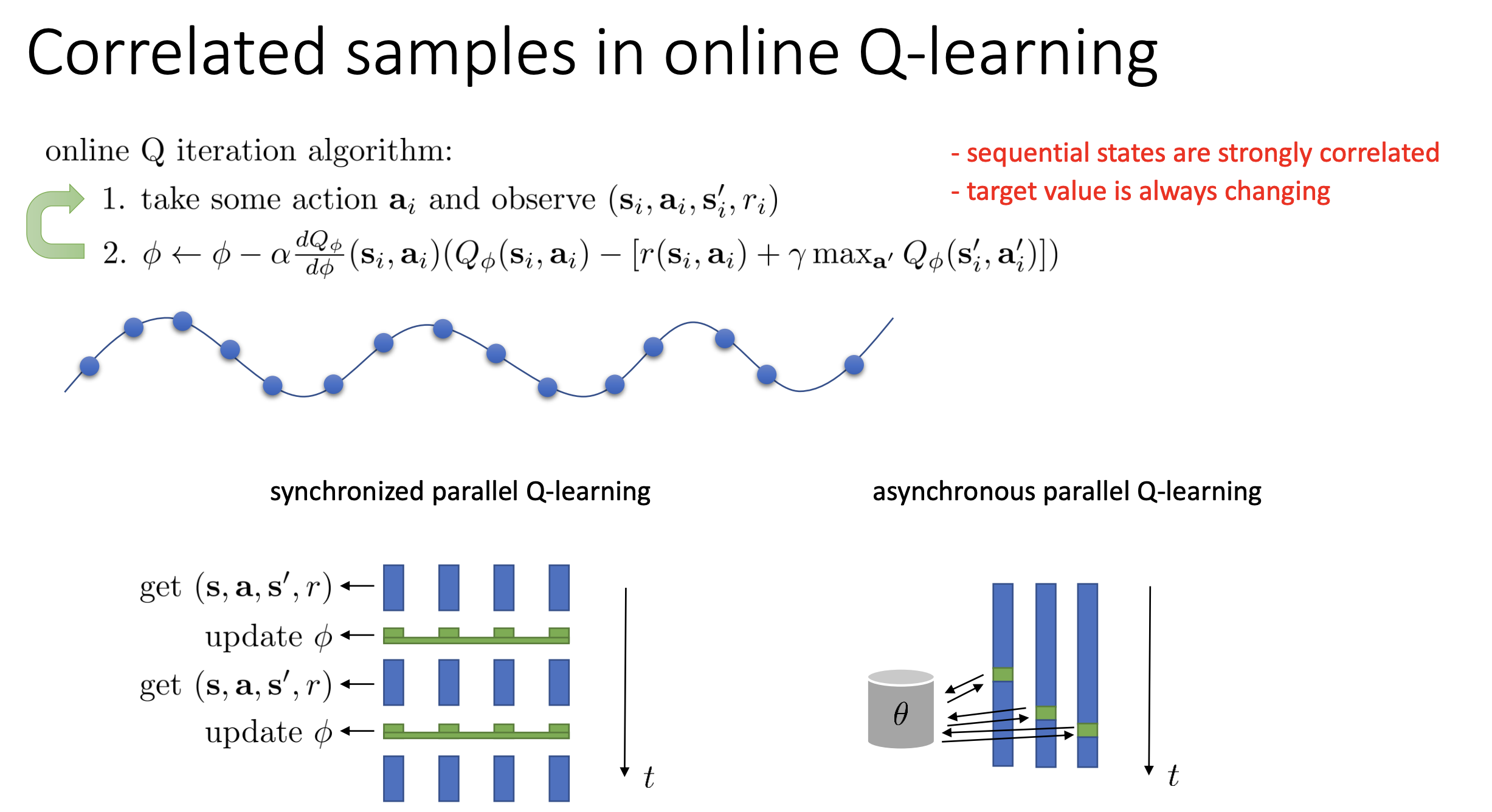
A) Synchronized Parallel Q-Learning
All workers collect transitions in parallel, then synchronize for one joint update.
How it works:
- Each of $W$ workers gathers one transition (or a short rollout).
- Combine all worker data into one batch.
- Compute one gradient update from that aggregated batch.
- Broadcast updated parameters back to workers.
Why it helps:
- Data from different workers is less correlated than a single trajectory.
- Batch gradient has lower variance.
Mini-example:
- 16 workers each collect one transition per cycle.
- Instead of updating from 1 sequential sample, you update from a 16-sample cross-worker batch.
- Correlation drops because samples come from different states/episodes/workers.
B) Asynchronous Parallel Q-Learning
Workers do not wait for each other.
How it works:
- Worker pulls latest parameters from a shared parameter server (or shared model).
- Worker collects data and computes gradients locally.
- Worker pushes update back immediately.
- Other workers continue in parallel with possibly slightly stale parameters.
Why this can still work for Q-learning:
- Q-learning is off-policy, so data from slightly older behavior policies is still usable.
- Throughput is higher because no global barrier.
Mini-example:
- Worker A updates model at time $t$.
- Worker B is still using parameters from $t-2$ while collecting data.
- That staleness is usually acceptable in off-policy Q-learning, though too much lag can hurt stability.
Practical note
Parallelization and replay buffers are often complementary:
- Parallelism increases data diversity and throughput.
- Replay buffer further decorrelates and reuses that data.
In many modern implementations, replay + target networks are still the default stability backbone, with parallel rollout workers added for scale.
3. Replay Buffers: Decorrelate and Reuse Data
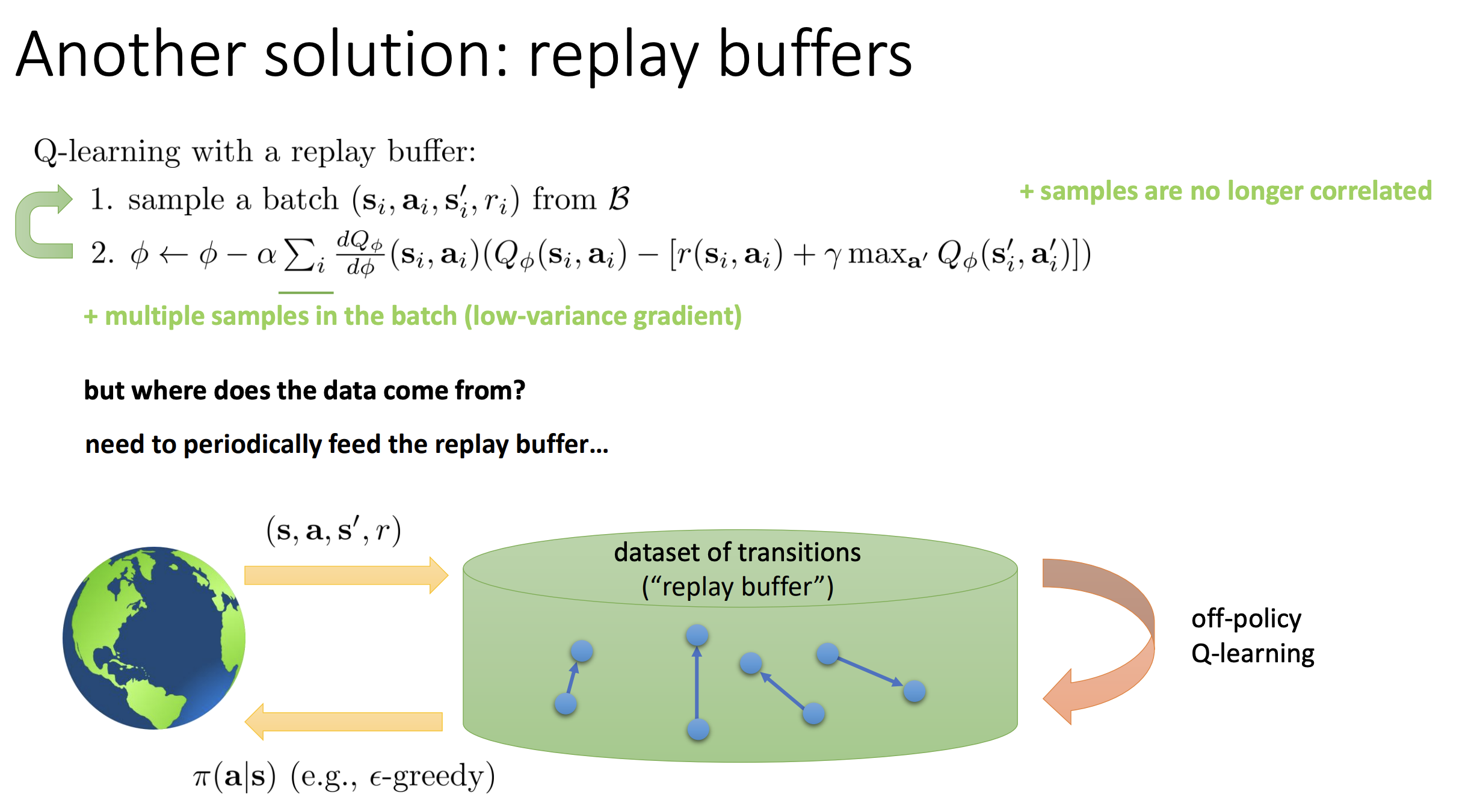
Replay buffer is a dataset $\mathcal{B}$ that stores transitions:
\[(s_t,a_t,r_t,s_{t+1})\]Instead of learning only from the newest transition, Q-learning repeatedly trains on random mini-batches from $\mathcal{B}$.
3.1 Why replay helps
Replay improves training in three ways:
- Decorrelates samples: random sampling breaks strong temporal correlation.
- Reduces gradient variance: batch average is smoother than single-sample updates.
- Reuses experience: each transition can contribute to many updates.
3.2 Buffer lifecycle (what happens in practice)
- Collect transition with behavior policy (often epsilon-greedy).
- Append transition to buffer.
- Sample random mini-batch from buffer.
- Compute targets for sampled transitions.
- Update network parameters with SGD.
- Repeat, while old entries are evicted when capacity is full.
Common implementation details:
- warm-up period (fill buffer before learning starts)
- finite capacity with FIFO/ring eviction
- update ratio $K$: do $K$ gradient steps per new env step
3.3 Step-by-step workflow (numeric)
Assume:
- buffer capacity = 100000
- current size = 20000
- mini-batch size = 256
- update ratio $K=4$
- discount $\gamma=0.99$
Per environment step:
- collect one new transition and append to buffer
- repeat 4 times:
- sample 256 random transitions
- for each sampled item compute \(y_i = r_i + \gamma \max_{a'}Q_{\phi_{\text{tgt}}}(s'_i,a')\)
- optimize \(\frac{1}{256}\sum_i\left(Q_\phi(s_i,a_i)-y_i\right)^2\)
So each new transition can influence learning many times (directly now, indirectly later when resampled).
3.4 Correlation example (why random sampling matters)
Without replay, consecutive updates might use:
\[(s_t,a_t,r_t,s_{t+1}),\ (s_{t+1},a_{t+1},r_{t+1},s_{t+2}),\ (s_{t+2},a_{t+2},r_{t+2},s_{t+3})\]These are very similar and push gradients in a narrow direction.
With replay, one mini-batch may include transitions from:
- different episodes
- different parts of episodes
- older and newer policies
This makes updates more i.i.d.-like and usually much more stable.
3.5 Practical tuning tips
- Use a large enough buffer (too small behaves almost online).
- Start updates after a warm-up threshold.
- Tune update ratio $K$ carefully:
- higher $K$ improves data efficiency
- too high can overfit stale replay data
- Keep target networks with replay; they work best together.
3.6 Connection to Fitted Q-Iteration (FQI)
Replay-buffer Q-learning is very close to FQI in spirit.
FQI-style view:
- collect a dataset
- run batch Bellman-regression updates
- collect more data and repeat
Replay-buffer Q-learning view:
- continuously append new transitions to buffer
- repeatedly sample random mini-batches from buffer
- run Bellman-regression SGD updates
So you can think of replay-buffer Q-learning as an incremental/streaming approximation of FQI:
- same Bellman target structure
- same regression objective
- different scheduling (continuous refresh vs fixed dataset phases)
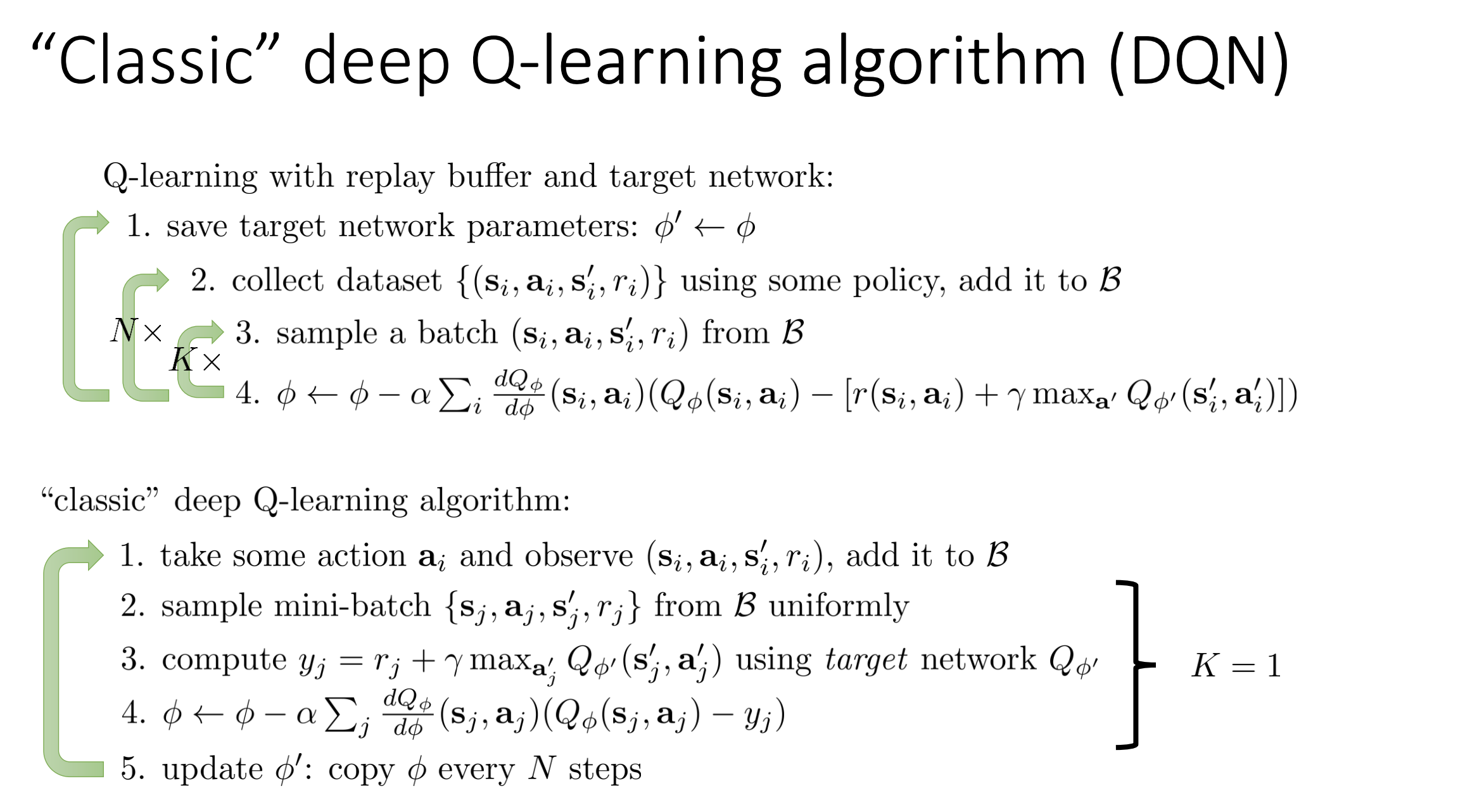
4. Target Networks: Freeze the Regression Target
Use two Q-networks:
- online network $Q_\phi$ (updated every gradient step)
- target network $Q_{\phi’}$ (updated more slowly)
Target uses the target network:
\[y_i = r_i + \gamma\max_{a'}Q_{\phi'}(s'_i,a')\]This makes the inner regression problem much more stationary.
4.1 Why target networks matter (more detail)
Without a target network, each update changes the same network used to define the target:
\[y_i = r_i + \gamma \max_{a'} Q_\phi(s'_i,a')\]So both prediction and labels move together, creating the “chasing your own tail” behavior from Section 2.3.
With target networks, we decouple them:
- prediction uses online network $Q_\phi$
- label uses slower network $Q_{\phi’}$
This makes the inner optimization look more like stable supervised regression.
4.2 Hard vs soft target updates (practical tradeoff)
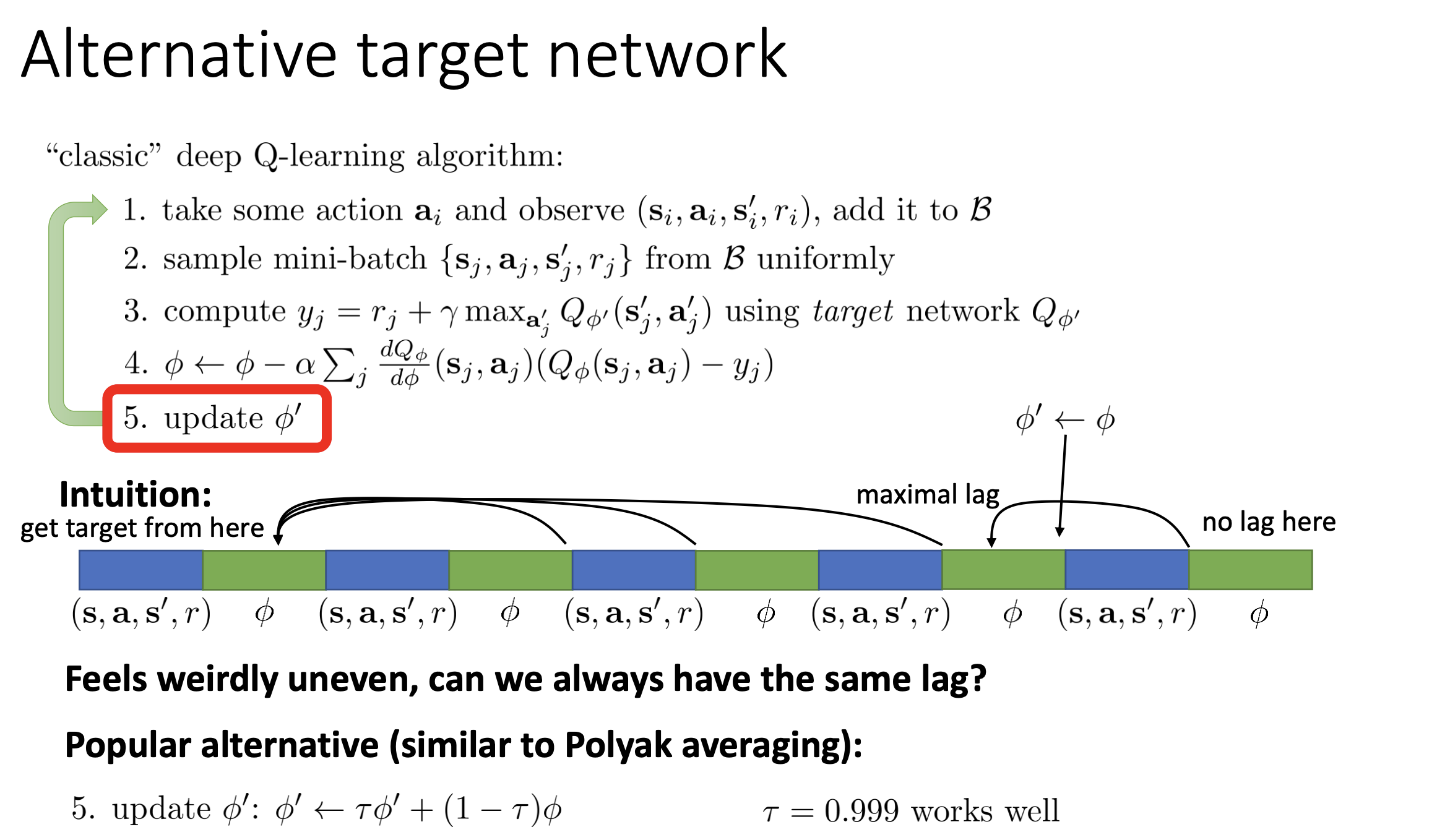
Hard update:
- every $N$ steps, copy $\phi’ \leftarrow \phi$
- simple and common in classic DQN
- downside: lag is uneven (fresh right after copy, stale just before next copy)
Soft/Polyak update:
\[\phi' \leftarrow \tau\phi' + (1-\tau)\phi\]- smoother lag at every step
- often easier to tune in continuous-control style algorithms
- common $\tau$ is close to 1 (e.g., 0.995 to 0.999 depending on convention)
Why this can work even though it is "just parameter interpolation":
- The target network is not the model you deploy for acting; it is a slowly moving teacher used only to compute stable Bellman targets.
- Exponential averaging acts like a low-pass filter on parameter noise from SGD, so target values change smoothly instead of jumping each step.
- Stability matters more than exact instant optimality for the target network; a slightly stale but smooth target is often better than a fresh but highly noisy one.
- Empirically, this reduces oscillation/divergence in bootstrap methods, even if parameter averaging is not theoretically perfect in non-convex neural nets.
4.3 Classic DQN loop (organized)
A standard DQN-style training cycle:
- Act in environment with epsilon-greedy policy from $Q_\phi$.
- Store transition $(s,a,r,s’)$ in replay buffer.
- Sample random mini-batch from buffer.
- Build targets with target network: \(y_j = r_j + \gamma \max_{a'} Q_{\phi'}(s'_j,a')\)
- Update online network by minimizing: \(\frac{1}{B}\sum_j\left(Q_\phi(s_j,a_j)-y_j\right)^2\)
- Update target network (hard copy every $N$ steps, or soft update every step).
4.4 Step-by-step mini example
Suppose a batch has one sample:
- $r=2$, $\gamma=0.9$
- target network gives $\max_{a’}Q_{\phi’}(s’,a’)=5$
- online prediction is $Q_\phi(s,a)=4$
Target:
\[y = 2 + 0.9\cdot 5 = 6.5\]Error:
\[Q_\phi(s,a)-y = 4 - 6.5 = -2.5\]SGD update pushes $Q_\phi(s,a)$ upward toward 6.5. Because $\phi’$ is fixed (for now), the target is stable during this inner step.
4.5 Why this is one of the key DQN tricks
Replay buffer + target network is the classic stability pair:
- replay buffer addresses sample correlation
- target network addresses moving labels
Together they made deep Q-learning practical at scale (e.g., Atari-era DQN systems).
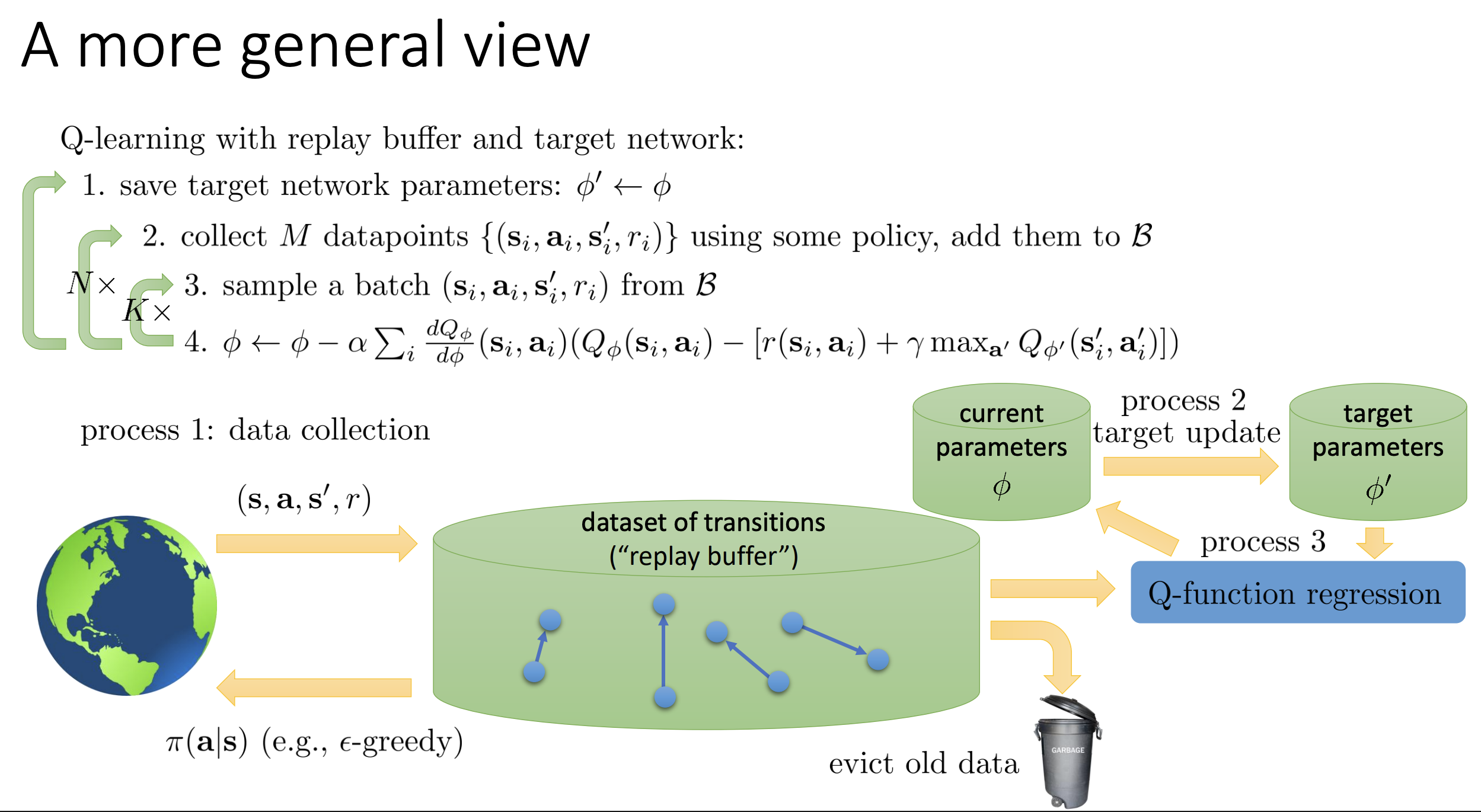
5. A General View: Data Collection, Training, Target Update
General view: Q-learning is not one loop, but three interacting processes:
- data collection (generate transitions)
- regression/training (fit Q with SGD)
- target update (refresh target network)
Different algorithms mostly differ in how fast each process runs.
5.1 Central object: replay buffer as shared memory
This three-process view is easiest to understand if replay is the shared memory between collection and training.
- Buffer stores tuples $(s,a,r,s’)$
- Buffer has finite capacity (often ring/FIFO behavior)
- Old samples are evicted as new samples arrive (capacity control)
Because of this, data collection and learning are partially decoupled: the agent can collect now, train later, and reuse the same transition many times.
5.2 The three processes (organized)
Process 1: Data collection
- Interact with environment using behavior policy (often epsilon-greedy from online Q).
- Push transitions into replay buffer.
Process 2: Target-network update
- Maintain slower parameters $\phi’$.
- Update by hard copy every $N$ steps or by soft/Polyak update.
Process 3: Regression (learning)
- Sample mini-batches from replay.
- Build Bellman targets using target network.
- Run SGD on online Q-network.
A common practical schedule for each environment step:
- collect 1 new transition and append to replay
- run 4 SGD updates from random replay mini-batches
- apply soft target update after each SGD step
This is usually more data-efficient than strict 1:1 (one transition, one update).
5.3 Algorithms as different rate configurations
From this perspective, online Q-learning, DQN, and FQI mainly differ by process rates:
- Online Q-learning:
- effectively tiny replay / near-immediate sample usage
- collection, learning, and target changes are tightly coupled
- DQN:
- large replay buffer
- target updates are intentionally slow
- collection and learning run continuously
- Fitted Q-Iteration (FQI):
- collect a dataset chunk
- run many regression steps (often inner loop)
- then refresh targets/data at slower outer-loop cadence
5.4 Why this view matters (non-stationarity control)
Each process changes what the other processes see:
- collection changes data distribution
- learning changes $Q_\phi$
- target updates change bootstrapped labels
Stability comes from separating timescales:
- fast enough learning to fit current targets
- slower target updates so labels do not move too quickly
- replay to smooth data-distribution shifts
This is the systems-level reason practical deep Q-learning can work.
6. Overestimation and Double Q-Learning
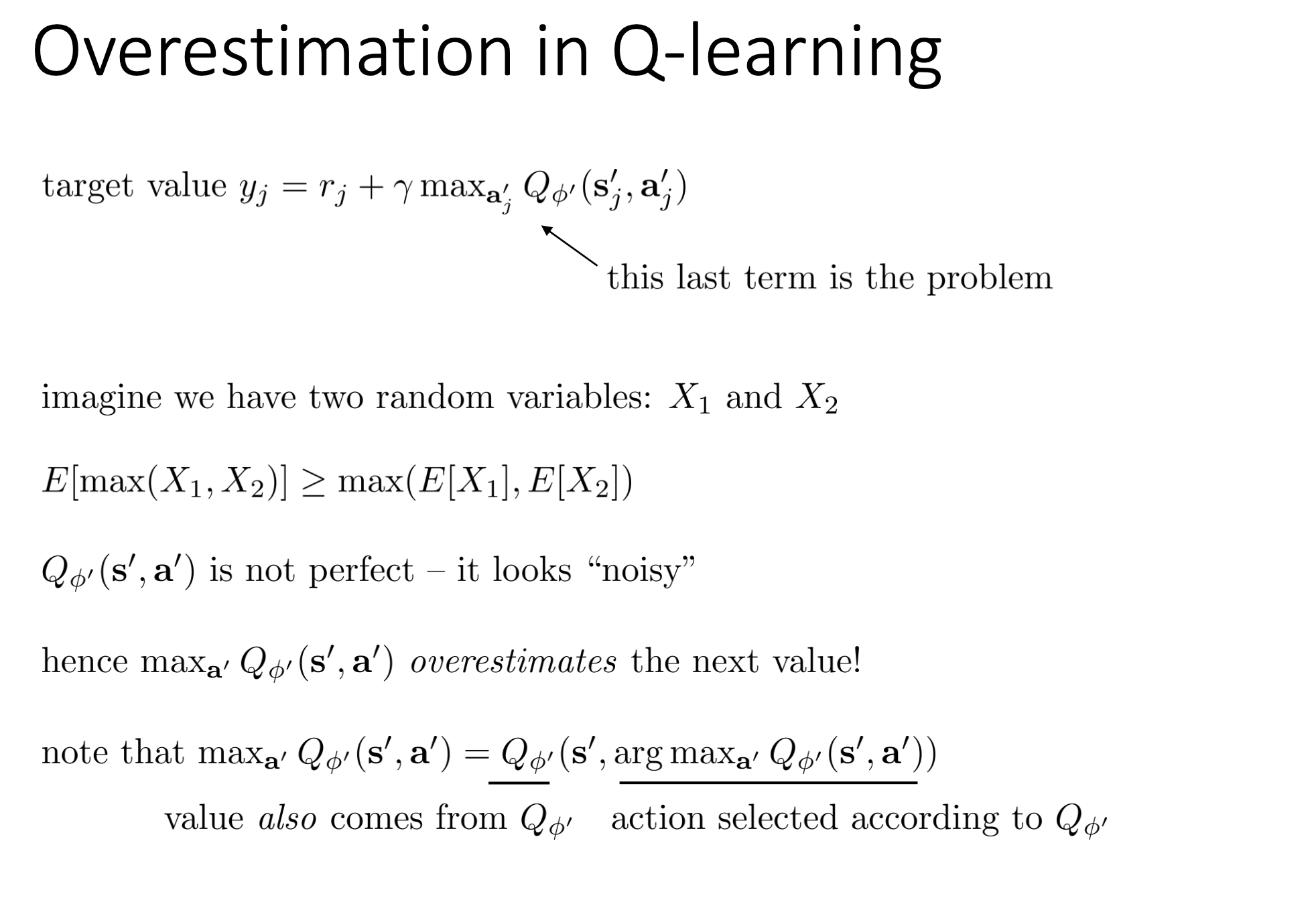
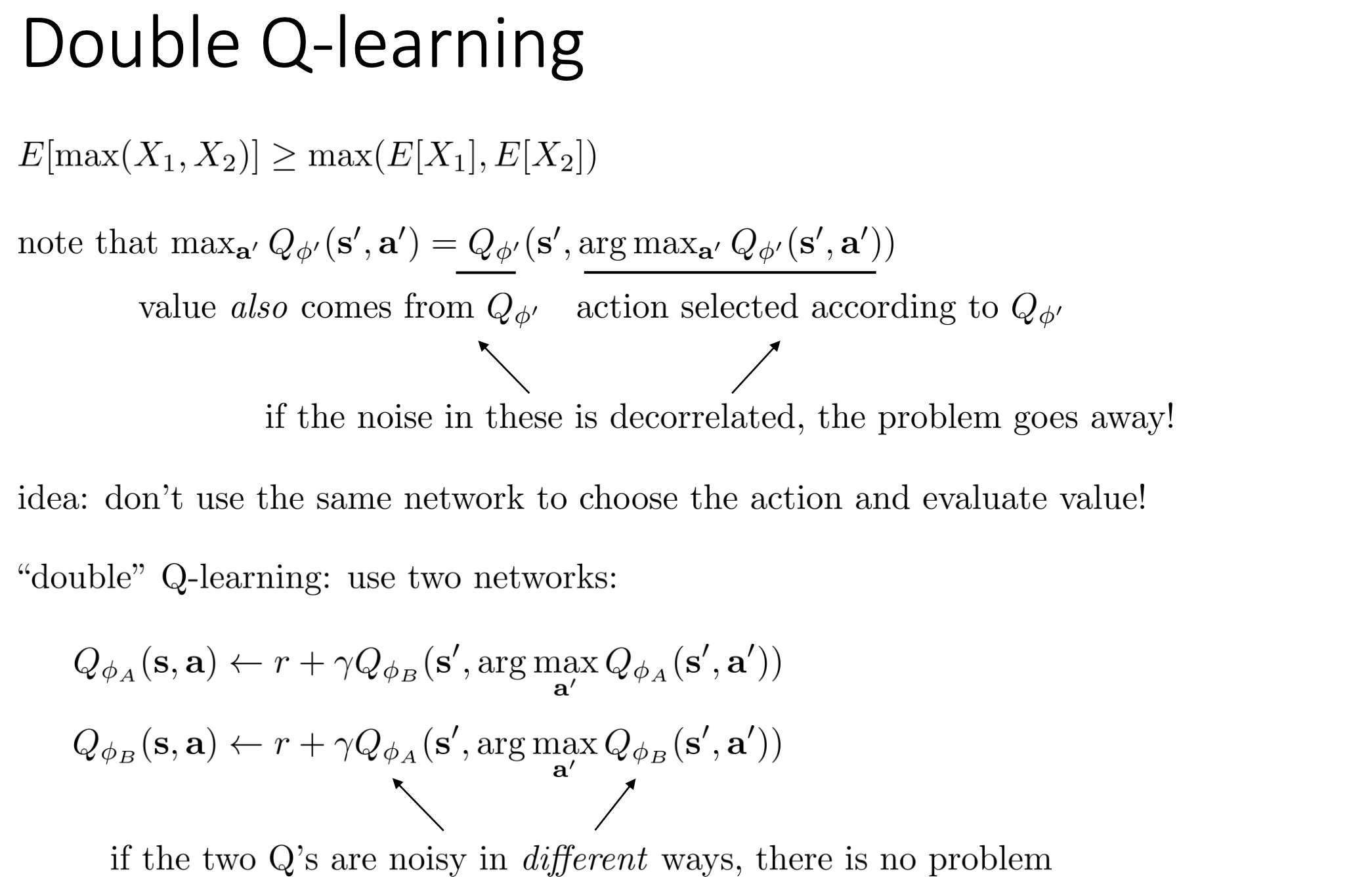
In deep Q-learning, the max in the Bellman target can create a systematic upward bias when Q estimates are noisy.
6.1 Why overestimation happens
Standard bootstrap target:
\[y = r + \gamma \max_{a'} Q_{\phi_{\text{tgt}}}(s',a')\]Even if each action-value estimate has zero-mean noise, the max tends to select actions with positive noise. So unbiased per-action noise becomes a biased maximum.
Equivalent intuition from random variables:
\[\mathbb{E}[\max(X_1, X_2, \dots)] \ge \max(\mathbb{E}[X_1], \mathbb{E}[X_2], \dots)\]This is the statistical root of Q overestimation.
6.2 Standard vs Double Q target
Standard DQN-style target (same network family for select and evaluate):
\[y_{\text{std}} = r + \gamma Q_{\phi_{\text{tgt}}}\left(s', \arg\max_{a'} Q_{\phi_{\text{tgt}}}(s',a')\right)\]Double Q target (decouple select and evaluate):
\[y_{\text{dbl}} = r + \gamma Q_{\phi_{\text{tgt}}}\left(s', \arg\max_{a'} Q_{\phi}(s',a')\right)\]- $Q_\phi$ (online): selects the action index
- $Q_{\phi_{\text{tgt}}}$ (target): evaluates that selected action
The key is to avoid using one noisy estimator for both selection and evaluation.
6.3 Step-by-step noise example
Assume true next-action values are both 5. One update step gives:
- online: $Q_\phi(s’,a_1)=6.2$, $Q_\phi(s’,a_2)=4.8$ so $\arg\max=a_1$
- target: $Q_{\phi_{\text{tgt}}}(s’,a_1)=5.1$, $Q_{\phi_{\text{tgt}}}(s’,a_2)=4.9$
Let $r=0, \gamma=0.99$:
- optimistic same-estimator bootstrap can be near $0.99\times 6.2 = 6.138$
- Double Q bootstrap is $0.99\times 5.1 = 5.049$
Gap is $1.089$ for this single sample, showing how max noise can inflate targets.
6.4 Practical implementation in DQN
For each sampled transition $(s_i,a_i,r_i,s_{\text{next},i},d_i)$:
- Select next action with online network: \(a_i^\star = \arg\max_a Q_{\phi}(s_{\text{next},i}, a)\)
- Evaluate that action with target network: \(v_i = Q_{\phi_{\text{tgt}}}(s_{\text{next},i}, a_i^\star)\)
- Build target: \(y_i = r_i + \gamma(1-d_i)\,v_i\)
- Regress online prediction $Q_\phi(s_i,a_i)$ toward $y_i$.
So yes, Q is evaluated at both current and next states, but for different roles:
- current pair $(s_i,a_i)$ gives the prediction being trained
- next state $s_{\text{next},i}$ gives the bootstrap part of the target
6.5 When Double Q helps most
Double Q is especially helpful when:
- action space is large (max over many noisy values)
- estimates are noisy early in training
- rewards are sparse and targets rely heavily on bootstrap
It does not solve every instability, but it is a strong overestimation fix.
7. Multi-Step Q Targets
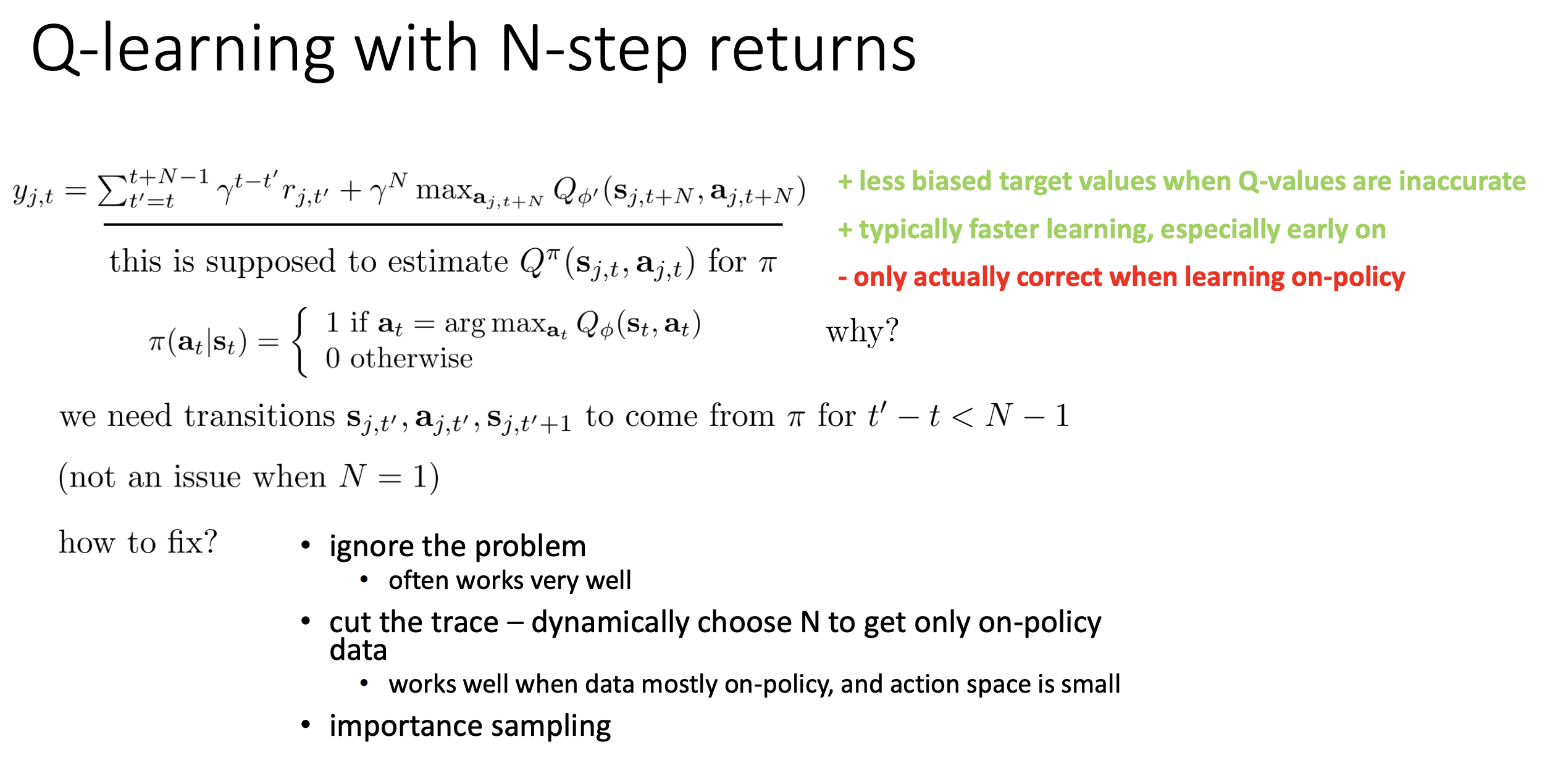
Multi-step targets use several real rewards before bootstrapping. This often improves learning signal quality early in training.
7.1 One-step vs N-step formulas
One-step target:
\[y_t^{(1)} = r_t + \gamma\max_{a'}Q(s_{t+1},a')\]N-step target:
\[y_t^{(N)} = \sum_{k=0}^{N-1}\gamma^k r_{t+k} + \gamma^N\max_{a'}Q(s_{t+N},a')\]If $N=1$, this is exactly standard Q-learning.
7.2 Why it can help
- often learns faster early
- reduces reliance on inaccurate bootstrap values
- propagates reward information farther per update
Reason: larger $N$ puts more weight on observed rewards and less on current Q errors.
7.3 Bias-variance-off-policy tradeoff
Increasing $N$ changes three things:
- lower bootstrap bias (good)
- higher target variance from sampled trajectories (cost)
- stronger off-policy mismatch sensitivity (cost)
So practical systems usually choose moderate $N$ (for example 3 or 5), not very large values.
7.4 Step-by-step 3-step example
Let $\gamma=0.9$, rewards be $(1,2,3)$, and tail bootstrap value be 4:
\[y^{(3)} = 1 + 0.9\cdot2 + 0.9^2\cdot3 + 0.9^3\cdot4\] \[= 1 + 1.8 + 2.43 + 2.916 = 8.146\]Compare with one-step if $\max_{a’}Q(s_{t+1},a’)=6$:
\[y^{(1)} = 1 + 0.9\cdot6 = 6.4\]The 3-step target carries richer near-future reward information than 1-step.
7.5 Why off-policy gets tricky for N-step
Why $N=1$ is usually safe in off-policy Q-learning:
- target uses a max over next actions, not the sampled next action
Why $N>1$ is harder:
- intermediate rewards come from behavior-policy actions in replay
- current policy may choose different actions
- then the sampled reward sequence is not exactly from the current target policy
This mismatch introduces extra bias.
7.6 Practical fixes for off-policy N-step
Common approaches:
- use small $N$ (e.g., 3 or 5)
- accept small mismatch bias in practice when behavior and target are close
- apply importance sampling corrections (more principled, can increase variance)
- truncate traces when policy mismatch is large
In practice, many deep RL systems pick moderate N-step returns because the speedup is often worth the approximation.
8. Q-Learning with Continuous Actions
In discrete action spaces, the bootstrap step
\[\max_{a'} Q(s',a')\]is cheap because we can enumerate all actions. In continuous action spaces, this inner maximization becomes a real optimization problem.
This affects both:
- action selection at interaction time
- target construction during critic updates
So practical methods focus on making this maximization fast and stable.
8.1 Option 1: Optimize action numerically inside the loop
Use a black-box optimizer to approximate
\[a^\star(s') \approx \arg\max_a Q_\phi(s',a)\]Common choices: random shooting, CEM, CMA-ES, or gradient-based action optimization.
Step-by-step random-shooting example
Assume 1D action range $a\in[-1,1]$ for one next state $s’$.
- Sample candidate actions: ${-1.0,-0.5,0.0,0.5,1.0}$.
- Evaluate critic: $Q(s’,-1.0)=1.2$, $Q(s’,-0.5)=1.9$, $Q(s’,0.0)=2.4$, $Q(s’,0.5)=2.1$, $Q(s’,1.0)=1.5$.
- Pick best candidate: $a^\star=0.0$.
- Use in target: $y=r+\gamma Q(s’,a^\star)$.
This is simple and easy to parallelize, but expensive in high-dimensional action spaces.
CEM workflow (high level)
- Initialize Gaussian over actions.
- Sample candidates from the Gaussian.
- Keep top-k actions by Q-value.
- Refit Gaussian to elites.
- Repeat for a few iterations; output mean or best sample.
Better than pure random shooting, but still adds nontrivial compute inside each target update.
8.2 Option 2: Constrain Q to be easy to maximize (NAF)
NAF (Normalized Advantage Function) uses a critic form where argmax is analytic.
Typical decomposition:
\[Q(s,a) = V(s) + A(s,a)\]with quadratic advantage:
\[A(s,a) = -\frac{1}{2}(a-\mu(s))^\top P(s)(a-\mu(s)), \quad P(s) \succeq 0\]Because the quadratic is maximized at its center,
\[\arg\max_a Q(s,a)=\mu(s)\]No inner optimization loop is needed.
Step-by-step intuition
For a fixed state $s$:
- Network outputs $\mu(s)=0.3$ and quadratic curvature matrix $P(s)$.
- Any action away from $0.3$ gets a negative advantage penalty.
- Maximum Q occurs exactly at $a=0.3$.
- Target computation directly plugs in this maximizing action.
Tradeoff: fast maximization, but less expressive critic class due to quadratic action structure.
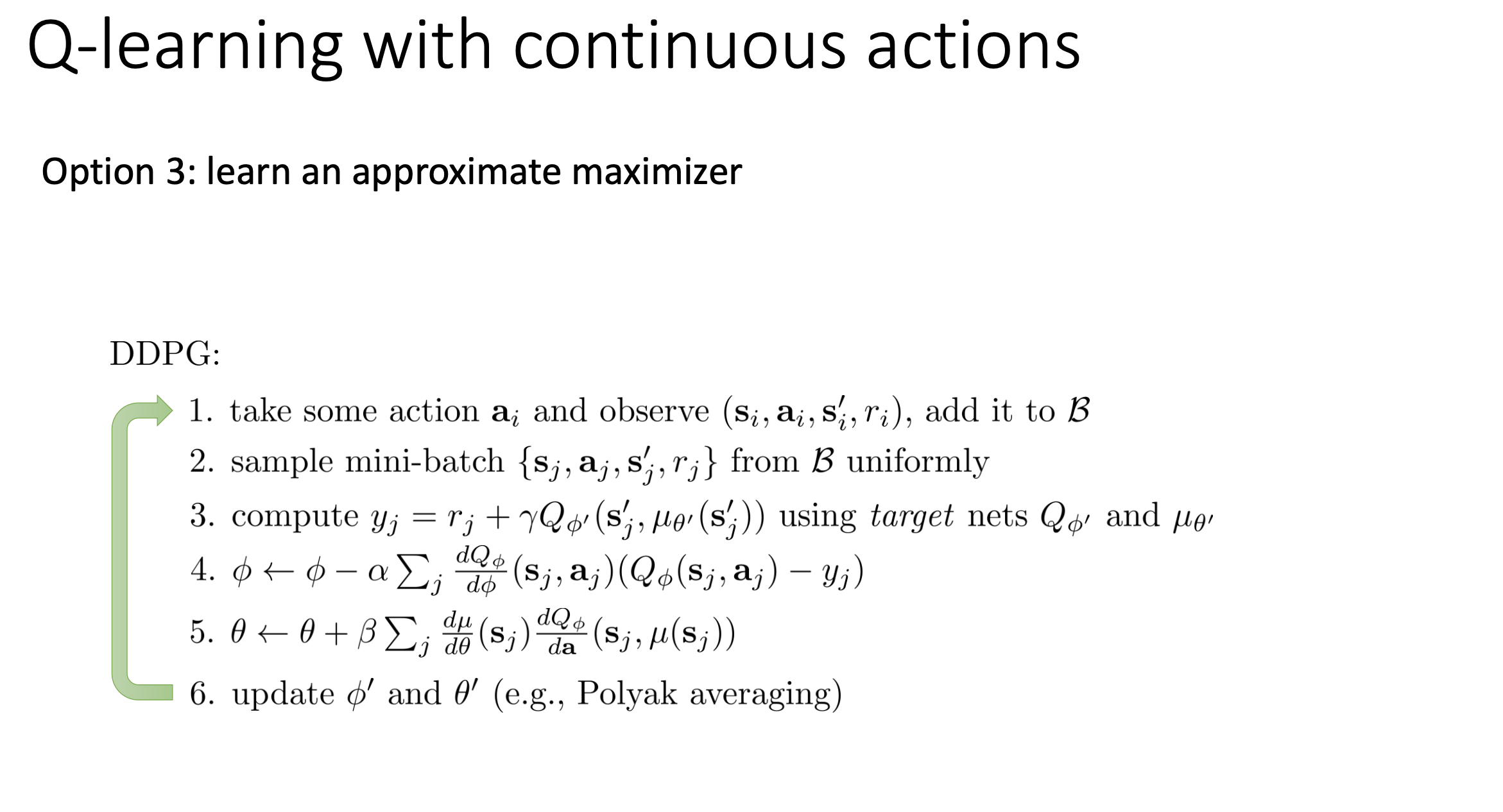
8.3 Option 3: Learn a separate maximizer network (DDPG/TD3 style)
Learn an actor $\mu_\theta(s)$ that approximates the maximizing action, and a critic $Q_\phi(s,a)$ that evaluates actions.
Actor idea:
\[\mu_\theta(s) \approx \arg\max_a Q_\phi(s,a)\]Critic target:
\[y_i = r_i + \gamma(1-d_i)\,Q_{\phi_{\text{tgt}}}\big(s_{\text{next},i},\mu_{\theta_{\text{tgt}}}(s_{\text{next},i})\big)\]Actor objective (maximize critic value):
\[J(\theta)=\mathbb{E}_{s\sim\mathcal{B}}\big[Q_\phi(s,\mu_\theta(s))\big]\]Step-by-step training workflow
- Collect transition $(s,a,r,s_{\text{next}},d)$ and store in replay.
- Sample mini-batch from replay.
- Build critic targets using target actor + target critic.
- Update critic by regression to targets.
- Update actor to increase $Q_\phi(s,\mu_\theta(s))$.
- Soft-update target networks with Polyak averaging.
This avoids per-sample inner optimization, so it scales better to higher-dimensional action spaces.
8.4 Side-by-side summary
Numerical optimization (Option 1)
- Pros: conceptually simple, flexible, no extra actor network required.
- Cons: expensive inner-loop optimization; gets harder as action dimension grows.
Easily maximizable critic (Option 2 / NAF)
- Pros: analytic argmax, very fast at runtime.
- Cons: restrictive Q parameterization can limit representational power.
Actor as learned maximizer (Option 3 / DDPG family)
- Pros: efficient in continuous control and scalable.
- Cons: introduces actor-critic coupling and extra stability concerns.
In modern continuous-control practice, actor-critic variants (DDPG/TD3/SAC families) are usually preferred.
9. Practical Tips from the Lecture
- start on simple tasks first (debug correctness)
- use large replay buffers for stability
- use target networks always
- clip gradients or use Huber loss
- prefer double Q-learning by default
- tune exploration schedule (high epsilon to low epsilon)
- run multiple random seeds (results are variable)
Huber loss (common robust choice):
\[L_{\delta}(x)=\frac{1}{2}x^2 \quad \text{for } \lvert x \rvert \le \delta\] \[L_{\delta}(x)=\delta\left(\lvert x \rvert-\frac{1}{2}\delta\right) \quad \text{for } \lvert x \rvert > \delta\]10. End-to-End DQN Style Loop (Concrete Checklist)
- interact with env using epsilon-greedy policy
- store transition in replay buffer
- sample random mini-batch
- compute targets with target network
- update online Q-network by SGD
- update target network (hard or soft)
- repeat
This is the practical core behind most Q-learning systems in this lecture.
11. Key Takeaways
- FQI is the stable conceptual template; online Q-learning is its fast but unstable limit.
- Replay buffers + target networks are the foundational stabilization tools.
- Double Q-learning directly addresses overestimation bias.
- Multi-step returns can speed learning but add off-policy complexity.
- Continuous-action Q-learning needs either inner optimization, constrained Q-form, or an actor network.