
⚖️ Scaling — Case Study and Details
This lecture, “Scaling – Case Study and Details,” dives into best practices for scaling and hyperparameter tuning in large language models (LLMs). It revisits whether the Chinchilla-derived scaling methodologies still hold in modern model development and explores recent case studies (CerebrasGPT, MiniCPM, DeepSeek) alongside the math behind stable training across scales.
🎯 I. Motivation and Overview
The lecture addresses critical questions for modern LM builders:
- ✅ Does the Chinchilla scaling approach still hold?
- 💰 Can we save compute during scaling analysis?
- 🧠 Which architectures or parameterizations scale predictably?
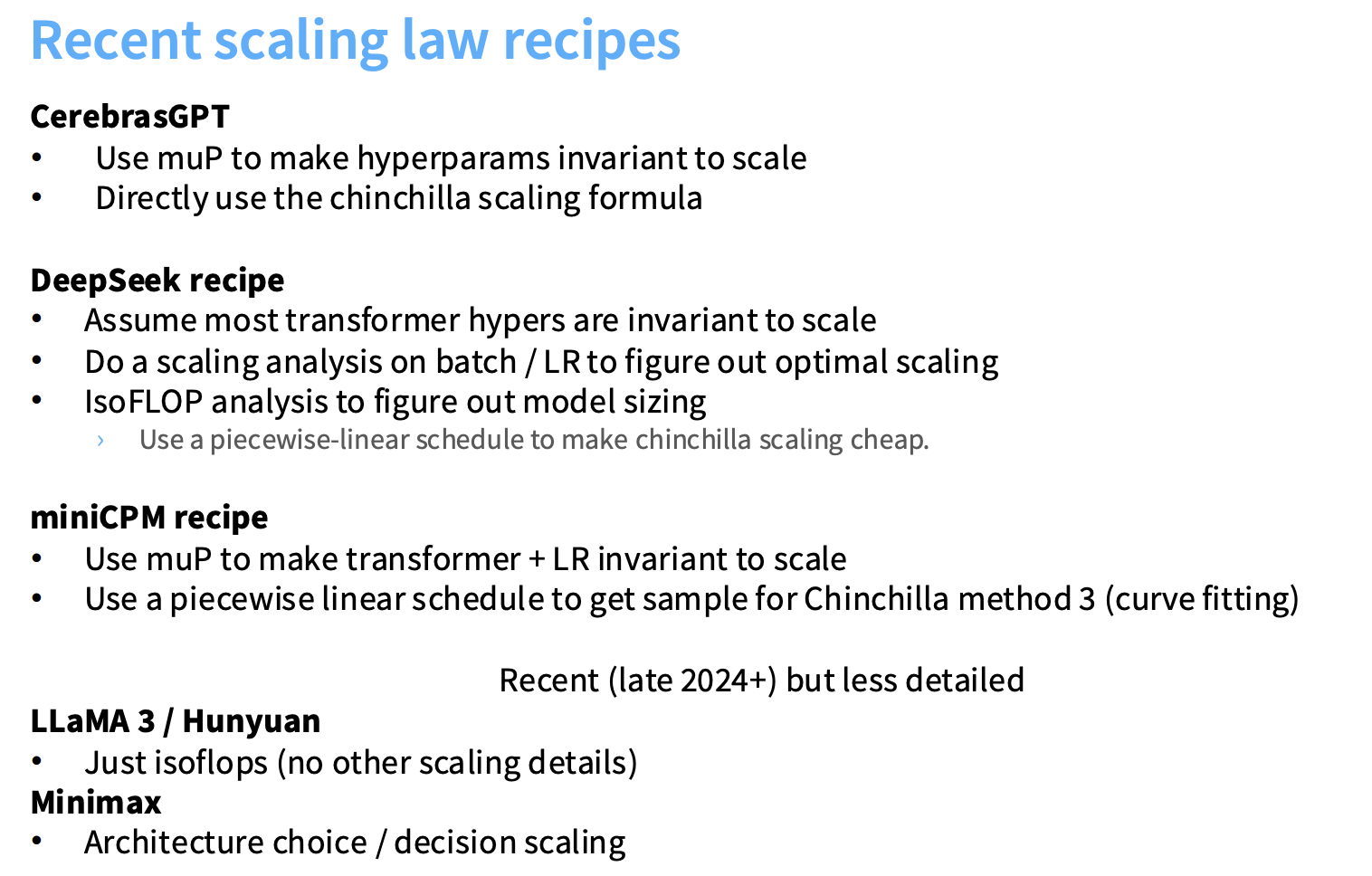
After the post-ChatGPT wave, detailed scaling data became secretive. Thus, this lecture draws insights from publicly transparent scaling studies — notably CerebrasGPT, MiniCPM, and DeepSeek LLM — now considered the gold standard for scaling law methodology.
🧪 II. Scaling in Practice — Model Case Studies
⚙️ Cerebras-GPT
Scaling Range: 0.1B → 13B parameters, following the Chinchilla recipe.
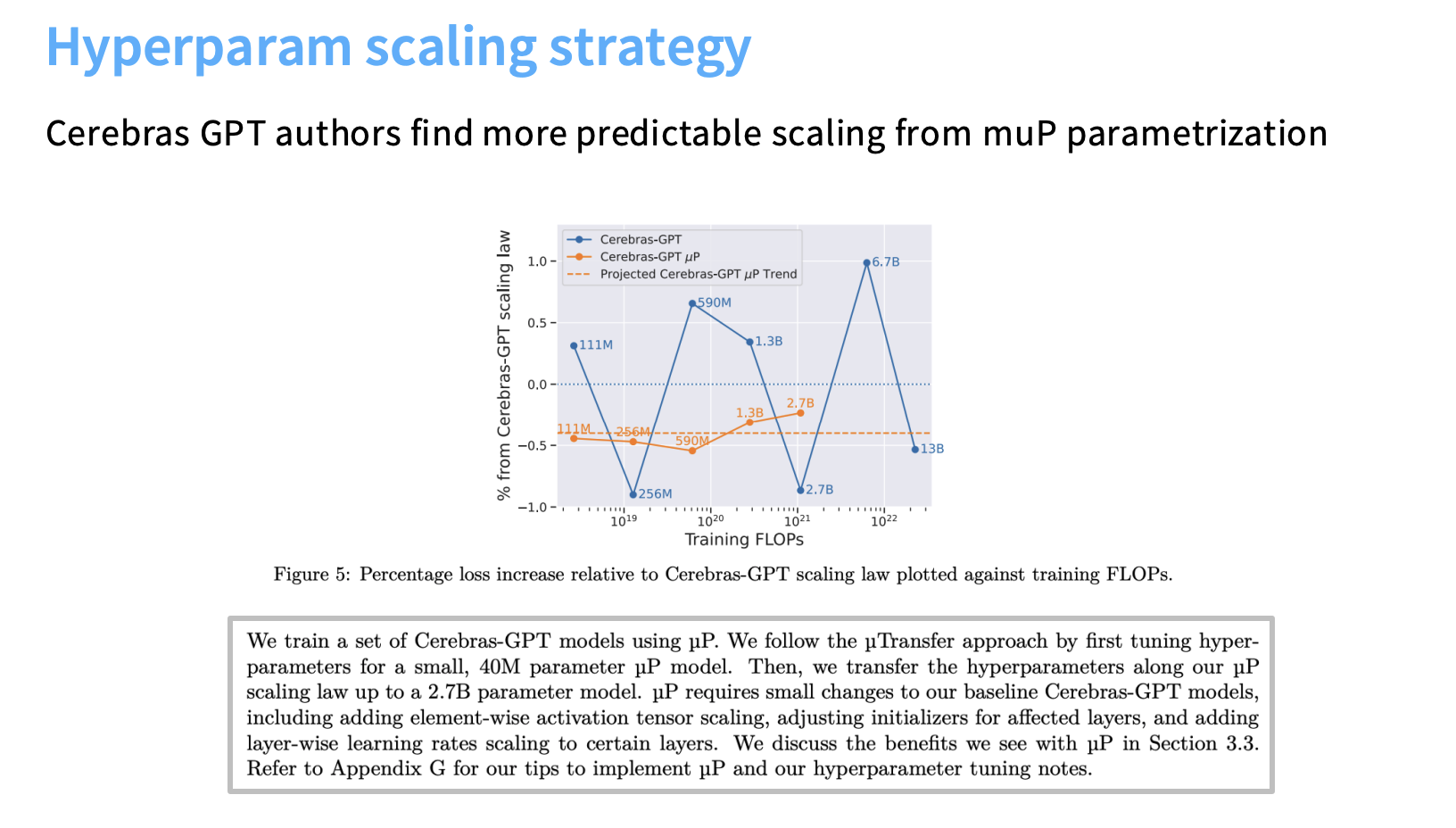
- 🔑 Core Finding: Stability via Maximal Update Parametrization (muP).
- Standard parameterization (SP) → “big oscillations” around the predicted scaling line.
- muP → smooth, predictable scaling curves.
- 🧭 Hyperparameter Strategy:
- SP required LR retuning as model size grew.
- muP produced stable learning curves across scales.
- 🧰 Implementation:
- Conducted hyperparameter searches on tiny models (40M).
- Used muP to reliably scale those hyperparameters up to 13B.
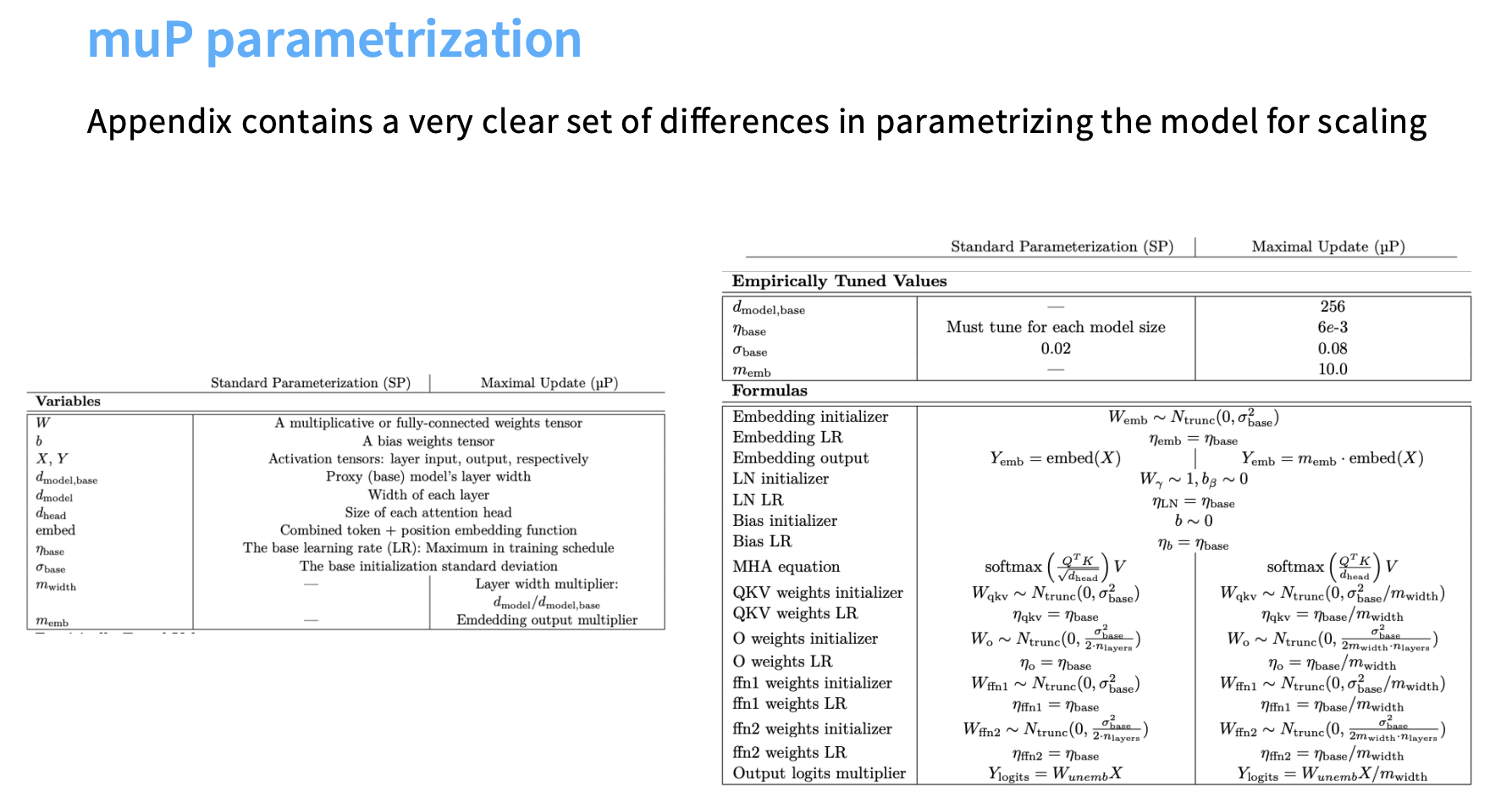
- muP sets per-layer LRs and initialization variances differently from SP.
⚙️ MiniCPM (2024)
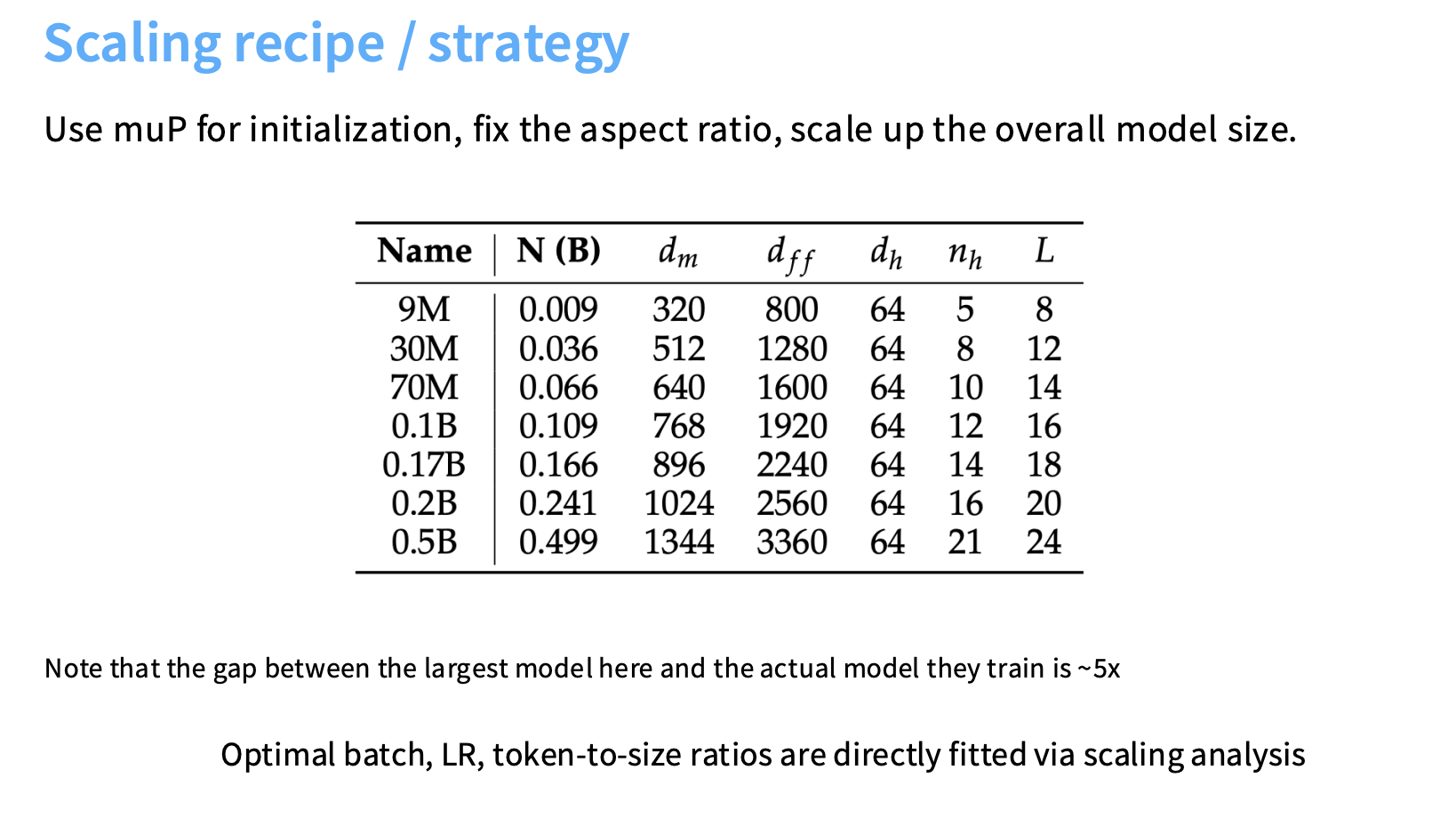
Scale: 1.2B → 2.4B parameters, performing on par with many 7B models.
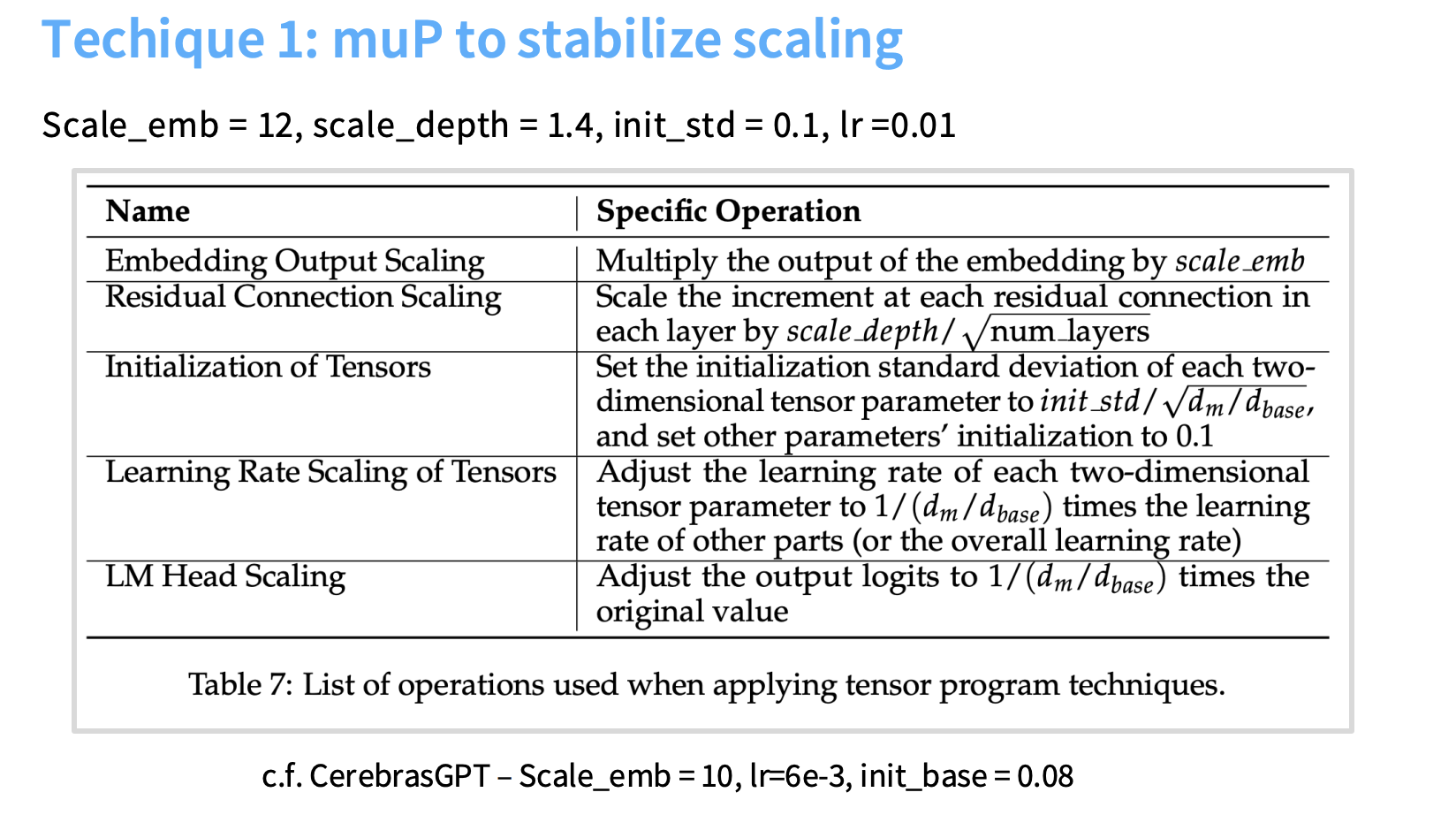
- 🧩 muP for Stability: Like Cerebras, MiniCPM used muP to simplify and stabilize scaling, saving ~5× compute from smallest to largest runs.
- 📦 Optimal Batch Size:
- Confirmed log-log linear trend between terminal loss and batch size.
- As loss decreases, batch size must polynomially increase.
- ⚡ Optimal Learning Rate:
- With muP, minimum optimal LR remains constant across scales → no complex LR tuning.
- 📉 WSD Learning Rate Schedule:
- Developed Warm-up Stable Decay (WSD) to make Chinchilla-style data analysis cheaper.
- Unlike cosine LR (depends on run length), WSD’s flat “stable phase” allows reuse of runs for multiple data checkpoints.
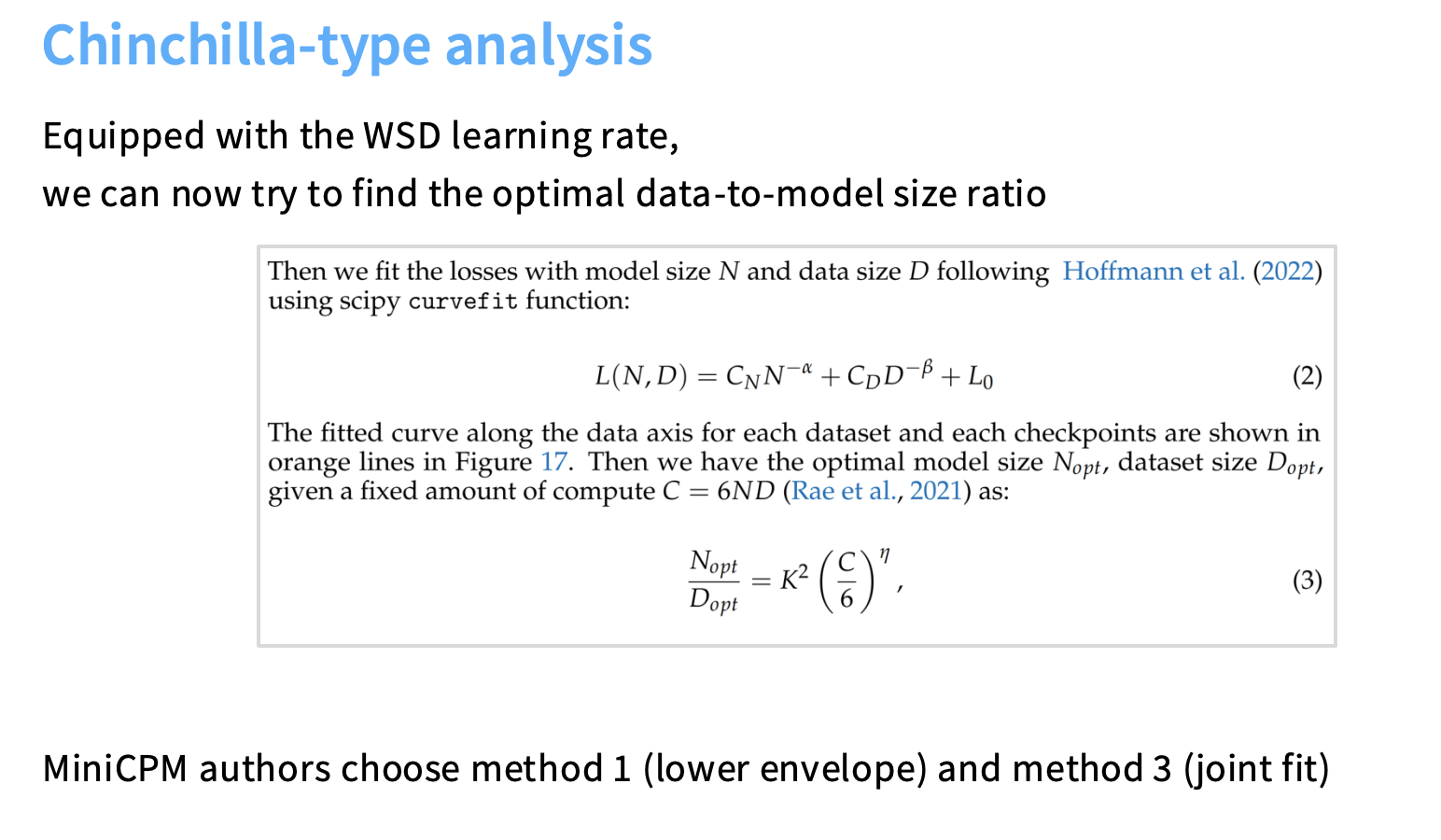
- 📈 Chinchilla Analysis:
- Used Method 1 (lower envelope) + Method 3 (joint fit).
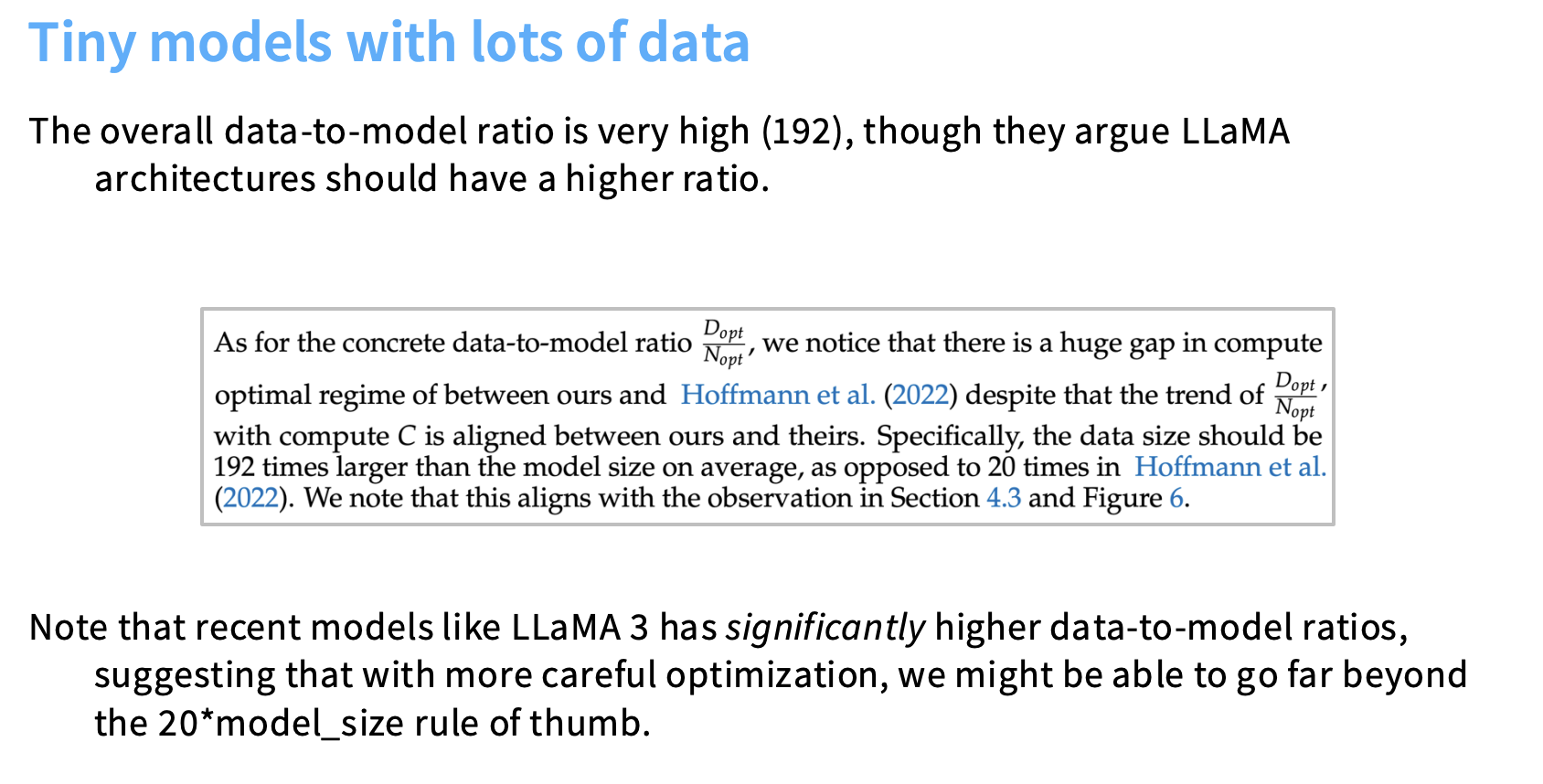
- Found 192 tokens per parameter, much higher than Chinchilla’s 20:1 → aligns with LLaMA 3’s high ratio.
⚡ Warm-up Stable Decay (WSD) Learning Rate Schedule
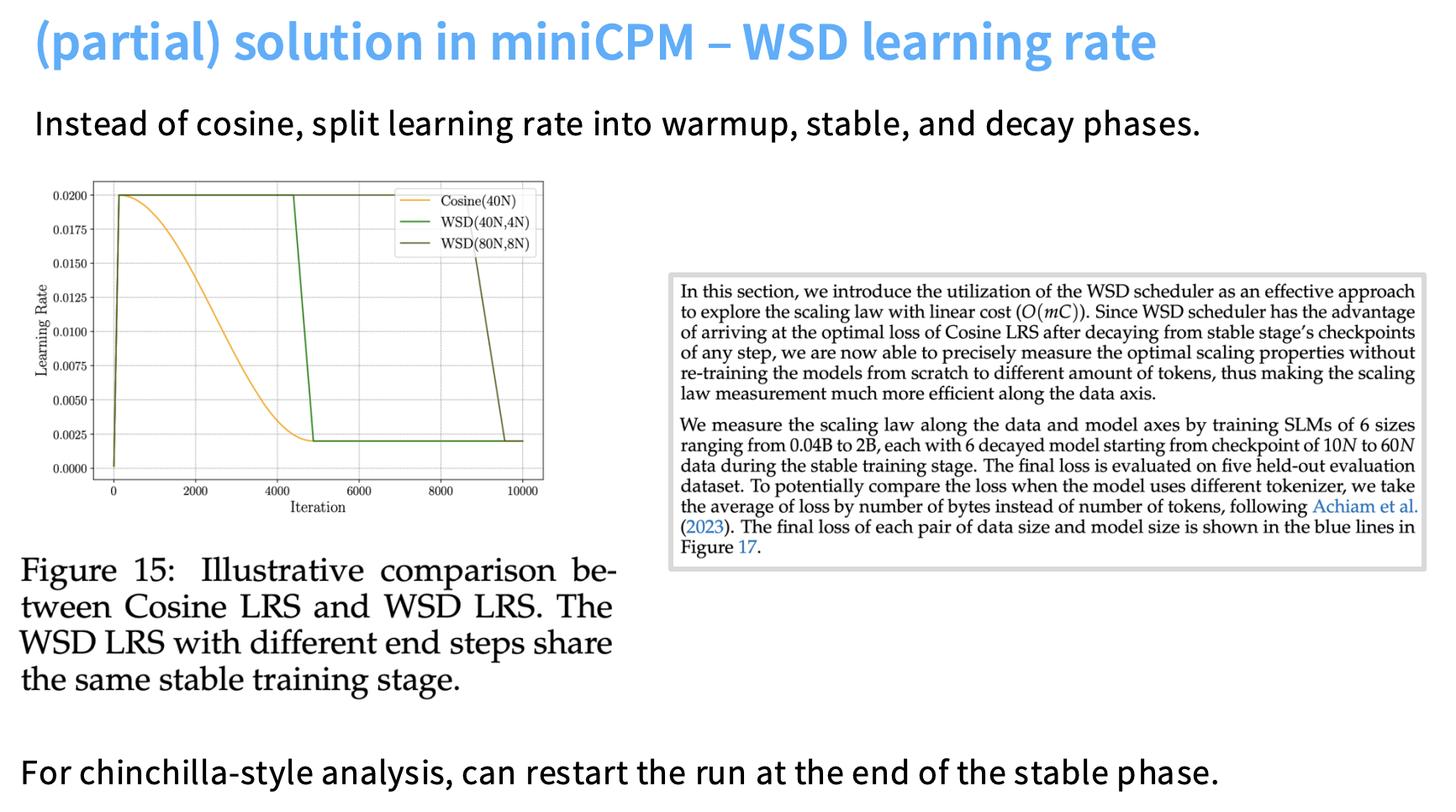
The Warm-up Stable Decay (WSD) learning rate schedule introduces a more flexible and cost-efficient way to manage training dynamics compared to traditional cosine learning rate schedules. It plays a key role in modern scaling law analysis, especially in models like MiniCPM and DeepSeek.
🧩 Structure of the WSD Learning Rate Schedule
The WSD schedule is a piecewise linear (trapezoid-shaped) learning rate curve, divided into three distinct phases:
-
🔥 Warm-up Phase
Rapidly increases the learning rate from zero to its maximum value — similar to a cosine warm-up.
Goal: Stabilize gradients and prevent early training instability. -
🟩 Stable Phase
Keeps the learning rate constant for the majority of training.
Goal: Enable consistent learning and predictable loss decay. -
🧊 Decay Phase
Rapidly cools down the learning rate to its minimum (or zero).
Goal: Refine the model and reach the terminal loss efficiently.
🧠 DeepSeek’s variant used a fast warm-up followed by two decay steps of 10% each — striking a balance between speed and stability.
🎯 Motivation — Fixing the Cosine Schedule Problem
The main motivation for WSD comes from limitations in cosine learning rate schedules when performing Chinchilla-style scaling law analysis.
- The Cosine Problem:
The cosine schedule’s shape depends on the target termination point (i.e., number of tokens).- Small runs → faster cool-down.
- Large runs → slower cool-down.
- The Consequence:
Because these decay curves differ, early checkpoints from a long run cannot represent the scaling behavior of shorter runs.
To get accurate scaling fits, researchers would have to train N² separate runs (for N target lengths) — extremely expensive!
💡 Advantage — Making Chinchilla Analysis Cheaper
WSD offers a computationally efficient workaround to this problem:
- Train once through the full stable phase (flat middle region).
- Reuse checkpoints from earlier in the stable phase to simulate shorter training runs.
- Apply new decay phases from those checkpoints to reach different target endpoints.
This means researchers can perform Chinchilla-style scaling analysis using almost one run, rather than N² runs — dramatically reducing compute requirements while keeping scaling curves consistent.
📊 Empirical Performance
In practice:
- 🧠 MiniCPM popularized the WSD schedule.
- While its loss curves look less smooth than cosine,
it often matches or beats the cosine minimum at every token count.
- While its loss curves look less smooth than cosine,
- 🚀 DeepSeek reported similar success — their WSD-style schedule
performs on par with cosine, maintaining stability across scales.
Trade-off:
The decay timing is crucial.
- The stable phase allows the model to explore far from initialization.
- The decay phase is essential to “anneal” the loss to a lower final value.
🧩 In short: WSD = Warm-up → Stable learning → Controlled Decay = ⚙️ Efficient scaling, 💰 cheaper compute, and 📈 competitive results.
⚙️ DeepSeek LLM (V1, 2024)
The DeepSeek LLM (V1, 2024) stands out as a strong example of a carefully engineered, scientifically grounded large-scale model.
It features models with 7B and 67B parameters — both delivering performance comparable to LLaMA 2 of similar sizes and rivaling Mistral models.
What makes DeepSeek notable is its “serious science” approach to scaling: methodical, data-driven, and computation-efficient.
⚙️ Scaling Strategy — Direct Estimation (No muP)
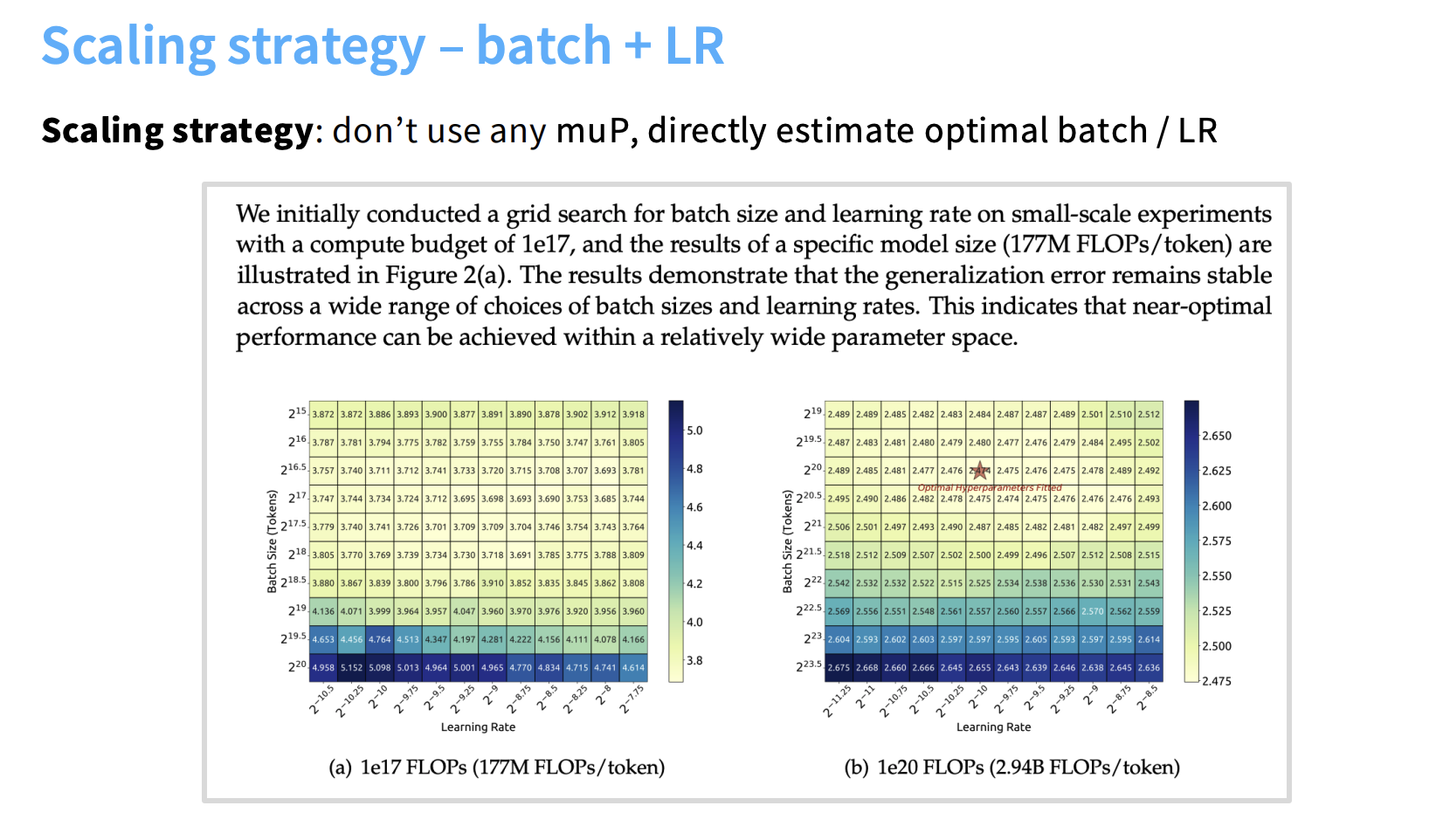
A defining characteristic of DeepSeek V1 is its decision not to use Maximal Update Parametrization (muP), unlike models such as CerebrasGPT and MiniCPM.
Instead, DeepSeek employed a direct estimation approach to achieve stable hyperparameters:
- 🧩 Assumption — Most Transformer hyperparameters are invariant to scale.
- 📈 Scaling Analysis — They identified only two non-invariant hyperparameters:
- Optimal batch size
- Optimal global learning rate
- 📊 Extrapolation Process —
- Conducted small-scale experiments and collected models within 0.25% of minimum loss.
- Fitted scaling laws for optimal batch size and learning rate as functions of compute.
- Extrapolated these fits to estimate hyperparameters for full-scale (7B and 67B) models.
⚠️ The resulting global learning rate scaling fit was described as “somewhat suspicious looking,” implying that the relationship may not follow a perfect power law — but it remained empirically effective.
🔬 Chinchilla Analysis and Optimal Sizing
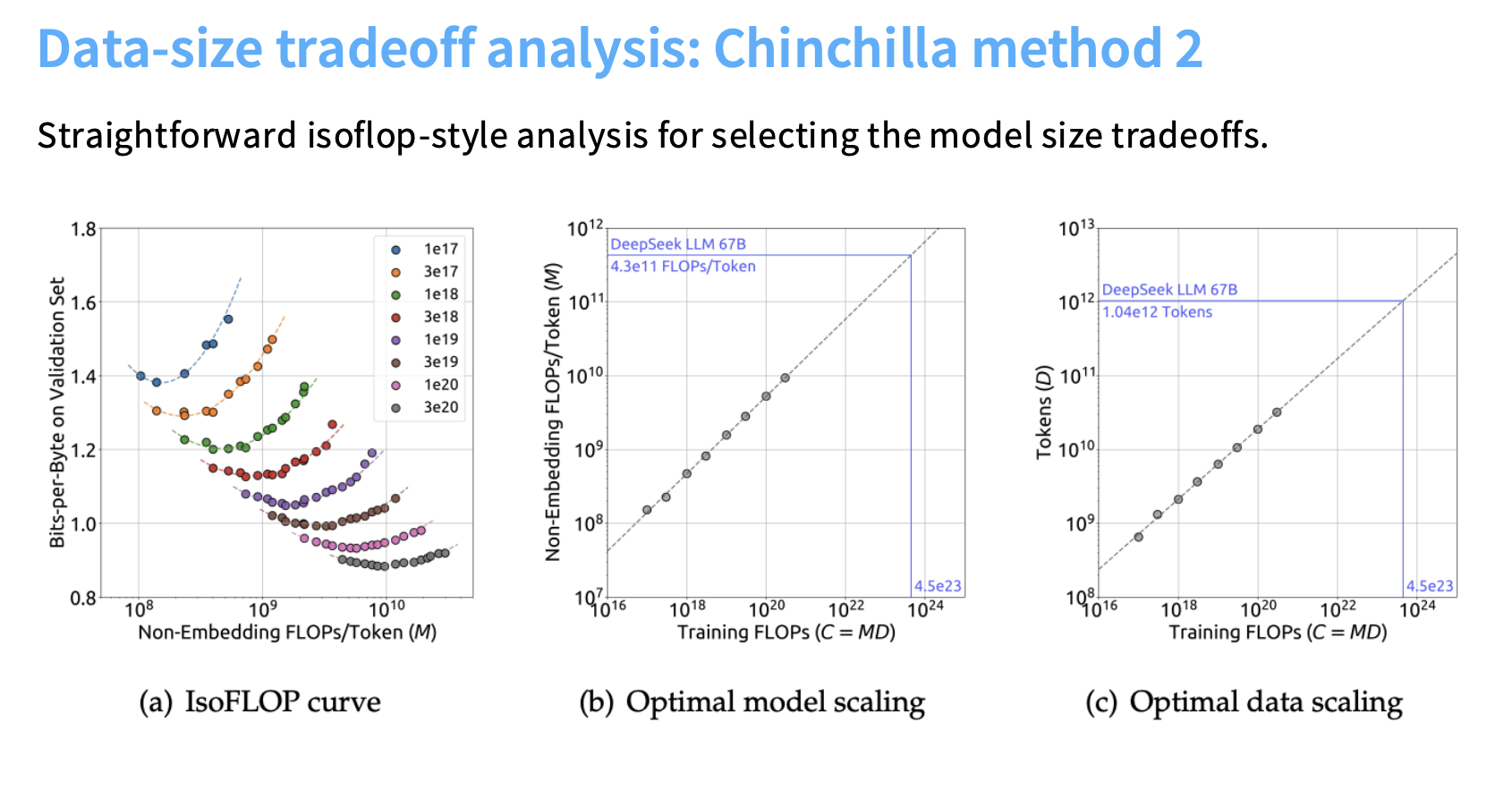
DeepSeek performed a Chinchilla-style IsoFLOPS analysis (Method 2) — a key benchmark for determining optimal trade-offs between model size and data size under fixed compute budgets.
- 📘 IsoFLOPS Method:
Sweep parameter counts at fixed FLOP budgets and identify the minimum-loss curve. - 🔮 Predictive Power:
The resulting scaling fits accurately predicted the final loss outcomes of both the 7B and 67B models.- They successfully extrapolated from 10²⁰ FLOPs small-scale runs to 10²⁴ FLOPs large-scale training.
- This validated their scaling law methodology as both practical and predictive.
📉 Learning Rate Schedule — WSD-Style
To complement their scaling strategy, DeepSeek adopted a Warm-up Stable Decay (WSD)-style learning rate schedule, inspired by MiniCPM.
- 🧱 Structure:
- Rapid warm-up phase
- Long stable plateau
- Two decay steps of 10% each
- ⚡ Performance:
- Matched or slightly exceeded cosine learning rate performance.
- Enabled Chinchilla-style scaling analysis at a fraction of the compute cost.
- 💰 Efficiency Gain:
By reusing the stable phase for different cool-down checkpoints, DeepSeek drastically reduced the number of full training runs needed for scaling curve estimation.
🧾 Summary — The DeepSeek Recipe
| Component | Approach | Key Insight |
|---|---|---|
| Parametrization | No muP | Relied on empirical direct fitting of batch size & LR |
| Scaling Analysis | Direct extrapolation from small runs | Used near-optimal small models to fit scaling laws |
| Compute Allocation | Chinchilla IsoFLOPS (Method 2) | Achieved accurate prediction across 4 orders of magnitude in FLOPs |
| Learning Rate Schedule | WSD-style (fast warm-up, stable plateau, 2-step decay) | Matched cosine performance, cheaper scaling analysis |
🧠 In essence:
DeepSeek V1 achieved strong results through empirical scaling discipline, not parameterization tricks — proving that a rigorous, data-driven approach can rival even the most sophisticated optimization methods.
🌍 Other Recent Scaling Insights
| 🧠 Model | ⚙️ Key Method | 📊 Scaling Result | 📚 Year |
|---|---|---|---|
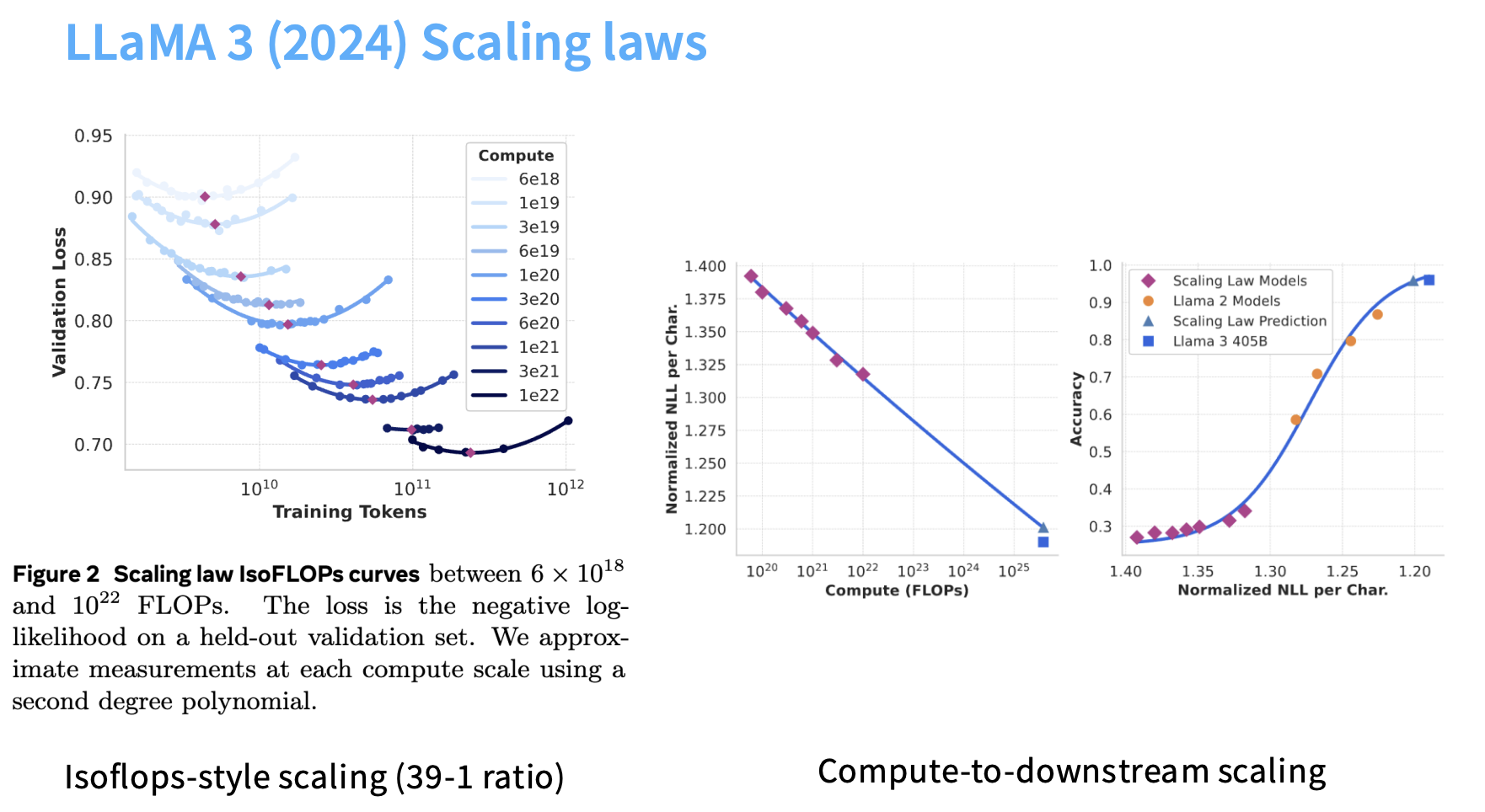
| LLaMA 3 | IsoFLOPS-style | Optimal 39:1 tokens-to-parameter ratio; fitted sigmoid between NLL & benchmark accuracy | 2024 |
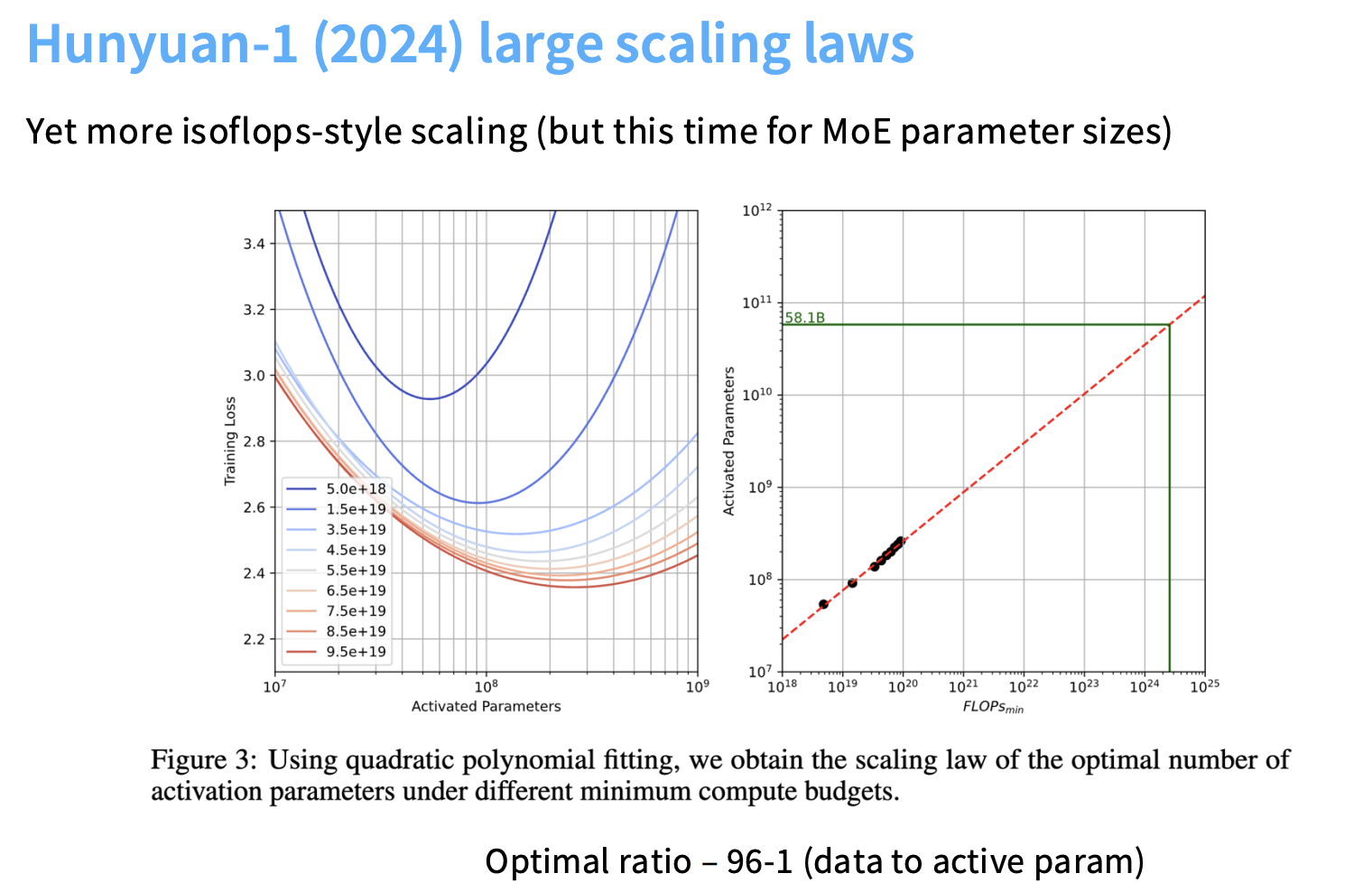
| Hunyuan-1 | IsoFLOPS for MoE | Extended scaling to expert layers | 2024 |
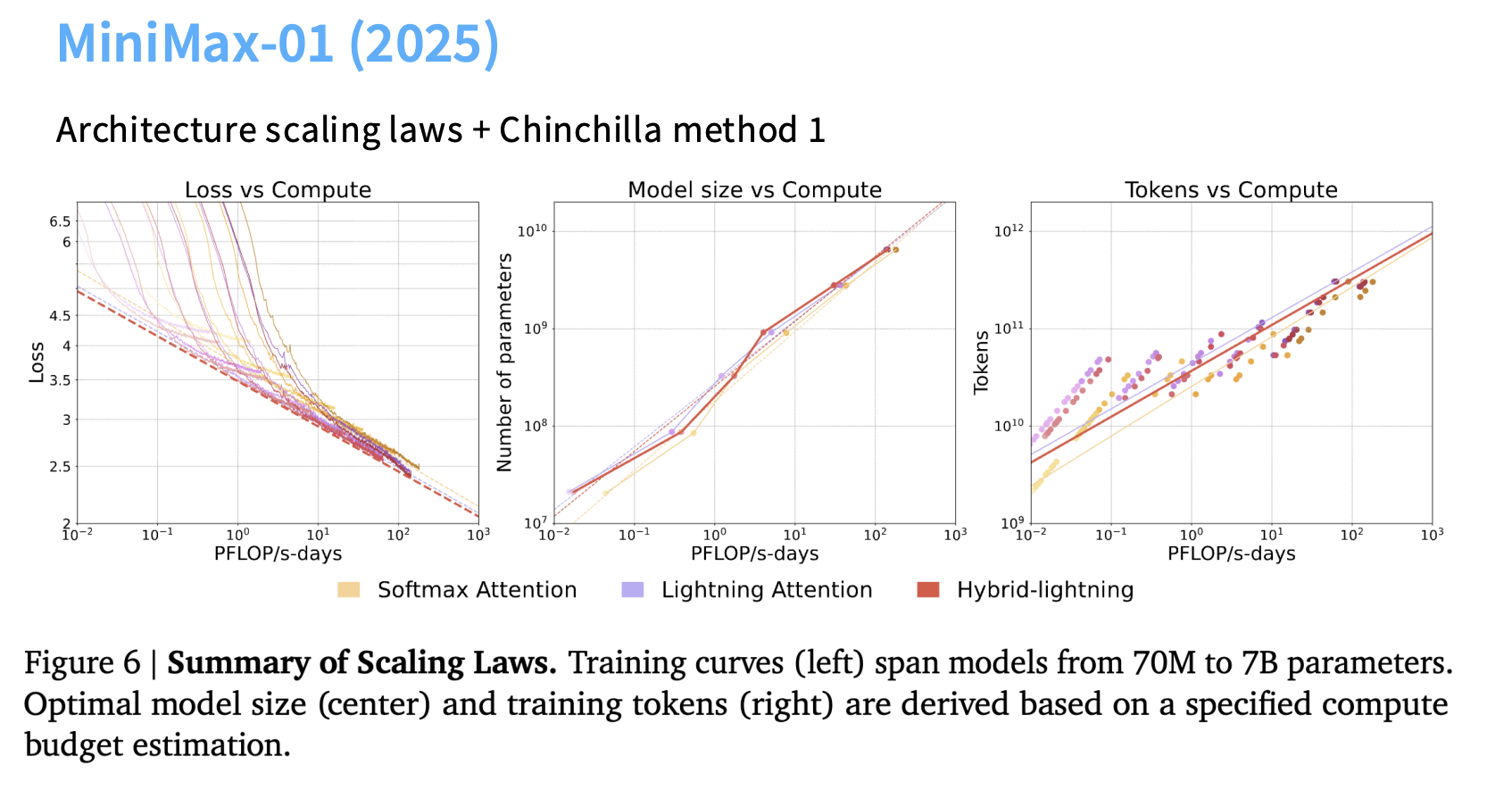
| Minimax-01 | Chinchilla Method 1 | Compared Lightning Attention (linear time) vs Softmax Attention; similar scaling performance | 2025 |
🧮 III. Maximal Update Parametrization (muP) — In-Depth
muP ensures scale-invariant hyperparameters, allowing stable transfer of learning rates and initialization across model sizes.
🧠 Conceptual Basis — Spectral Conditions
muP applies two constraints when scaling network width $( n_l )$:
- A1: Activation Stability
- Activations per coordinate remain Θ(1).
- Initialization variance $( σ )$ must satisfy:
$[ σ^2 = Θ\left(\frac{1}{n_{l-1}} \min(1, \frac{n_l}{n_{l-1}})\right) ]$ - Prevents activation explosion/vanishing.
- A2: Update Stability
- Change in activation per gradient step must remain Θ(1).
- Assuming ΔL = O(1):
- For SGD: $( η_l = Θ(n_l / n_{l-1}) )$
- For Adam: $( η_l = Θ(1 / \text{fan-in}) )$
⚖️ muP vs Standard Parameterization (SP)
| 🔍 Aspect | 🧩 SP | 🚀 muP |
|---|---|---|
| Initialization | $( 1/n_{l-1} )$ | Same base form |
| Learning Rate | Global constant (Θ(1)) | Per-layer, $( 1/\text{fan-in} )$ |
| Stability | Scale-sensitive | Scale-invariant |
| Practical Benefit | Requires LR tuning | Transfers LR across scales |
✅ Empirical Validation
- Transferability: Optimal LR scales reliably (width 128 → 2048).
- Robustness: Works with
- SwiGLU / Squared ReLU
- Varying batch sizes
- Zero-attention inits
- ⚠️ Known Failures:
- Learnable gains in RMSNorm
- Exotic optimizers (e.g., Lion)
- Strong weight decay (≥0.1)
Despite these caveats, muP remains a powerful and practical tool for stable scaling.
🧭 IV. Recap — Scaling in the Wild
Modern scaling efforts face three core challenges:
- 🏗️ Architectural Hyperparameters: Choosing width, depth, and shape.
- ⚙️ Optimizer Hyperparameters: Learning rate, batch size, and stability.
- 💰 Compute Cost: Chinchilla-style sweeps are expensive.
🧩 Strategies by Frontier Labs
| 🧪 Goal | 🔧 Strategy | 🏁 Example |
|---|---|---|
| Hyperparameter Search | Assume muP stability or fit scaling laws from small runs | DeepSeek (fit laws), MiniCPM & CerebrasGPT (muP) |
| Reducing Sweep Cost | Use WSD-like schedules to reuse runs | MiniCPM, DeepSeek |
| Model Sizing | Replicate IsoFLOPS (Method 2) to find optimal token-to-parameter ratio | All major LMs |
💡 Key Takeaway
Scaling laws remain the foundation of efficient model development — but modern practice refines them with muP, WSD, and IsoFLOPS to handle today’s trillion-parameter regimes.
“Scaling smartly is no longer about bigger models — it’s about predictable, stable, and efficient growth.” 🚀
IV 🧮 How to Actually Run a Scaling Law Experiment — Step-by-Step
Scaling laws let researchers predict large model performance and hyperparameters from small, cheap experiments.
This is the blueprint followed by DeepMind, OpenAI, Anthropic, and MiniCPM teams.
🔧 Step 1: Tuning the Learning Rate (LR) and Batch Size (Fixed Dataset)
The first phase focuses on optimizer stabilization — finding the optimal learning rate (LR) and critical batch size (B₍crit₎) for small models trained on a fixed dataset.
🧩 Why Fix the Dataset?
At this stage, we’re isolating optimization dynamics — not data–model tradeoffs.
We want to know how LR and batch scale with model size under identical data and compute settings.
| Setting | Typical Choice | Explanation |
|---|---|---|
| Dataset | Fixed 10B–20B tokens | Keeps experiments consistent |
| Model sizes | 125M → 1B parameters | Cheap but informative |
| Compute | Same order of magnitude | Fair comparison across scales |
⚗️ Step-by-Step
- Train small models (e.g., 125M, 350M, 1B params) on the same dataset.
- Sweep peak learning rates (e.g., 1e-5 → 3e-3) with a standard schedule (cosine, linear, or short WSD).
- Measure validation loss and fit a parabola to find the LR minimizing loss.
- Identify critical batch size (B₍crit₎) — the largest batch before performance plateaus.
| Model Size | Optimal LR | Critical Batch Size |
|---|---|---|
| 125M | 3e-4 | 2K |
| 350M | 2.5e-4 | 4K |
| 1B | 2e-4 | 8K |
🧮 Fit Scaling Laws
You can now fit smooth relations between model size (N) and optimal hyperparameters:
$[ \eta^*(N) \propto N^{-\alpha}, \quad B_{crit}(N) \propto N^{\beta} ]$
These equations tell you how LR and batch scale with model width or depth —
forming the foundation for all later scaling analysis.
💡 Some groups (e.g., MiniCPM) use a short Warmup-Stable-Decay (WSD) schedule here
to separate warmup, flat, and decay phases cleanly — but this is optional in Phase 1.
⚙️ Step 2: Handle Learning Rate Scaling — Two Paths
Once you know how LR behaves with scale, you can choose one of two strategies:
| Path | Method | Description | Example |
|---|---|---|---|
| A. muP (Maximal Update Parametrization) | Scale-invariant LR | Modify initialization and per-layer LR to make a single LR work across all model widths. | MiniCPM, CerebrasGPT |
| B. Empirical Fitting (No muP) | Fit LR scaling law | Directly fit a power-law relation between model size and optimal LR, e.g. (LR \propto m^{-0.25}). | DeepSeek |
- If using μP: You only tune LR once on the smallest model — it transfers automatically.
- If not using μP: Fit the LR vs. size curve empirically and extrapolate to large models.
📈 Step 3: Fit Critical Batch Size Scaling
Batch size scaling is usually log-linear with loss or compute:
$[ \log(B_{crit}) = a + b \cdot \log(L_{target}) ]$ or $[ B_{crit} \propto \text{Compute}^{\beta} ]$
Interpretation:
- Better models (lower loss) → larger $(B_{crit})$
- Fit a straight line in log–log space → extrapolate for large models.
Output: Predicted $(B_{crit})$ for your final large-scale run.
📊 Step 4: Run the Chinchilla IsoFLOP Analysis (WSD Introduced Here ✅)
Now comes the core scaling law experiment — the Chinchilla analysis.
This phase determines the optimal ratio between model parameters (M) and training tokens (N)
for a fixed total compute budget.
🧮 Compute Budget
$[ \text{Total FLOPs} \approx 6 \times M \times N ]$
🧠 Why WSD (Warmup-Stable-Decay)?
Training from scratch for every target data length is too expensive.
WSD enables checkpoint reuse:
- Train once through the stable phase (flat LR in step1).
- Rewind checkpoints to simulate shorter runs.
- Apply a new decay phase for each simulated endpoint.
This lets you explore multiple token budgets from a single run —
cutting Chinchilla sweep compute by 3–5×.
Procedure
- Choose FLOP budgets: e.g., $(10^{20})$–$(10^{24})$ FLOPs.
- Sweep tradeoffs: For each budget, vary $(M)$ and $(N)$ to keep FLOPs constant.
- Plot validation loss vs. model size → the curve is convex.
- Find minima: The loss minimum gives the optimal $(N:M)$ ratio.
Result: Optimal tokens-to-parameter ratio, e.g.
- Chinchilla: 20:1
- LLaMA 3: 39:1
- MiniCPM: 192:1
🚀 Step 5: Scale Up and Train the Final Model
After Phases 1–4, you now have:
- ✅ Stable learning rate scaling (μP or empirical fit)
- ✅ Predicted critical batch size $(B_{crit})$
- ✅ Optimal data–model ratio (from IsoFLOP/Chinchilla analysis)
Apply these to your final large model:
| Parameter | Source | Example |
|---|---|---|
| LR | From μP or power-law fit | $(2.0 \times 10^{-4})$ |
| Batch size | From $(B_{crit})$ scaling | 8K |
| Tokens | From optimal N:M ratio | 70B model → 2.7T tokens |
📊 Example Summary Table
| 🧠 Phase | Goal | Outputs | Example |
|---|---|---|---|
| Phase 1 | Stabilize optimizer, tune LR & batch | μP or empirical LR scaling, $(B_{crit})$ | LR ≈ 3e-4, $(B_{crit})$ ≈ 2K |
| Phase 2 | Joint data–model scaling (IsoFLOP) | Optimal N:M ratio | 39 tokens/param |
| Phase 3 | Final large run | Tokens, compute, and hyperparams | 70B model → 2.7T tokens |
📉 Typical Plots and Results
- Log–log plot: Loss vs. compute (linear trend until saturation).
- Chinchilla curve: Convex loss vs. model size under fixed FLOPs; minimum gives optimal tradeoff.
- Batch scaling curve: Log–linear relation defining (B_{crit}).
Scaling laws demonstrate that the relationship between resources (data, params, compute)
and performance (loss) is remarkably linear on a log–log plot.
Think of it like using a telescope:
studying small, cheap models lets you predict the behavior of massive frontier systems —
with near-astronomical accuracy.