
⚙️ The Predictable World of Scaling Laws in Language Models
Scaling laws provide simple, predictive rules 📈 that govern the performance of Language Models (LMs), offering a pathway to optimize large-scale model design without relying on expensive, full-scale experimentation.
They enable developers to tune hyperparameters on small models and confidently extrapolate to production-scale systems 🚀.
🧠 Part 1: Data Scaling – The Log-Log Linear Relationship
The most fundamental scaling observation is the relationship between dataset size ($n$) and error.
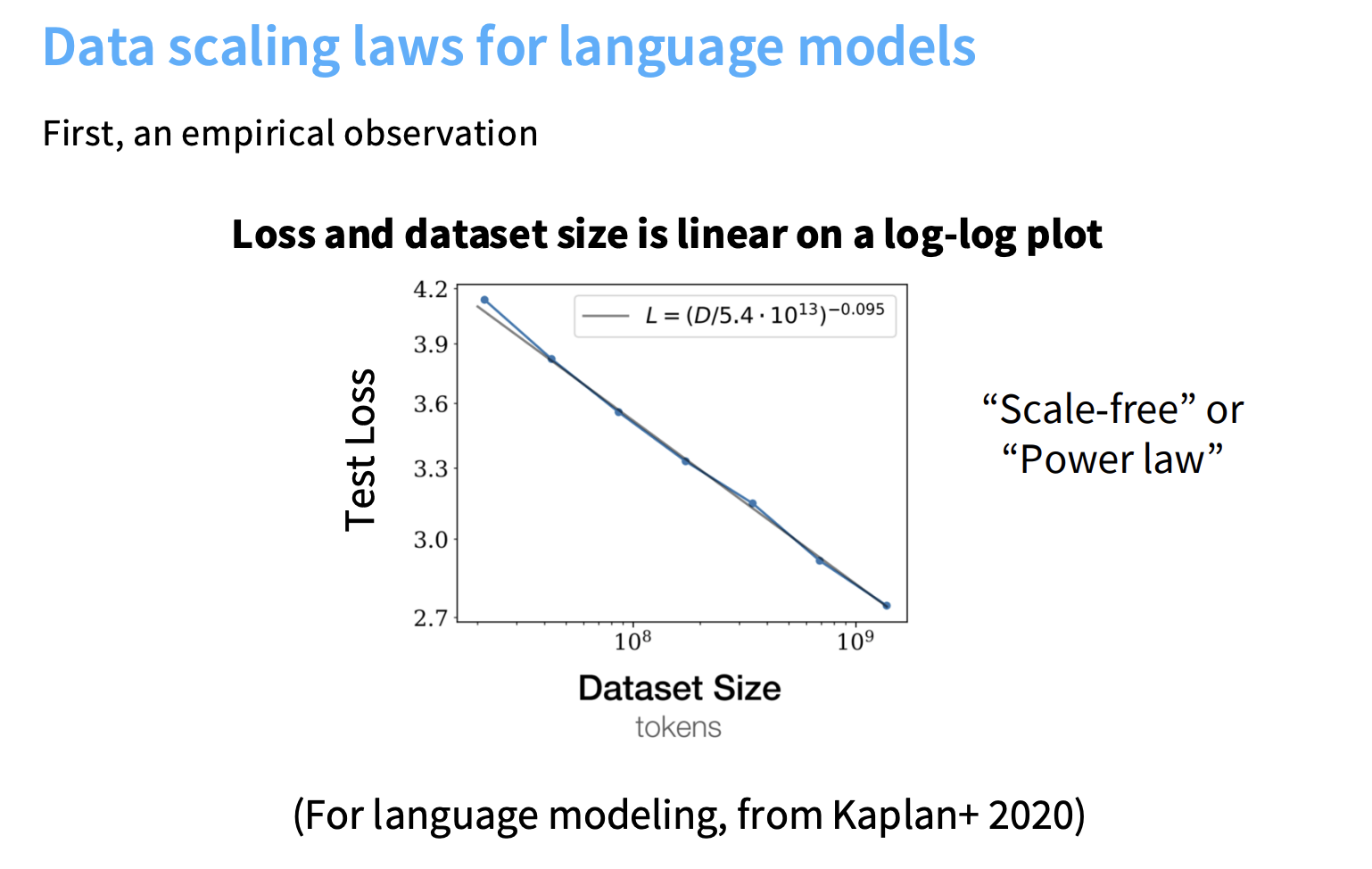
Empirically, plotting test loss vs. dataset size on a log-log scale yields a linear relationship, indicative of power law (scale-free) scaling ⚖️.
🔬 Theoretical Basis
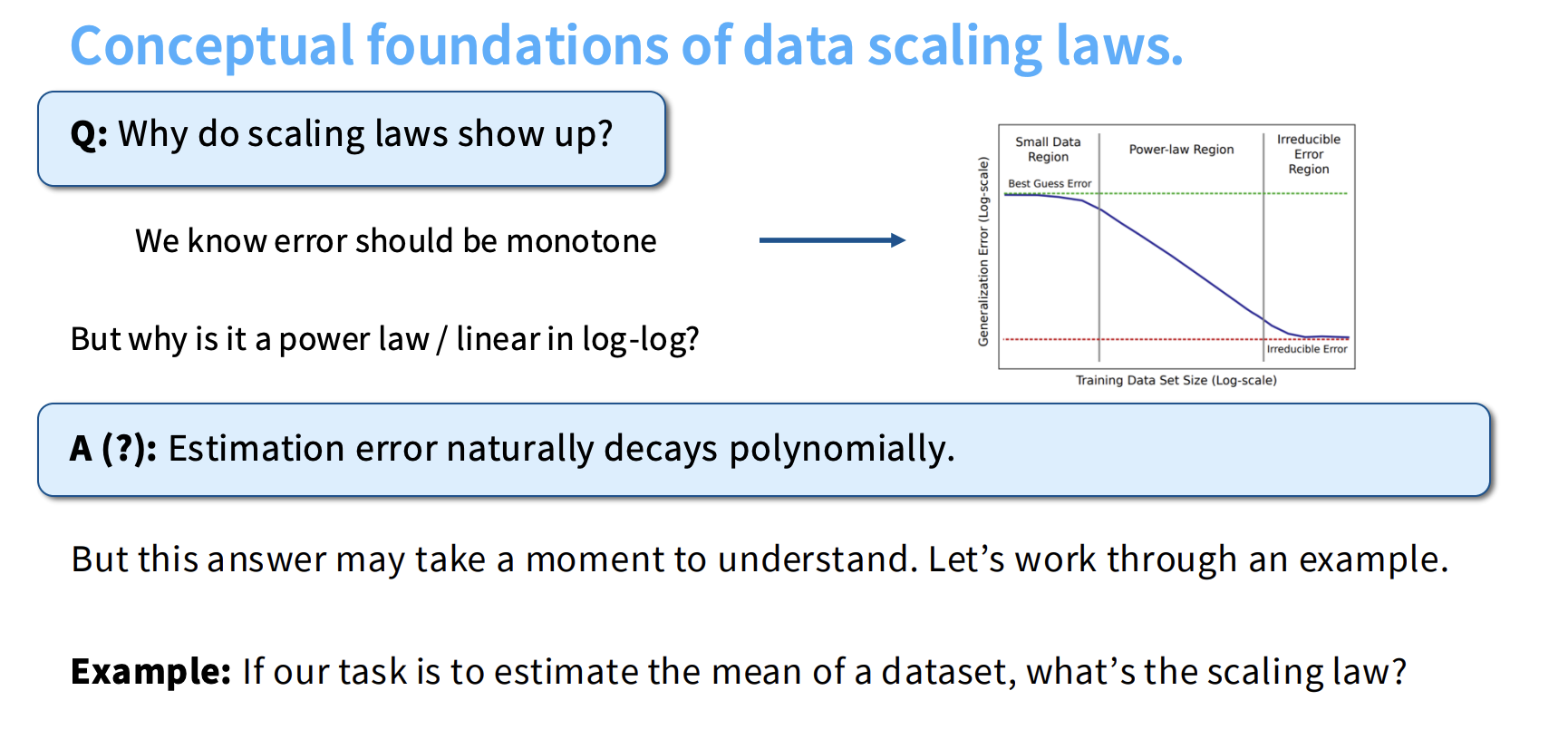
The polynomial decay of estimation error underlies this behavior:
- For simple models (e.g., mean estimation), error decays as $1/n$ → slope of -1.
- For neural networks (flexible, nonparametric models), the decay is much slower ⏳.
🧩 Intrinsic Dimensionality
Observed shallow slopes (e.g., LMs: $\alpha \approx 0.095$) are linked to the intrinsic dimensionality ($d$) of the data manifold.
In nonparametric settings, error scales as $n^{-1/d}$ → slope = −1/d.
This means the scaling exponent reveals the inherent difficulty of the learning task 🎯.
🔍 Key Data Scaling Applications
-
📚 Data Composition:
Affects the offset, not the slope, of the scaling curve.
→ Enables optimal data mixtures using small-scale models. -
🔁 Data Repetition:
When data is reused, diminishing returns occur.
Scaling laws track this via effective data (unique tokens), helping balance between high-quality repeats and new, lower-quality data.
🧮 Understanding Log-Linear Scaling Between Data and Error
One of the most fundamental — yet often misunderstood — ideas in scaling laws is the log-linear relationship between data size and model error (or loss).
📊 What Does “Log-Linear” Mean?
When you train a model and record:
- n → amount of training data (tokens or samples)
- E(n) → resulting error or loss
you’ll find that if you plot log(error) vs. log(data size), the points form a straight line 📈.
That’s what “log-linear” means.
Mathematically, this corresponds to a power law relationship:
$[ E(n) = A \cdot n^{-\alpha} + C ]$
where
- $( A )$ is a scaling constant,
- $( \alpha )$ (alpha) is the scaling exponent,
- $( C )$ is the irreducible error floor.
Taking logs gives:
$[ \log E = \log A - \alpha \log n ]$
which is a linear equation in log-space:
Slope = −α → constant rate of improvement per data doubling.
💡 Intuitive Example
| Data Size (n) | Error (E) | log(n) | log(E) |
|---|---|---|---|
| 1M | 1.0 | 6 | 0.00 |
| 10M | 0.7 | 7 | -0.15 |
| 100M | 0.5 | 8 | -0.30 |
| 1B | 0.35 | 9 | -0.46 |
Plotting these on a log-log scale yields a straight line with slope ≈ −0.15 → the log-linear relationship.
🧠 Why It Matters
This relationship means model improvement with more data is predictable:
- Each data doubling reduces error by a constant multiplicative factor.
- You can train small models to estimate this slope and extrapolate performance for larger data sizes — saving huge compute costs.
In large language models (Kaplan et al., 2020; Chinchilla, 2022),
the scaling exponent ( \alpha ) ≈ 0.095, indicating a shallow but consistent improvement.
⚖️ Data Scaling vs. Joint Data–Model Scaling
Now comes the subtle — but crucial — point:
Does log-linear scaling hold if we only increase data? Or do we need to grow the model too? 🤔
🧩 Pure Data Scaling (Fixed Model)
If the model size stays fixed and you increase data:
$[ E(n) = A \cdot n^{-\alpha} + C ]$
✅ You’ll initially see log-linear improvement.
But after a point, the model saturates — it can’t absorb more information.
Think of the model as a bucket 🪣 and data as water 💧:
- A small bucket can only hold so much.
- Beyond that, pouring more data doesn’t help — it just spills over.
- Similarly, after the saturation point, the curve flattens and scaling breaks.
🧠 The Joint Data–Model Scaling Law
To stay in the linear regime, both data size and model size must scale together.
The general form is:
$[ E(n, m) = n^{-\alpha} + m^{-\beta} + C ]$
where $( m )$ = model size (parameters).
Empirically, optimal performance follows a near-linear relationship:
$[ n_{\text{optimal}} \propto m ]$
This means:
📏 The amount of data should increase proportionally to model size
to maintain predictable power-law improvement.
🧮 The Chinchilla Rule of Thumb
From Hoffmann et al. (2022, Chinchilla):
- For compute-optimal training, the best ratio is roughly
20 tokens per parameter.
This is the “Chinchilla ratio”, balancing data and model size so the model learns efficiently.
Modern LLMs (like Llama 3) deliberately use more data (≈215 tokens/param) —
this “overtraining” trades higher training cost for lower inference cost later on 💰.
🧭 Practical Summary
| Scenario | Model | Data | Effect |
|---|---|---|---|
| 🟢 Increase data, fixed model | Constant | ↑ | Initial log-linear gain → then saturation |
| 🟠 Increase model, fixed data | ↑ | Constant | Improves until overfitting or wasted capacity |
| 🔵 Increase both proportionally | ↑ | ↑ | Sustains clean power-law scaling → optimal efficiency |
🧩 TL;DR
| Concept | Meaning |
|---|---|
| Log-linear (data scaling) | On a log-log plot, error decreases linearly with data size (power law) |
| Saturation | When the model is too small to use more data effectively |
| Joint scaling law | Data and model size must grow together for efficient scaling |
| Optimal ratio | ≈ 20 tokens per parameter (Chinchilla) |
| Modern trend | Overtraining (e.g., Llama 3 uses ~215 tokens/param) for inference efficiency |
💬 In short:
“Scaling laws are linear in log-space — but only if you scale data and model together.
Stop pouring water into a small bucket; build a bigger one.”
🧩 Part 2: Model Engineering via Extrapolation
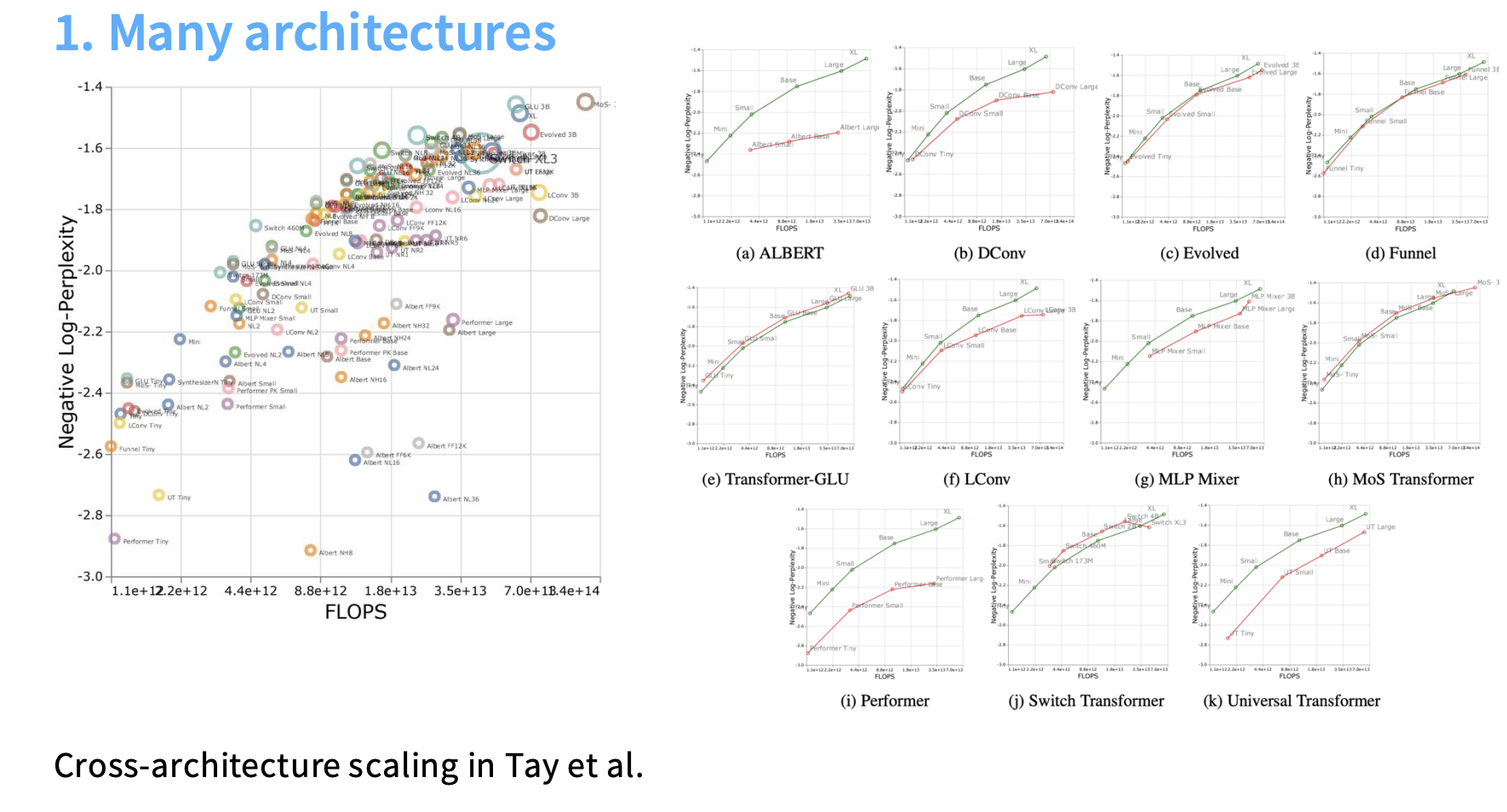
Scaling laws offer a roadmap 🗺️ for selecting architectures, optimizers, and aspect ratios (depth/width) using small-scale training.
| ⚙️ Hyperparameter | 💡 Scaling Law Insight |
|---|---|
| Architecture | Transformers show a constant factor compute advantage over LSTMs. Newer designs (GLU, MoE) may outperform across compute budgets. |
| Optimizer | Choice (e.g., ADAM vs. SGD) yields predictable constant factor efficiency gaps. |
| Depth/Width | Beyond 2 layers → diminishing returns 📉. Embedding layers behave differently and should be analyzed separately. |
| Batch Size ($B_{crit}$) | Strong diminishing returns past the Critical Batch Size. Larger models require proportionally larger batches to reach lower loss. |
| Learning Rate (LR) | Optimal LR is scale-dependent. 🧮 |
| muP (Maximal Update Parametrization) makes LR stable across model sizes → easy small-to-large transfer. |
⚠️ Caution:
Training loss (e.g., perplexity) scales predictably, but downstream performance may not follow the same clean log-linear pattern.
🧮 Batch Size and Diminishing Returns
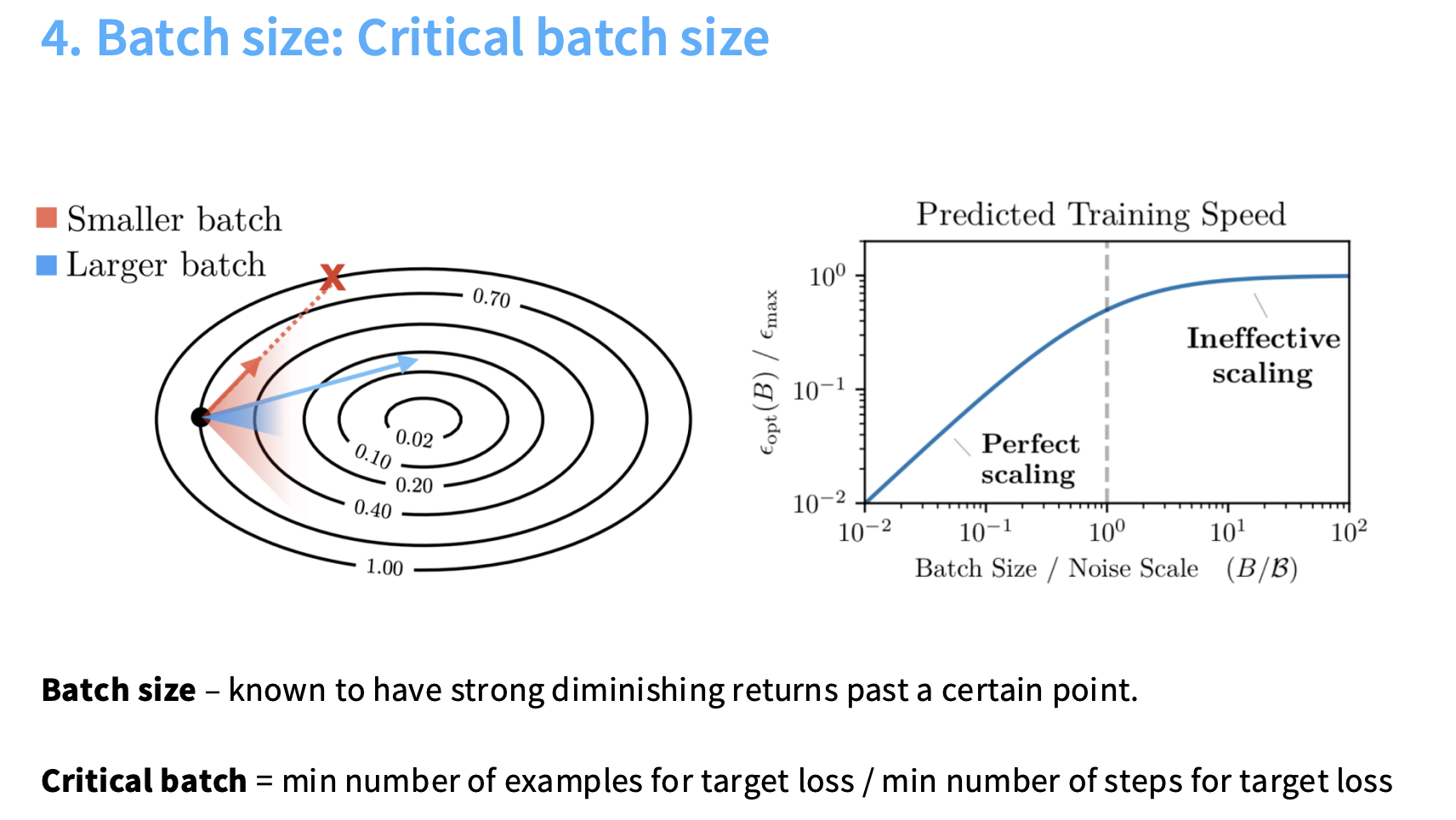
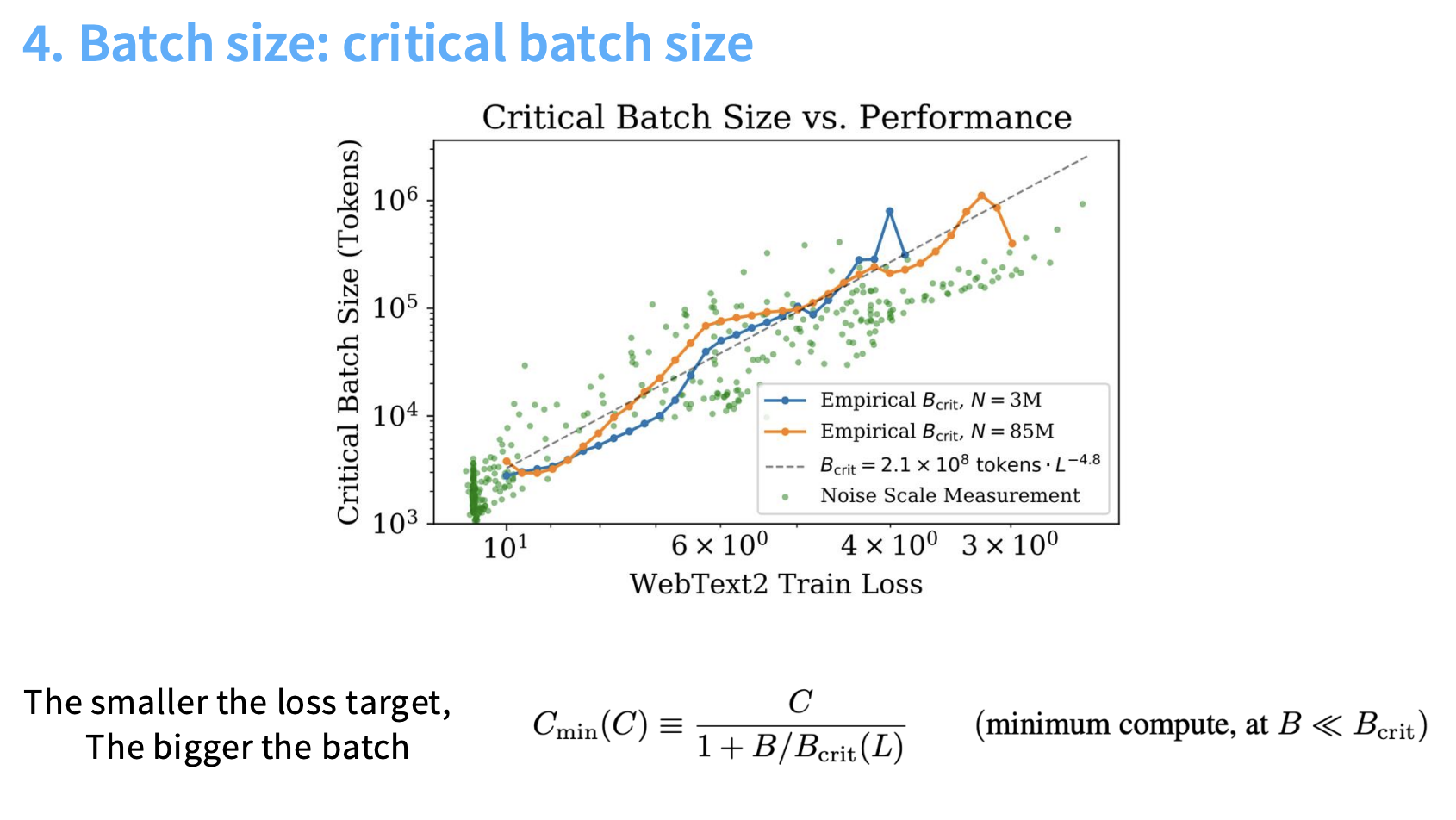
The fundamental observation regarding batch size is that it exhibits strong diminishing returns past a certain point. This behavior defines two distinct regimes of scaling efficiency:
-
Efficient Scaling Regime
When the batch size is smaller than the noise scale, increasing the batch size is almost equivalent to taking more gradient steps.
→ This is the ideal scenario, allowing practitioners to leverage data parallelism while maintaining the optimization efficiency of more gradient updates. -
Ineffective Scaling Regime
Once the batch size becomes comparable to the noise scale, additional samples in the batch no longer reduce useful noise.
→ Optimization progress becomes dominated by the curvature of the loss landscape (bias term) rather than noise reduction, leading to strong diminishing returns.
🧠 The Critical Batch Size ((B_{\text{crit}}))
The Critical Batch Size ($(B_{\text{crit}})$) marks the boundary between these two regimes.
It is defined as the threshold where scaling transitions from efficient to inefficient.
Formally:
$[ B_{\text{crit}} = \frac{\text{minimum number of examples for target loss}}{\text{minimum number of steps for target loss}} ]$
In theoretical analyses, $(B_{\text{crit}})$ relates to the gradient noise expected from random sampling within the batch — serving as a useful analytical quantity to understand training dynamics.
📉 Scaling of $(B_{\text{crit}})$ with Loss Target
A key insight from scaling analysis is that the critical batch size itself scales predictably as a function of the target loss.
Empirically:
The smaller the target loss, the larger the batch size that can be effectively utilized.
This means that as models train and their loss decreases (i.e., they become better), the optimal batch size grows.
Intuition:
- When aiming for a very low loss, optimization becomes more sensitive.
- Gradients need to be more precise (de-noised).
- A larger batch size provides this de-noising — similar to how the learning rate is reduced later in training.
🧩 Practical Implications
Understanding $(B_{\text{crit}})$ is crucial for resource allocation and scaling efficiency in large-scale training.
When increasing both compute and model size, engineers face a trade-off:
- Use larger batches with fewer steps
vs. - Use smaller batches with more steps.
Scaling analyses suggest that as compute increases, reasonable parallelism can be achieved:
The number of total training steps can stay roughly constant while the batch size grows.
This efficient trade-off — where resource investment enables larger batches without a proportional increase in steps — represents good news for data-parallel training at scale.
🚀 Learning Rate Scaling and Maximal Update Parametrization (muP)
The sources provide detailed context on the importance of the learning rate (LR) in scaling large language models (LMs) and introduce Maximal Update Parametrization (muP) as a novel solution to stabilize the optimal learning rate across different model sizes.
⚠️ The Challenge of Learning Rate Scaling
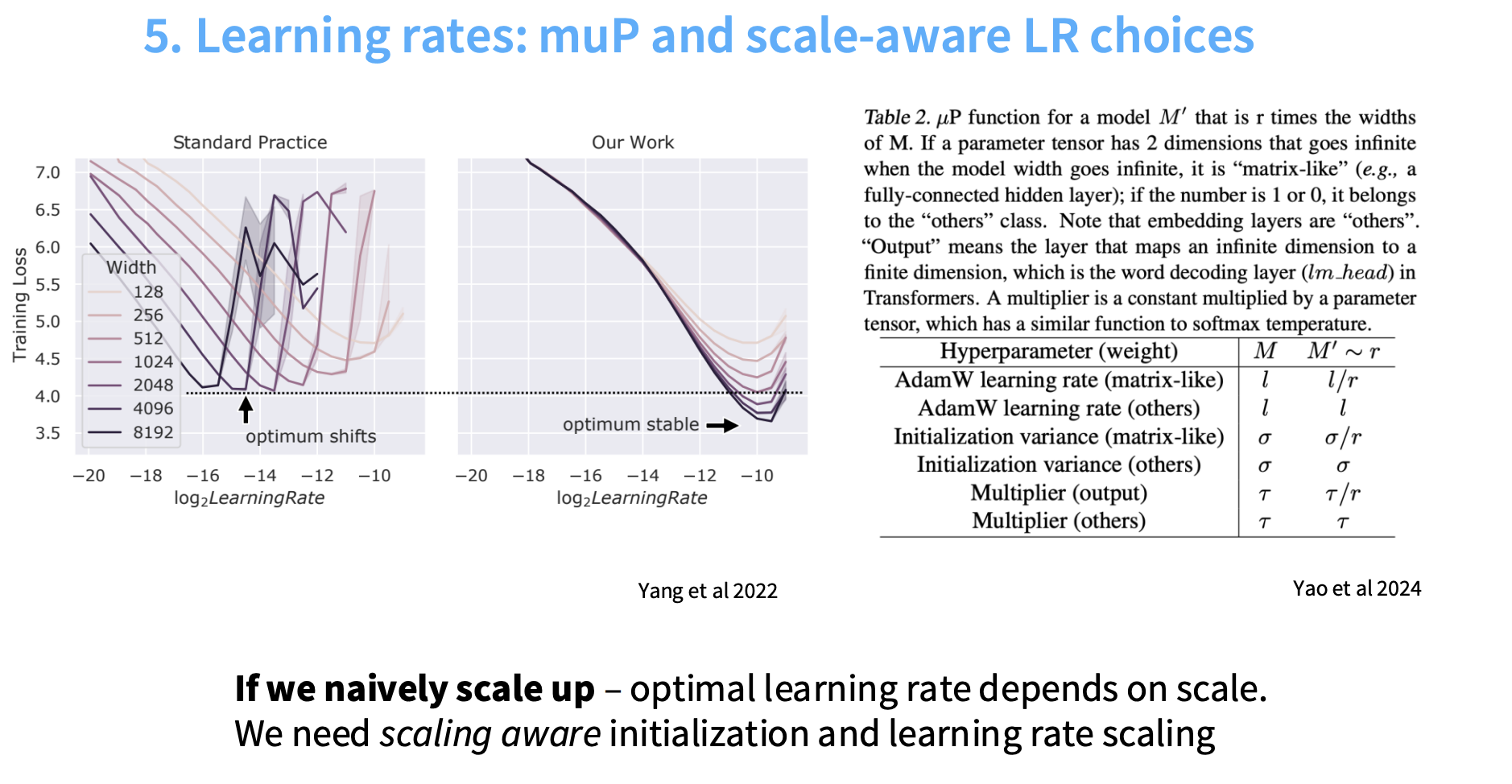
When training large language models — particularly standard Transformer architectures — the optimal learning rate is not stable across scales. It depends on model width and depth, making it scale-dependent.
🧩 Standard Practice
In traditional parameterization (the default used in most deep learning frameworks):
- When you scale up a model (making it wider or deeper), the optimal learning rate changes with size.
- Specifically, as the model width increases (e.g., larger MLP dimensions), the optimal LR decreases — often following a rough inverse relationship with width (∝ 1/width).
- Conversely, smaller models tolerate larger learning rates.
- Practitioners sometimes fit an empirical scaling law for learning rate vs. model size to predict good hyperparameters.
This dependency implies that a learning rate tuned on a small model cannot be directly transferred to a much larger one.
That breaks one of the core goals of scaling laws — to tune hyperparameters efficiently on small models and then extrapolate to large models.
🧠 Maximal Update Parametrization (muP)
To overcome this instability, researchers proposed Maximal Update Parametrization (muP) — a principled method for scaling-aware initialization and learning rate design.
🎯 Goal of muP
muP aims to reparameterize the model such that the optimal learning rate remains constant across different model widths.
In other words:
Tune the learning rate once on a small model → use the same LR for a much larger model without retuning.
⚙️ Mechanism of muP
Under the muP framework, several scaling rules are applied depending on model width:
-
Scaling Initialization
The variance of parameter initialization is adjusted as a function of width.
(Ensures gradients and activations stay in a stable range as models widen.) -
Scaling Learning Rates
Learning rates of parameters in different layers (e.g., weights vs. biases) are scaled differently to maintain consistent update magnitudes. -
Scaling Forward Paths
The output of certain layers is multiplied by width-dependent scale factors so that signal propagation remains balanced across scales.
If these adjustments are implemented correctly, the model’s parameterization becomes scale-aware — meaning gradient magnitudes, signal propagation, and update sizes all behave consistently across model sizes.
🧩 Practical Benefits of muP
The main benefit of muP is stability and transferability of hyperparameters:
- You can tune the learning rate once on a small prototype model.
- The same learning rate will remain optimal (or near-optimal) as you scale to larger models.
- This saves huge amounts of compute and simplifies large-scale experiments.
While in theory muP makes the LR exactly scale-invariant, in practice it achieves highly predictable scaling — a major step toward reproducible and efficient LM training.
🔬 Extensions and Future Directions
Since muP’s introduction, similar ideas have appeared, such as Meta’s “meta-p” parameterization (reportedly used in Llama 4), suggesting an active research focus across labs on stabilizing learning rates during scaling.
✅ Summary
| Concept | Description |
|---|---|
| Problem | Learning rate changes unpredictably with model size (larger → smaller LR) |
| Solution (muP) | Reparameterize model and scale initialization, learning rates, and activations by width |
| Goal | Make the optimal learning rate stable across model sizes |
| Benefit | Tune once on small models → reuse LR at large scale |
| Trend | Research continues (e.g., Meta’s “meta-p”) to improve cross-scale training stability |
⚖️ Part 3: Joint Scaling and Optimal Compute Tradeoffs
A key question:
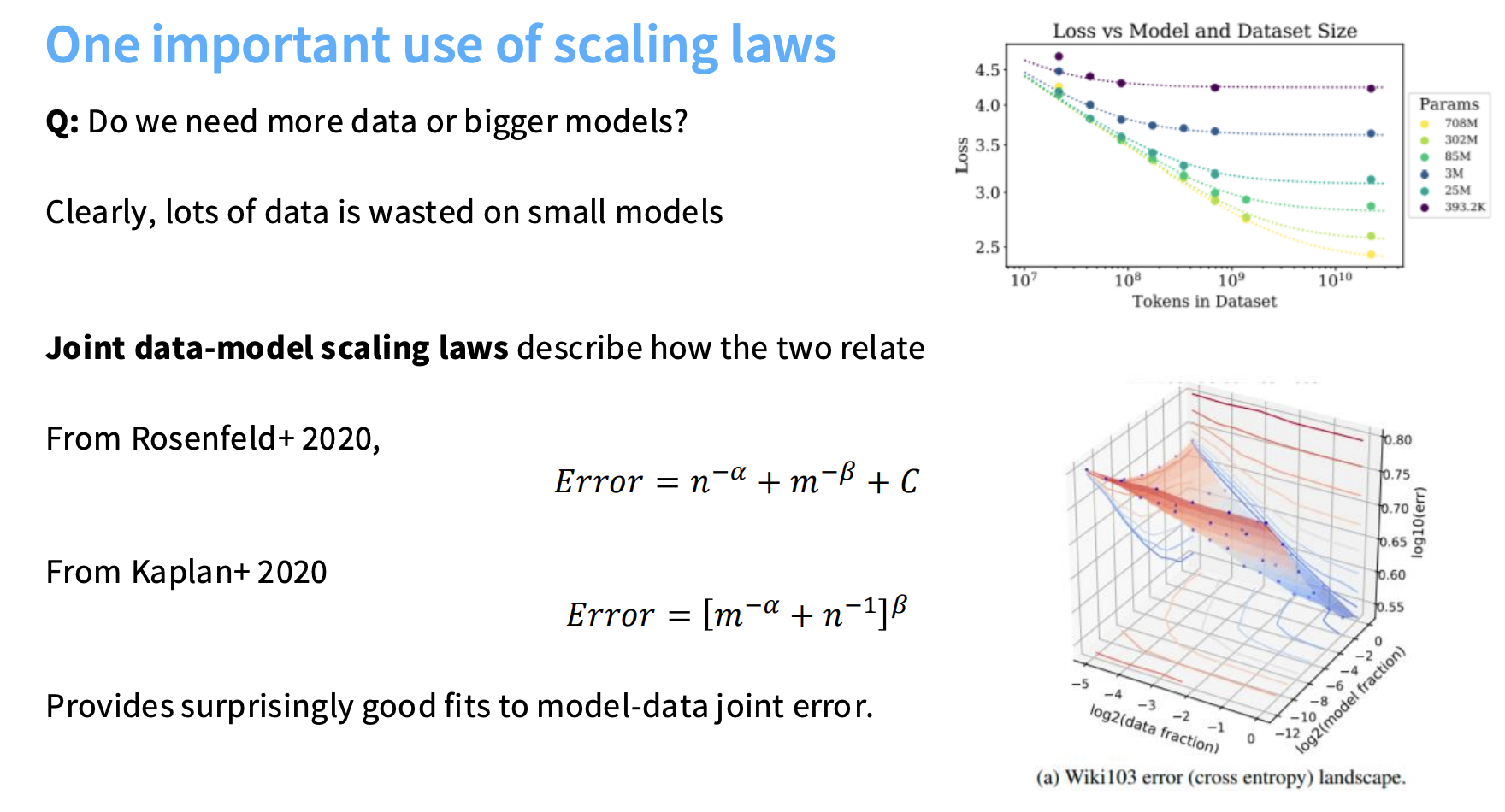
🧮 Should we prioritize more data ($n$) or bigger models ($m$)?
📈 Joint Scaling Laws
Model error can be expressed as:
\(E = n^{-\alpha} + m^{-\beta} + C\)
This joint formulation allows optimal allocation of compute between data and parameters.
🧮 The Chinchilla Principle (Hoffman et al. 2022)
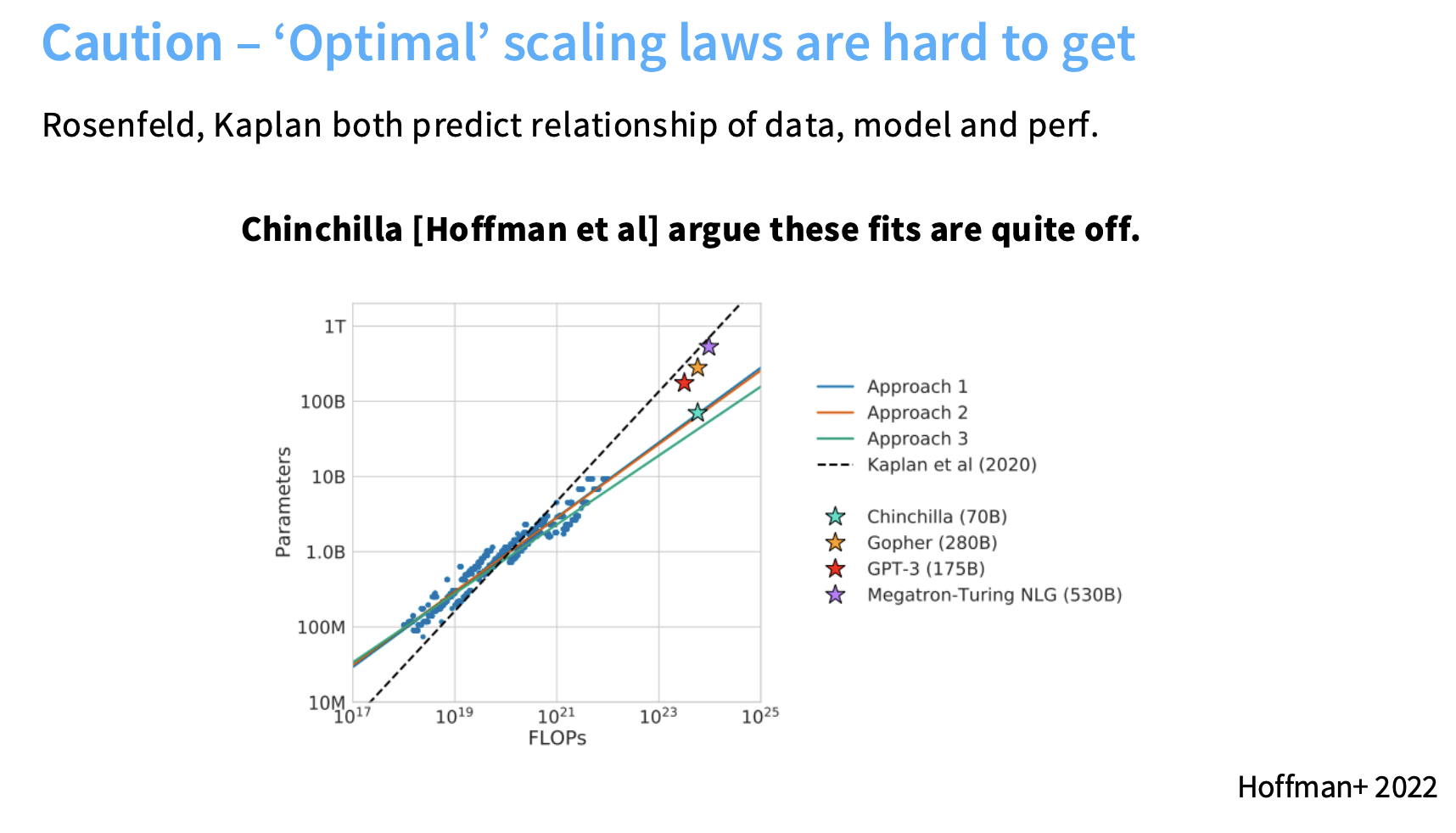
The Chinchilla paper (Hoffmann et al., 2022) is a pivotal work in the study of scaling laws, focusing on how to determine the optimal tradeoff between model size (m) and data size (n) for a fixed compute budget.
🎯 Core Motivation
The central question Chinchilla addressed:
For a fixed amount of compute (total FLOPs), should we train a larger model for fewer steps, or a smaller model for more steps?
Earlier large models like GPT-3 were undertrained for their size — they had too many parameters and too little data.
Chinchilla set out to find the compute-optimal configuration that yields the best model for a given training budget.
⚔️ Challenging Earlier Scaling Estimates
Before Chinchilla, earlier works such as Rosenfeld (2020) and Kaplan (2020) proposed empirical joint scaling laws between data, model, and error. However, Chinchilla argued those fits were inaccurate due to methodological flaws.
🧩 Key Issue: Learning Rate Schedules
One major source of error was the improper handling of learning rate schedules:
- Many models in earlier studies were trained with cosine decay schedules but not run to completion.
- Truncating such training early produces undertrained models, which are not equivalent to models trained fully at that compute level.
- This led to incorrect scaling ratios between data and model size.
By running all models to completion, Chinchilla corrected this and derived much more accurate scaling constants.
⚖️ The Chinchilla Optimal Ratio
The Chinchilla analysis produced the now-famous optimal ratio:
20 tokens per parameter
This ratio reflects the optimal balance between model size (parameters) and data size (tokens) for a fixed compute budget.
In practical terms:
- A model with 1B parameters should ideally be trained on 20B tokens.
- This ensures no undertraining (too little data) and no overtraining (too much data) for the available compute.
🧮 Methods for Fitting Scaling Laws
The Chinchilla authors described three main methods for empirically deriving these scaling relationships.
They found methods 1 and 2 produced consistent, reliable results, while method 3 required later correction.
Method 1 – Minimum over Runs
- Train many models of varying sizes across multiple total FLOP budgets.
- For each configuration, track the minimum validation loss achieved.
- The lower envelope (minimum over all runs) forms a clean power-law curve with compute.
- The parameter sizes corresponding to these optimal points follow predictable scaling relationships.
Method 2 – IsoFLOPs (Canonical Method)
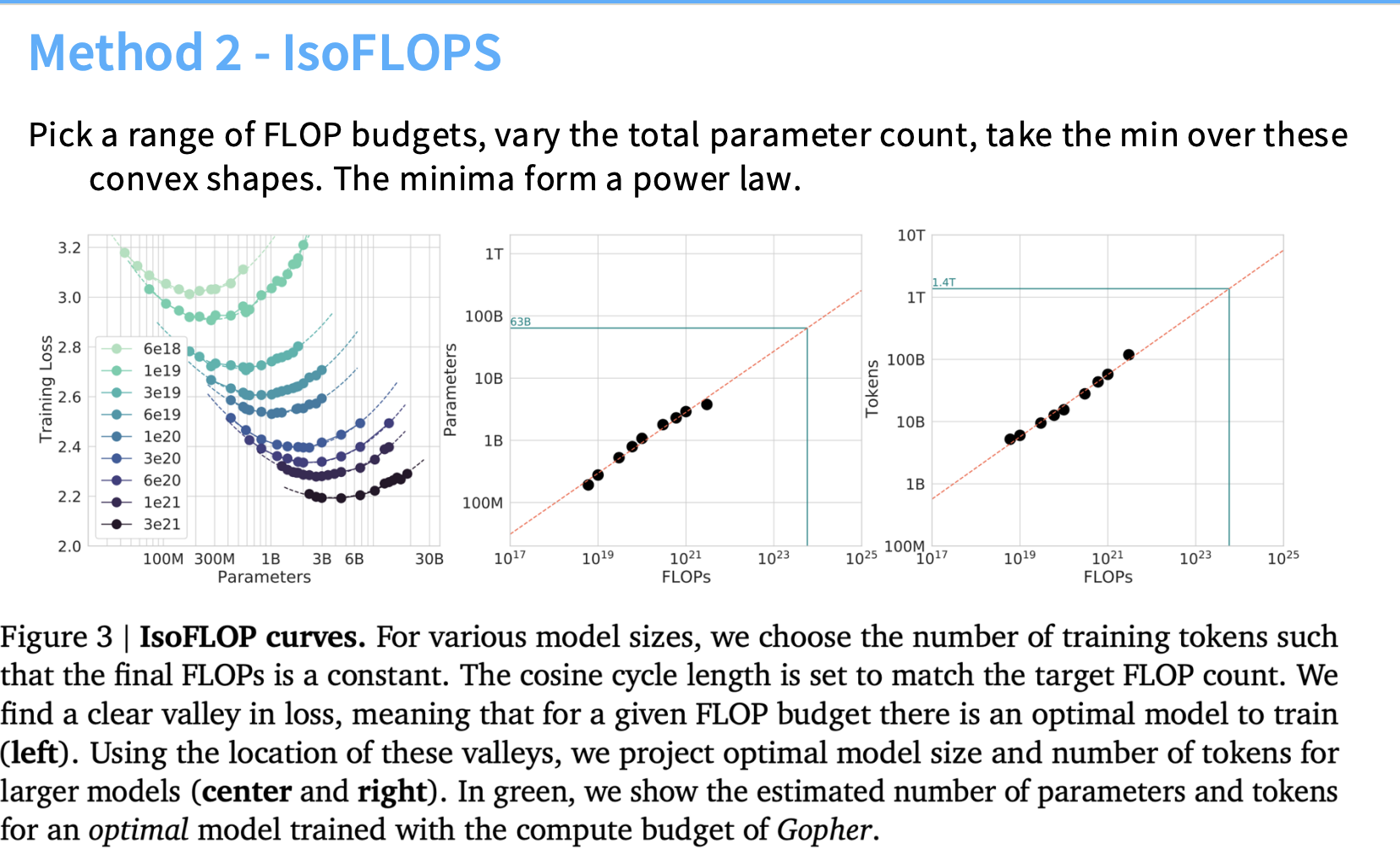
This is the canonical Chinchilla method and is conceptually simple:
- Fix a total compute budget (FLOPs).
- Sweep across model sizes (m), adjusting data size (n) so that total compute remains constant.
- For each compute level, this produces a convex loss curve as a function of model size.
- The minimum of this curve (found via fitting) gives the optimal tradeoff between data and parameters.
- Repeating this across multiple compute budgets yields a smooth scaling law that reveals the optimal tokens-per-parameter ratio.
✅ Methods 1 and 2 produced consistent results confirming the 20:1 ratio.
Method 3 – Joint Fits
This method fits a joint scaling law of the form:
$[ E = n^{-\alpha} + m^{-\beta} + C ]$
- Involves training a grid of models across multiple ( (m, n) ) combinations.
- Fit the above function via least squares regression to derive exponents and constants.
- Initially flawed due to residual errors in the fitting process.
- Later replications corrected the errors, confirming that this method also matched results from Methods 1 and 2.
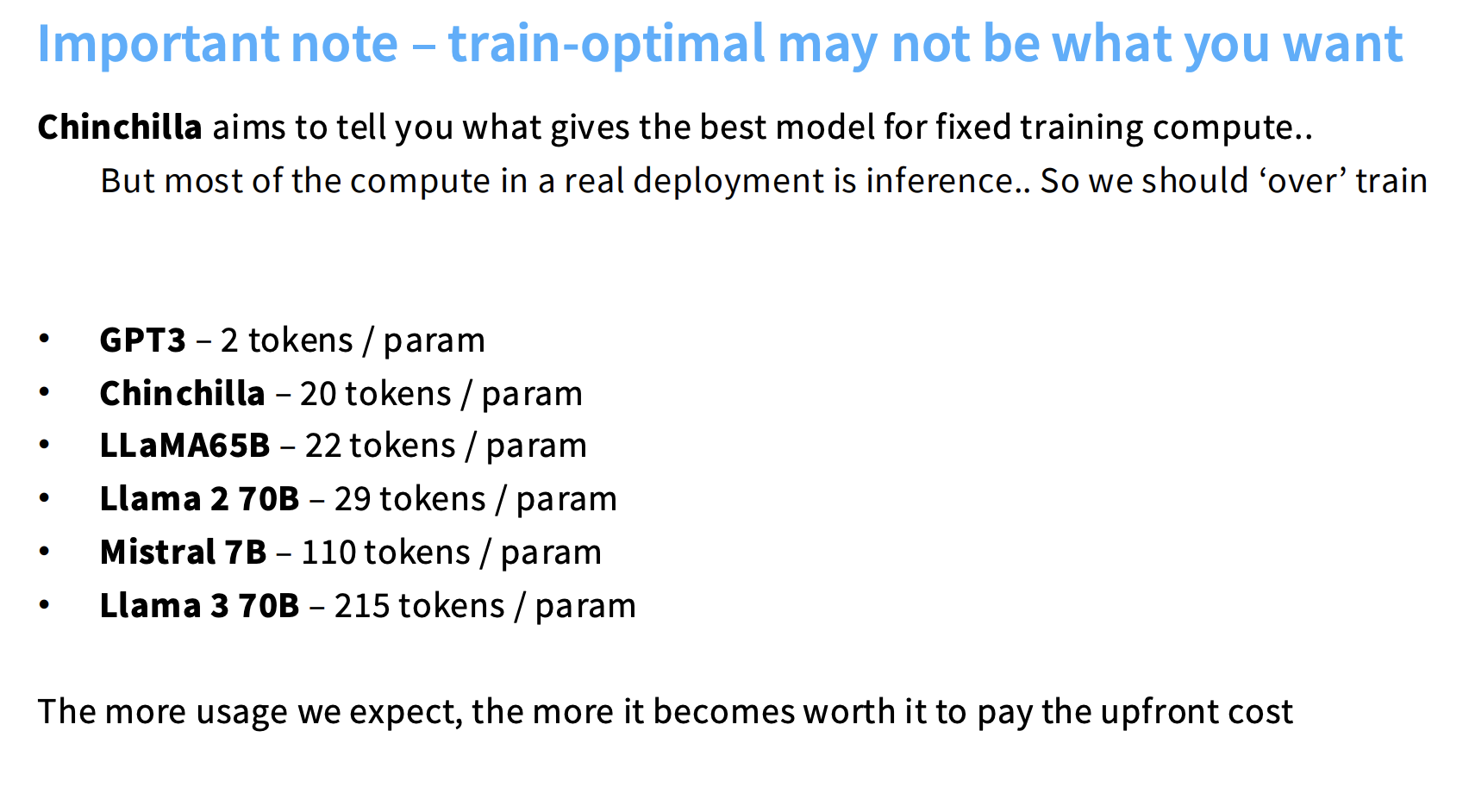
🧩 Train-Optimal vs. Inference-Optimal Models
A key distinction from Chinchilla is between:
| Type | Optimization Focus | Typical Use |
|---|---|---|
| Train-Optimal | Best performance for a fixed training compute | Research training curves, scaling analysis |
| Inference-Optimal | Best deployment efficiency for given inference cost | Production LLMs (e.g., Llama, Claude, Gemini) |
While Chinchilla determined the train-optimal configuration,
modern LLMs are increasingly designed for inference-optimal efficiency.
💡 That means —
Companies overtrain models (use far more tokens than 20× parameters) to make them smaller, faster, and cheaper at inference time.
📊 Examples of Token-to-Parameter Ratios
| Model | Tokens / Parameter Ratio |
|---|---|
| GPT-3 | 2 : 1 |
| Chinchilla (optimal) | 20 : 1 |
| Llama 3 70B | 215 : 1 |
Modern models often operate far above the Chinchilla ratio, trading extra training compute for massive inference efficiency gains.
💰 The Economic View of Scaling Laws
Scaling laws — especially those revealed by Chinchilla — function like economic optimization models for AI training:
Instead of blindly throwing compute at bigger models, they tell us how to invest compute most efficiently — balancing model size and data size to maximize performance under a strict budget.
This concept has become a cornerstone of efficient foundation model training strategies across all major AI labs.
💬 “Scaling laws turn deep learning from trial-and-error into engineering.”
— paraphrased from the lecture’s closing message