
LLM Alignment - GRPO Implementation
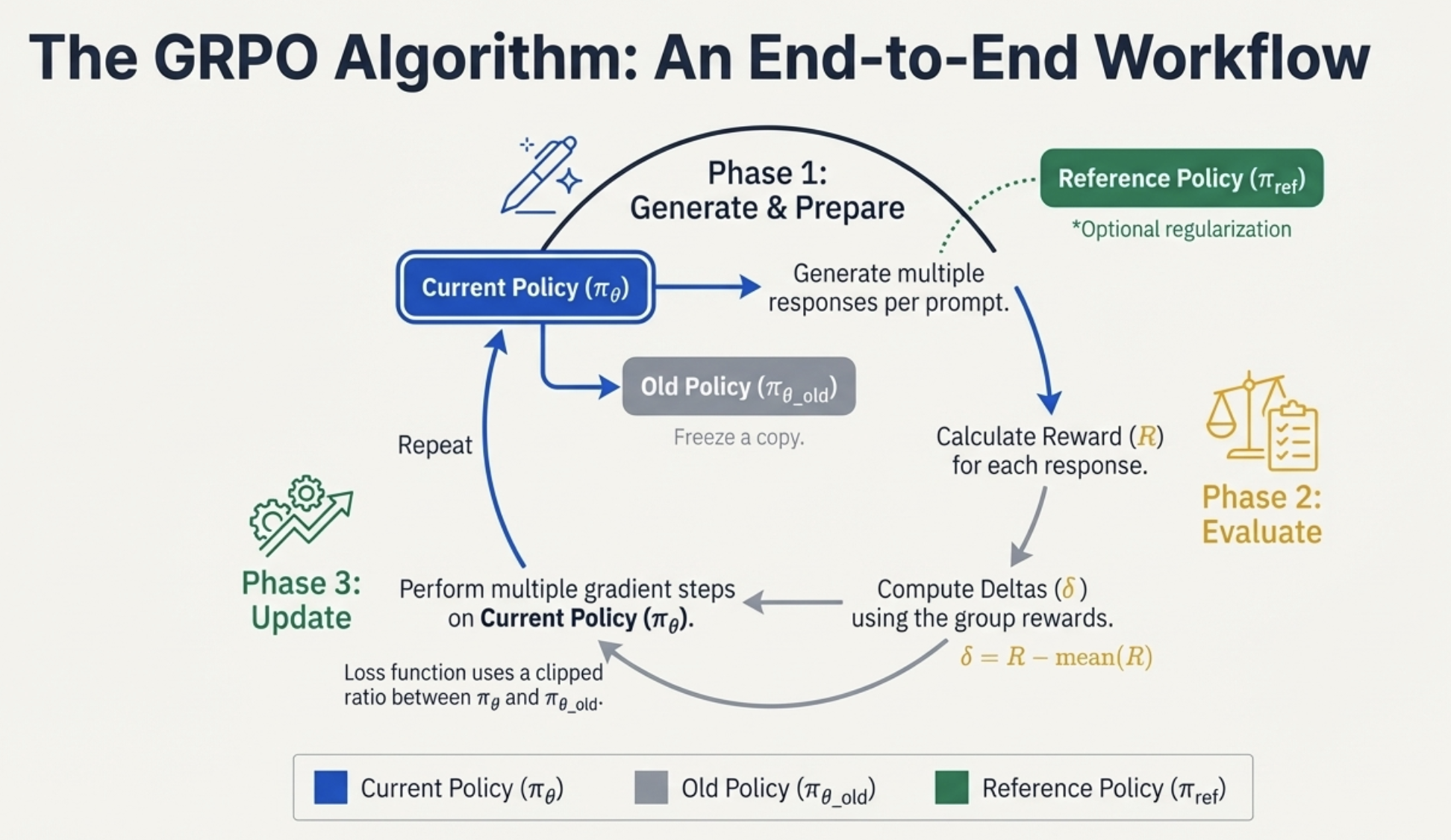
The blog transitions to a practical walkthrough illustrating policy gradient mechanics through the lens of GRPO (Group Relative Policy Optimization).
GRPO simplifies PPO by removing the Value function (critic) and instead leveraging the group structure of LLM rollouts — i.e., multiple responses per prompt — to compute baselines internally.
1. The Simple Task and Reward Design
A toy example is used where a simple, non-autoregressive model learns to sort $n$ numbers.
Task Definition
def sort_distance_reward(prompt: list[int], response: list[int]) -> float:  # @inspect prompt, @inspect response
    """
    Return how close response is to ground_truth = sorted(prompt).
    In particular, compute number of positions where the response matches the ground truth.
    """
    assert len(prompt) == len(response)
    ground_truth = sorted(prompt)
    return sum(1 for x, y in zip(response, ground_truth) if x == y)

def sort_inclusion_ordering_reward(prompt: list[int], response: list[int]) -> float:  # @inspect prompt, @inspect response
    """
    Return how close response is to ground_truth = sorted(prompt).
    """
    assert len(prompt) == len(response)
    # Give one point for each token in the prompt that shows up in the response
    inclusion_reward = sum(1 for x in prompt if x in response)  # @inspect inclusion_reward
    # Give one point for each adjacent pair in response that's sorted
    ordering_reward = sum(1 for x, y in zip(response, response[1:]) if x <= y)  # @inspect ordering_reward
    return inclusion_reward + ordering_reward

def simple_task():
    # Task: sorting n numbers
    # Prompt: n numbers
    prompt = [1, 0, 2]
    # Response: n numbers
    response = [0, 1, 2]
    # Reward should capture how close to sorted the response is.
    # Define a reward that returns the number of positions where the response matches the ground truth.
    reward = sort_distance_reward([3, 1, 0, 2], [0, 1, 2, 3])  # @inspect reward
    reward = sort_distance_reward([3, 1, 0, 2], [7, 2, 2, 5])  # @inspect reward  @stepover
    reward = sort_distance_reward([3, 1, 0, 2], [0, 3, 1, 2])  # @inspect reward  @stepover
    # Define an alternative reward that gives more partial credit.
    reward = sort_inclusion_ordering_reward([3, 1, 0, 2], [0, 1, 2, 3])  # @inspect reward
    reward = sort_inclusion_ordering_reward([3, 1, 0, 2], [7, 2, 2, 5])  # @inspect reward  @stepover
    reward = sort_inclusion_ordering_reward([3, 1, 0, 2], [0, 3, 1, 2])  # @inspect reward  @stepover
    #Note that the second reward function provides more credit to the 3rd response than the first reward function.
Reward Components
- The goal is to define a reward that provides partial credit to mitigate the sparse reward problem.
- Two types of reward components are defined:
- Inclusion reward: Gives points for tokens from the prompt that appear in the response.
- Ordering reward: Gives points for adjacent token pairs that are correctly sorted.
This yields a scalar reward $R$ for each sampled completion.
2. Computing Deltas ($\delta$)
Different formulations for the advantage-like quantity $\delta$ are explored:
Centered Rewards
\(\delta = R - \mu_{\text{group}}\) Here $\mu_{\text{group}}$ is the mean reward within the group (responses to the same prompt).
- If all rewards are equal → no update occurs.
- Centering stabilizes training by pushing the model away from below-average completions.
- Normalized Rewards (GRPO style): \(\delta = \frac{R - \mu_{\text{group}}}{\sigma_{\text{group}}}\) Dividing by the group’s standard deviation $\sigma_{\text{group}}$ makes the update scale-invariant to reward magnitudes.
Max Rewards
\(\delta = \begin{cases} R - \mu_{\text{group}}, & \text{if } R = \max(R_{\text{group}}) \\ 0, & \text{otherwise} \end{cases}\) Only the best-performing completions in a group receive gradient updates — helping the model focus on “top answers” instead of partial-credit responses.
def compute_reward(prompts: torch.Tensor, responses: torch.Tensor, reward_fn: Callable[[list[int], list[int]], float]) -> torch.Tensor:
    """
    Args:
        prompts (int[batch pos])
        responses (int[batch trial pos])
    Returns:
        rewards (float[batch trial])
    """
    batch_size, num_responses, _ = responses.shape
    rewards = torch.empty(batch_size, num_responses, dtype=torch.float32)
    for i in range(batch_size):
        for j in range(num_responses):
            rewards[i, j] = reward_fn(prompts[i, :], responses[i, j, :])
    return rewards

def compute_deltas(rewards: torch.Tensor, mode: str) -> torch.Tensor:  # @inspect rewards
    """
    Args:
        rewards (float[batch trial])
    Returns:
        deltas (float[batch trial]) which are advantage-like quantities for updating
    """
    if mode == "rewards":
        return rewards
    if mode == "centered_rewards":
        # Compute mean over all the responses (trial) for each prompt (batch)
        mean_rewards = rewards.mean(dim=-1, keepdim=True)  # @inspect mean_rewards
        centered_rewards = rewards - mean_rewards  # @inspect centered_rewards
        return centered_rewards
    if mode == "normalized_rewards":
        mean_rewards = rewards.mean(dim=-1, keepdim=True)  # @inspect mean_rewards
        std_rewards = rewards.std(dim=-1, keepdim=True)  # @inspect std_rewards
        centered_rewards = rewards - mean_rewards  # @inspect centered_rewards
        normalized_rewards = centered_rewards / (std_rewards + 1e-5)  # @inspect normalized_rewards
        return normalized_rewards
    if mode == "max_rewards":
        # Zero out any reward that isn't the maximum for each batch
        max_rewards = rewards.max(dim=-1, keepdim=True)[0]
        max_rewards = torch.where(rewards == max_rewards, rewards, torch.zeros_like(rewards))
        return max_rewards
    raise ValueError(f"Unknown mode: {mode}")
3. Computing the Loss
Model Definition
class Model(nn.Module):
    def __init__(self, vocab_size: int, embedding_dim: int, prompt_length: int, response_length: int):
        super().__init__()
        self.embedding_dim = embedding_dim
        self.embedding = nn.Embedding(vocab_size, embedding_dim)
        # For each position, we have a matrix for encoding and a matrix for decoding
        self.encode_weights = nn.Parameter(torch.randn(prompt_length, embedding_dim, embedding_dim) / math.sqrt(embedding_dim))
        self.decode_weights = nn.Parameter(torch.randn(response_length, embedding_dim, embedding_dim) / math.sqrt(embedding_dim))
    def forward(self, prompts: torch.Tensor) -> torch.Tensor:
        """
        Args:
            prompts: int[batch pos]
        Returns:
            logits: float[batch pos vocab]
        """
        # Embed the prompts
        embeddings = self.embedding(prompts)   # [batch pos dim]
        # Transform using per prompt position matrix, collapse into one vector
        encoded = einsum(embeddings, self.encode_weights, "batch pos dim1, pos dim1 dim2 -> batch dim2")
        # Turn into one vector per response position
        decoded = einsum(encoded, self.decode_weights, "batch dim2, pos dim2 dim1 -> batch pos dim1")
        # Convert to logits (input and output share embeddings)
        logits = einsum(decoded, self.embedding.weight, "batch pos dim1, vocab dim1 -> batch pos vocab")
    return logits
Log-Probability Computation
def compute_log_probs(prompts: torch.Tensor, responses: torch.Tensor, model: Model) -> torch.Tensor:
    """
    Args:
        prompts (int[batch pos])
        responses (int[batch trial pos])
    Returns:
        log_probs (float[batch trial pos]) under the model
    """
    # Compute log prob of responses under model
    logits = model(prompts)  # [batch pos vocab]
    log_probs = F.log_softmax(logits, dim=-1)  # [batch pos vocab]
    # Replicate to align with responses
    num_responses = responses.shape[1]
    log_probs = repeat(log_probs, "batch pos vocab -> batch trial pos vocab", trial=num_responses)  # [batch trial pos vocab]
    # Index into log_probs using responses
    log_probs = log_probs.gather(dim=-1, index=responses.unsqueeze(-1)).squeeze(-1)  # [batch trial pos]
    return log_probs
Loss Variants
def compute_loss(log_probs: torch.Tensor, deltas: torch.Tensor, mode: str, old_log_probs: torch.Tensor | None = None) -> torch.Tensor:
    if mode == "naive":
        return -einsum(log_probs, deltas, "batch trial pos, batch trial -> batch trial pos").mean()
    if mode == "unclipped":
        ratios = log_probs / old_log_probs  # [batch trial]
        return -einsum(ratios, deltas, "batch trial pos, batch trial -> batch trial pos").mean()
    if mode == "clipped":
        epsilon = 0.01
        unclipped_ratios = log_probs / old_log_probs  # [batch trial]
        unclipped = einsum(unclipped_ratios, deltas, "batch trial pos, batch trial -> batch trial pos")
        clipped_ratios = torch.clamp(unclipped_ratios, min=1 - epsilon, max=1 + epsilon)
        clipped = einsum(clipped_ratios, deltas, "batch trial pos, batch trial -> batch trial pos")
        return -torch.minimum(unclipped, clipped).mean()
    raise ValueError(f"Unknown mode: {mode}")
The basic loss for policy optimization is computed as:
\[\mathcal{L}_{\text{policy}} = - \sum \log \pi_\theta(a \mid s) \, \delta\]This encourages the model to increase log-probabilities of tokens with positive $\delta$ (above-average responses) and decrease them for negative $\delta$.
🧱 Clipped Loss (PPO / GRPO Variant)
To keep the new policy close to the old one, the importance ratio is introduced:
\[r_t(\theta) = \frac{\pi_\theta(a_t \mid s_t)} {\pi_{\text{old}}(a_t \mid s_t)}\]The final clipped objective is:
\[\mathcal{L}_{\text{clip}}(\theta) = - \mathbb{E}_t \Big[ \min \big( r_t(\theta) \, \delta_t,\; \text{clip}(r_t(\theta), 1-\epsilon, 1+\epsilon) \, \delta_t \big) \Big]\]Typical clipping range: $\epsilon \in [0.1, 0.2]$
Important implementation detail:
When computing $r_t(\theta)$, the old policy $\pi_{\text{old}}$ must be frozen — you should not differentiate through it, or the gradient will collapse to zero.
⚖️ KL Penalty Regularization
def compute_kl_penalty(log_probs: torch.Tensor, ref_log_probs: torch.Tensor) -> torch.Tensor:
    """
    Compute an estimate of KL(model | ref_model), where the models are given by:
        log_probs [batch trial pos vocab]
        ref_log_probs [batch trial pos vocab]
    Use the estimate:
        KL(p || q) = E_p[q/p - log(q/p) - 1]
    """
    return (torch.exp(ref_log_probs - log_probs) - (ref_log_probs - log_probs) - 1).sum(dim=-1).mean()
An optional KL penalty is often added to prevent excessive deviation from a reference model $\pi_{\text{ref}}$:
\[\mathcal{L}_{\text{KL}} = \lambda \cdot D_{\text{KL}}(\pi_\theta \, \| \, \pi_{\text{ref}})\]where:
\[D_{\text{KL}}(\pi_\theta \, \| \, \pi_{\text{ref}}) = \sum_t \pi_\theta(a_t \mid s_t) \log \frac{\pi_\theta(a_t \mid s_t)} {\pi_{\text{ref}}(a_t \mid s_t)}\]This regularization term preserves the model’s existing capabilities while encouraging new behaviors.
4. The Full GRPO Algorithm and Infrastructure
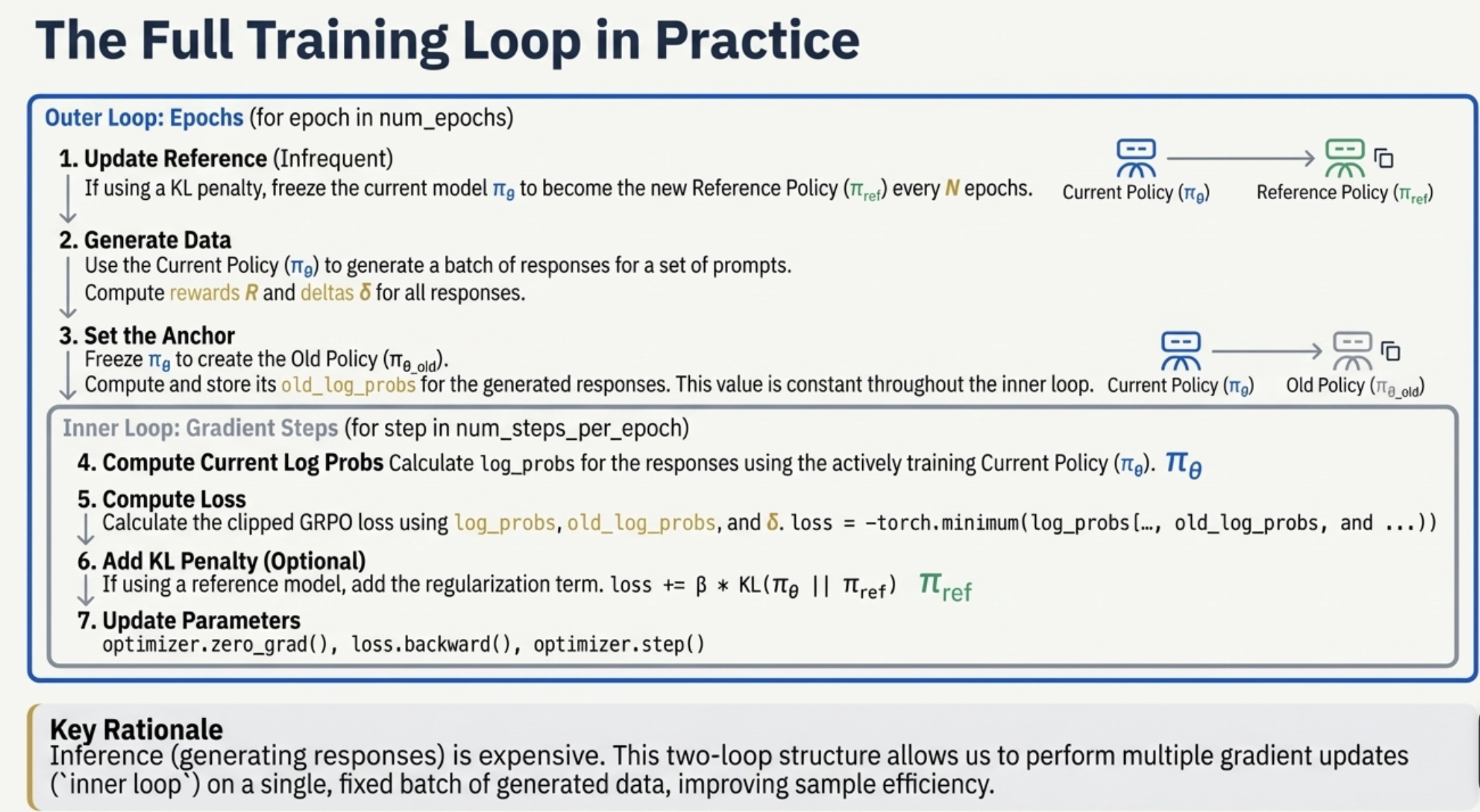
The GRPO training setup typically involves nested optimization loops and multiple concurrent model versions.
def generate_responses(prompts: torch.Tensor, model: Model, num_responses: int) -> torch.Tensor:
    """
    Args:
        prompts (int[batch pos])
    Returns:
        generated responses: int[batch trial pos]
    Example (batch_size = 3, prompt_length = 3, num_responses = 2, response_length = 4)
    p1 p1 p1 r1 r1 r1 r1
             r2 r2 r2 r2
    p2 p2 p2 r3 r3 r3 r3
             r4 r4 r4 r4
    p3 p3 p3 r5 r5 r5 r5
             r6 r6 r6 r6
    """
    logits = model(prompts)  # [batch pos vocab]
    batch_size = prompts.shape[0]
    # Sample num_responses (independently) for each [batch pos]
    flattened_logits = rearrange(logits, "batch pos vocab -> (batch pos) vocab")
    flattened_responses = torch.multinomial(softmax(flattened_logits, dim=-1), num_samples=num_responses, replacement=True)  # [batch pos trial]
    responses = rearrange(flattened_responses, "(batch pos) trial -> batch trial pos", batch=batch_size)
    return responses

def simple_model():
  """
    Define a simple model that maps prompts to responses

    Assume fixed prompt and response length

    Captures positional information with separate per-position parameters

    Decode each position in the response independently (not autoregressive)
  """
      model = Model(vocab_size=3, embedding_dim=10, prompt_length=3, response_length=3)
      # Start with a prompt s
      prompts = torch.tensor([[1, 0, 2]])  # [batch pos]
      # Generate responses a
      torch.manual_seed(10)
      responses = generate_responses(prompts=prompts, model=model, num_responses=5)  # [batch trial pos]  @inspect responses
      # Compute rewards R of these responses:
      rewards = compute_reward(prompts=prompts, responses=responses, reward_fn=sort_inclusion_ordering_reward)  # [batch trial]  @inspect rewards
      # Compute deltas δ given the rewards R (for performing the updates)
      deltas = compute_deltas(rewards=rewards, mode="rewards")  # [batch trial]  @inspect deltas
      deltas = compute_deltas(rewards=rewards, mode="centered_rewards")  # [batch trial]  @inspect deltas
      deltas = compute_deltas(rewards=rewards, mode="normalized_rewards")  # [batch trial]  @inspect deltas
      deltas = compute_deltas(rewards=rewards, mode="max_rewards")  # [batch trial]  @inspect deltas
      # Compute log probabilities of these responses:
      log_probs = compute_log_probs(prompts=prompts, responses=responses, model=model)  # [batch trial]  @inspect log_probs
      # Compute loss so that we can use to update the model parameters
      loss = compute_loss(log_probs=log_probs, deltas=deltas, mode="naive")  # @inspect loss
      freezing_parameters()
      old_model = Model(vocab_size=3, embedding_dim=10, prompt_length=3, response_length=3)  # Pretend this is an old checkpoint @stepover
      old_log_probs = compute_log_probs(prompts=prompts, responses=responses, model=old_model)  # @stepover
      loss = compute_loss(log_probs=log_probs, deltas=deltas, mode="unclipped", old_log_probs=old_log_probs)  # @inspect loss
      loss = compute_loss(log_probs=log_probs, deltas=deltas, mode="clipped", old_log_probs=old_log_probs)  # @inspect loss
      # Sometimes, we can use an explicit KL penalty to regularize the model.
      # This can be useful if you want RL a new capability into a model, but you don't want it to forget its original capabilities.
      # KL(p || q) = E_{x ~ p}[log(p(x)/q(x))]
      # KL(p || q) = E_{x ~ p}[-log(q(x)/p(x))]
      # KL(p || q) = E_{x ~ p}[q(x)/p(x) - log(q(x)/p(x)) - 1] because E_{x ~ p}[q(x)/p(x)] = 1
      kl_penalty = compute_kl_penalty(log_probs=log_probs, ref_log_probs=old_log_probs)  # @inspect kl_penalty
      # Summary:
      # Generate responses
      # - Compute rewards R and δ (rewards, centered rewards, normalized rewards, max rewards)
      # - Compute log probs of responses
      # - Compute loss from log probs and δ (naive, unclipped, clipped)
The GRPO (Group Relative Policy Optimization) algorithm organizes training into two nested loops to separate:
- Expensive work → Inference / sampling rollouts
- Cheap work → Gradient updates on already-collected data
This is the core idea behind PPO-style on-policy optimization.
def run_policy_gradient(num_epochs: int = 100,
                        num_steps_per_epoch: int = 10,
                        compute_ref_model_period: int = 10,
                        num_responses: int = 10,
                        deltas_mode: str = "rewards",
                        loss_mode: str = "naive",
                        kl_penalty: float = 0.0,
                        reward_fn: Callable[[list[int], list[int]], float] = sort_inclusion_ordering_reward,
                        use_cache: bool = False) -> tuple[str, str]:
    """Train a model using policy gradient.
    Return:
    - Path to the image of the learning curve.
    - Path to the log file
    """
    torch.manual_seed(5)
    image_path = f"var/policy_gradient_{deltas_mode}_{loss_mode}.png"
    log_path = f"var/policy_gradient_{deltas_mode}_{loss_mode}.txt"
    # Already ran, just cache it
    if use_cache and os.path.exists(image_path) and os.path.exists(log_path):
        return image_path, log_path
    # Define the data
    prompts = torch.tensor([[1, 0, 2], [3, 2, 4], [1, 2, 3]])
    vocab_size = prompts.max() + 1
    prompt_length = response_length = prompts.shape[1]
    model = Model(vocab_size=vocab_size, embedding_dim=10, prompt_length=prompt_length, response_length=response_length)
    optimizer = torch.optim.Adam(model.parameters(), lr=1e-3)
    records = []
    ref_log_probs = None
    ref_model = None
    old_log_probs = None
    if use_cache:
        out = open(log_path, "w")
    else:
        out = sys.stdout
    for epoch in tqdm(range(num_epochs), desc="epoch"):
        # If using KL penalty, need to get the reference model (freeze it every few epochs)
        if kl_penalty != 0:
            if epoch % compute_ref_model_period == 0:
                ref_model = model.clone()
        # Sample responses and evaluate their rewards
        responses = generate_responses(prompts=prompts, model=model, num_responses=num_responses)  # [batch trial pos]
        rewards = compute_reward(prompts=prompts, responses=responses, reward_fn=reward_fn)  # [batch trial]
        deltas = compute_deltas(rewards=rewards, mode=deltas_mode)  # [batch trial]
        if kl_penalty != 0:  # Compute under the reference model
            with torch.no_grad():
                ref_log_probs = compute_log_probs(prompts=prompts, responses=responses, model=ref_model)  # [batch trial]
        if loss_mode != "naive":  # Compute under the current model (but freeze while we do the inner steps)
            with torch.no_grad():
                old_log_probs = compute_log_probs(prompts=prompts, responses=responses, model=model)  # [batch trial]
        # Take a number of steps given the responses
        for step in range(num_steps_per_epoch):
            log_probs = compute_log_probs(prompts=prompts, responses=responses, model=model)  # [batch trial]
            loss = compute_loss(log_probs=log_probs, deltas=deltas, mode=loss_mode, old_log_probs=old_log_probs)  # @inspect loss
            if kl_penalty != 0:
                loss += kl_penalty * compute_kl_penalty(log_probs=log_probs, ref_log_probs=ref_log_probs)
            # Print information
            print_information(epoch=epoch, step=step, loss=loss, prompts=prompts, rewards=rewards, responses=responses, log_probs=log_probs, deltas=deltas, out=out)
            global_step = epoch * num_steps_per_epoch + step
            records.append({"epoch": epoch, "step": global_step, "loss": loss.item(), "mean_reward": rewards.mean().item()})
            # Backprop and update parameters
            optimizer.zero_grad()
            loss.backward()
            optimizer.step()
    if use_cache:
        out.close()
    if use_cache:
        # Plot step versus loss and reward in two subplots
        steps = [r["step"] for r in records]
        losses = [r["loss"] for r in records]
        rewards = [r["mean_reward"] for r in records]
        fig, (ax1, ax2) = plt.subplots(1, 2, figsize=(12, 4))
        # Loss subplot
        ax1.plot(steps, losses)
        ax1.set_xlabel("Step")
        ax1.set_ylabel("Train Loss")
        ax1.set_title("Train Loss")
        # Reward subplot
        ax2.plot(steps, rewards)
        ax2.set_xlabel("Step")
        ax2.set_ylabel("Mean Reward")
        ax2.set_title("Mean Reward")
        plt.tight_layout()
        plt.savefig(image_path)
        plt.close()
    return image_path, log_path
def print_information(epoch: int, step: int, loss: torch.Tensor, prompts: torch.Tensor, rewards: torch.Tensor, responses: torch.Tensor, log_probs: torch.Tensor, deltas: torch.Tensor, out):
    print(f"epoch = {epoch}, step = {step}, loss = {loss:.3f}, reward = {rewards.mean():.3f}", file=out)
    if epoch % 1 == 0 and step % 5 == 0:
        for batch in range(prompts.shape[0]):
            print(f"  prompt = {prompts[batch, :]}", file=out)
            for trial in range(responses.shape[1]):
                print(f"    response = {responses[batch, trial, :]}, log_probs = {tstr(log_probs[batch, trial])}, reward = {rewards[batch, trial]}, delta = {deltas[batch, trial]:.3f}", file=out)
def tstr(x: torch.Tensor) -> str:
    return "[" + ", ".join(f"{x[i]:.3f}" for i in range(x.shape[0])) + "]"
4.1 Outer Loop (Epoch-Level Operations)
The outer loop defines how often new responses are sampled and when reference models are updated.
A. Rollout / Sampling
The current policy $\pi$ is used to generate responses (rollouts) for a batch of prompts.
This step:
- Requires inference (expensive)
- Produces the raw data used for training
B. Reward & Delta Computation
For each sampled response, compute:
- Reward $R$
- Delta (advantage-like signal)
Common GRPO choice: group-centered rewards
or normalized rewards:
\[\delta_i = \frac{R_i - \mu_{\text{group}}}{\sigma_{\text{group}} + \epsilon}\]These reduce variance without needing a critic.
C. Reference Model Updates (Optional)
If using KL regularization, the reference model $\pi_{\text{ref}}$ may be:
- Frozen
- Or periodically updated (e.g., every 10 epochs)
D. Cache Old Log-Probabilities
Compute: \(\log \pi_{\text{old}}(a \mid s)\)
using torch.no_grad(), because:
- These log-probs must stay fixed
- Used for the ratio inside PPO/GRPO clipping
This avoids storing the full old model.
4.2 Inner Loop (Gradient Update Steps)
The inner loop performs many updates using the same sampled data.
A. Compute Loss
GRPO uses PPO-style clipped objectives:
Let:
\[r = \exp\!\left( \log \pi(a \mid s) \;-\; \log \pi_{\text{old}}(a \mid s) \right)\]Then:
\[L_{\text{GRPO}} = -\,\min\!\Big( r \cdot \delta,\; \text{clip}\!\left(r,\; 1 - \epsilon,\; 1 + \epsilon\right)\cdot \delta \Big)\]Clipping prevents large, unstable steps.
B. KL Regularization (Optional)
If using a reference model:
\[\mathrm{KL}\!\left(\pi \;\|\; \pi_{\text{ref}}\right) = \sum_a \pi(a \mid s)\; \Big[ \log \pi(a \mid s) \;-\; \log \pi_{\text{ref}}(a \mid s) \Big]\]Then:
\[L = L_{\text{GRPO}} + \beta \cdot \text{KL}\]This keeps the model from drifting too far.
C. Optimizer Step
Standard PyTorch steps:
optimizer.zero_grad()loss.backward()optimizer.step()
This inner loop is cheap → so we run it many times.
5. Use and Update of πold and πref in GRPO
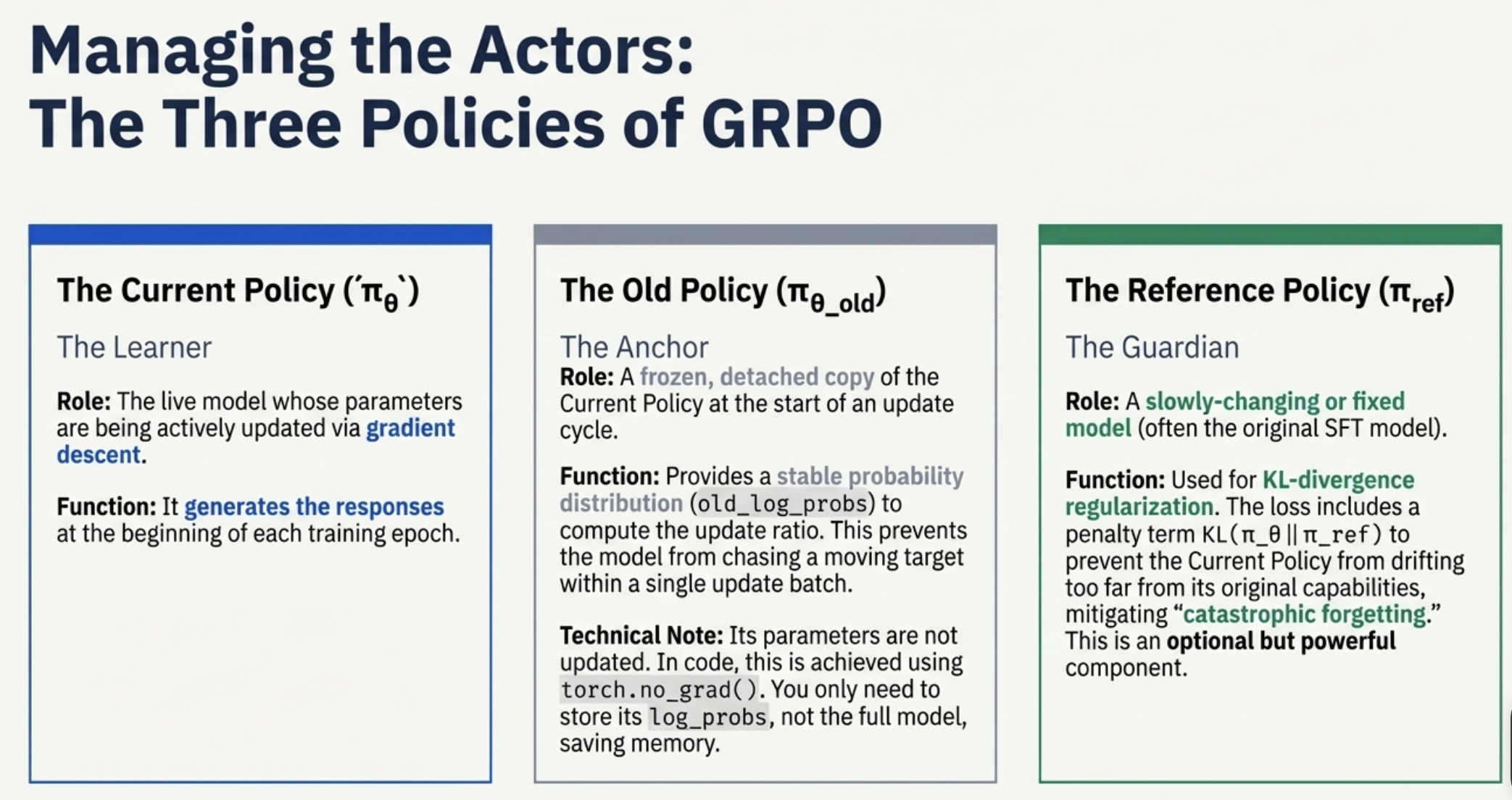
5.1 Use and Update of the Old Model (πold)
The Old Model (or old policy)
\(\pi_{\text{old}}\)
is essential for computing importance ratios in the clipped GRPO (and PPO) loss. It ensures that the updated policy does not shift too far from the policy that generated the sampled data.
A. Usage
During optimization, GRPO uses the log-prob ratio:
\[r = \exp\!\left( \log \pi(a \mid s)\;-\;\log \pi_{\text{old}}(a \mid s) \right)\]This ratio is multiplied by the delta and fed into the clipped objective:
\[L = -\min \big( r\delta,\; \text{clip}(r, 1-\epsilon, 1+\epsilon)\delta \big)\]B. Updating / Freezing Behavior
Outer Loop (Data Collection)
- Compute log-probs of sampled actions under the current policy:
\(\log\pi_{\text{old}}\) - Cache these values using
torch.no_grad(). - These cached values serve as πold for the entire inner loop.
Inner Loop (Optimization)
- π remains trainable.
- πold stays frozen as cached log-probs.
- Used for all gradient steps within the epoch.
Conclusion
You do not store a full copy of πold.
Only the cached log-probs:
are needed.
πold is “updated” implicitly once per outer loop.
5.2 Use and Update of the Reference Model (πref)
The Reference Model
\(\pi_{\text{ref}}\)
is used only when KL regularization is applied:
This helps prevent catastrophic drift or capability loss.
A. Usage
Compute:
\[\mathrm{KL}\!\left(\pi \;\|\; \pi_{\text{ref}}\right) = \sum_a \pi(a \mid s)\; \Big[ \log \pi(a \mid s) \;-\; \log \pi_{\text{ref}}(a \mid s) \Big]\]The KL penalty is added to the clipped objective.
B. Updating / Freezing Behavior
Outer Loop (Reference Update)
- πref is cloned from the current model only when
\(\text{epoch} \bmod \text{compute\_ref\_model\_period} = 0\) e.g., every 10 epochs. - Otherwise, πref remains frozen.
Outer Loop (Data Collection)
- If πref exists, compute & cache:
\(\log \pi_{\text{ref}}\) over sampled actions (torch.no_grad()).
Inner Loop (Optimization)
- The KL penalty uses the cached logπref.
- πref is completely frozen.
🔶 Summary: How the Loops Use Each Model
| Loop | Model | Action | Frequency |
|---|---|---|---|
| Outer Loop | πref | Freeze/update by cloning π every N epochs | Infrequent (e.g., every 10) |
| Outer Loop | πold | Cache logπ of current model → becomes πold | Every epoch |
| Inner Loop | πold | Used for clipped ratio; stays constant | Fixed for all inner steps |
| Inner Loop | πref | Provides logπref for KL penalty | Fixed for all inner steps |
| Inner Loop | π (current) | Updated by backprop & optimizer | Many times per epoch |
This structure is what allows GRPO to:
- Reuse expensive rollout data efficiently
- Stabilize training
- Control policy drift via clipping and KL penalties
6. Required Infrastructure & Model Management
RL training is much more complex than pre-training because you must coordinate multiple models and manage heavy inference workloads.
Managing Multiple Model Copies
| Model | Role | Purpose | Memory Cost |
|---|---|---|---|
| Current Model \(\pi\) | Policy being trained | Generates responses, computes current log-probs | 1× model |
| Old Log-Prob Cache \(\pi_{\text{old}}\) | Reference for clipping | Need only log π_old, not full model |
Tiny |
| Reference Model \(\pi_{\text{ref}}\) | KL anchor | Prevents capability drift | +1× model |
| Critic (Not used in GRPO) | Used in PPO | Estimates value baseline | Extra model |
GRPO removes the critic to simplify infra.
Infrastructure Challenges
Expensive Inference Workloads
You must repeatedly run rollouts:
- Very expensive
- Often needs:
- VLM inference clusters
- Parallel model workers
- Async rollout pipelines
This becomes the bottleneck.
Coordination Between Multiple Models
Need to coordinate:
- Current model updates
- π_old snapshots (log-probs)
- π_ref freezing or updating
All must remain consistent across machines and GPUs.
Distributed Complexity
Everything must be:
- Parallel
- Synchronized
- Fault-tolerant
RL training involves:
- Distributed inference
- Distributed optimization
- Rollout queues
- Logging/monitoring pipelines
This is why RLHF/GRPO infrastructure is significantly harder than pre-training.