
Policy Gradients in Reinforcement Learning
This lecture summarizes the core concepts, derivations, practical considerations, and advanced topics related to Policy Gradients, a fundamental algorithm in reinforcement learning (RL). Course Link
1. Introduction to Policy Gradients
Policy gradients are a foundational RL algorithm that directly optimize the policy parameters through gradient descent to maximize the expected sum of rewards. They are considered “model-free” because they do not require knowledge of the environment’s transition probabilities or initial state distributions.
Key Idea:
The goal of RL is to find policy parameters $\theta$ that maximize the expected value of the sum of rewards under the trajectory distribution $P_\theta(\tau)$.
\[J(\theta) = \mathbb{E}_{\tau \sim P_\theta(\tau)} \left[\sum_{t=1}^T R(s_t, a_t)\right]\]The policy $\pi$ (with parameters $\theta$) defines a distribution over actions given a state or observation. If represented by a deep neural network, $\theta$ are the network’s weights.
2. Evaluating the RL Objective and Policy Gradient
Since the transition probabilities and initial state distribution are typically unknown in model-free RL, evaluation relies on sampling.
2.1. Evaluating the Objective
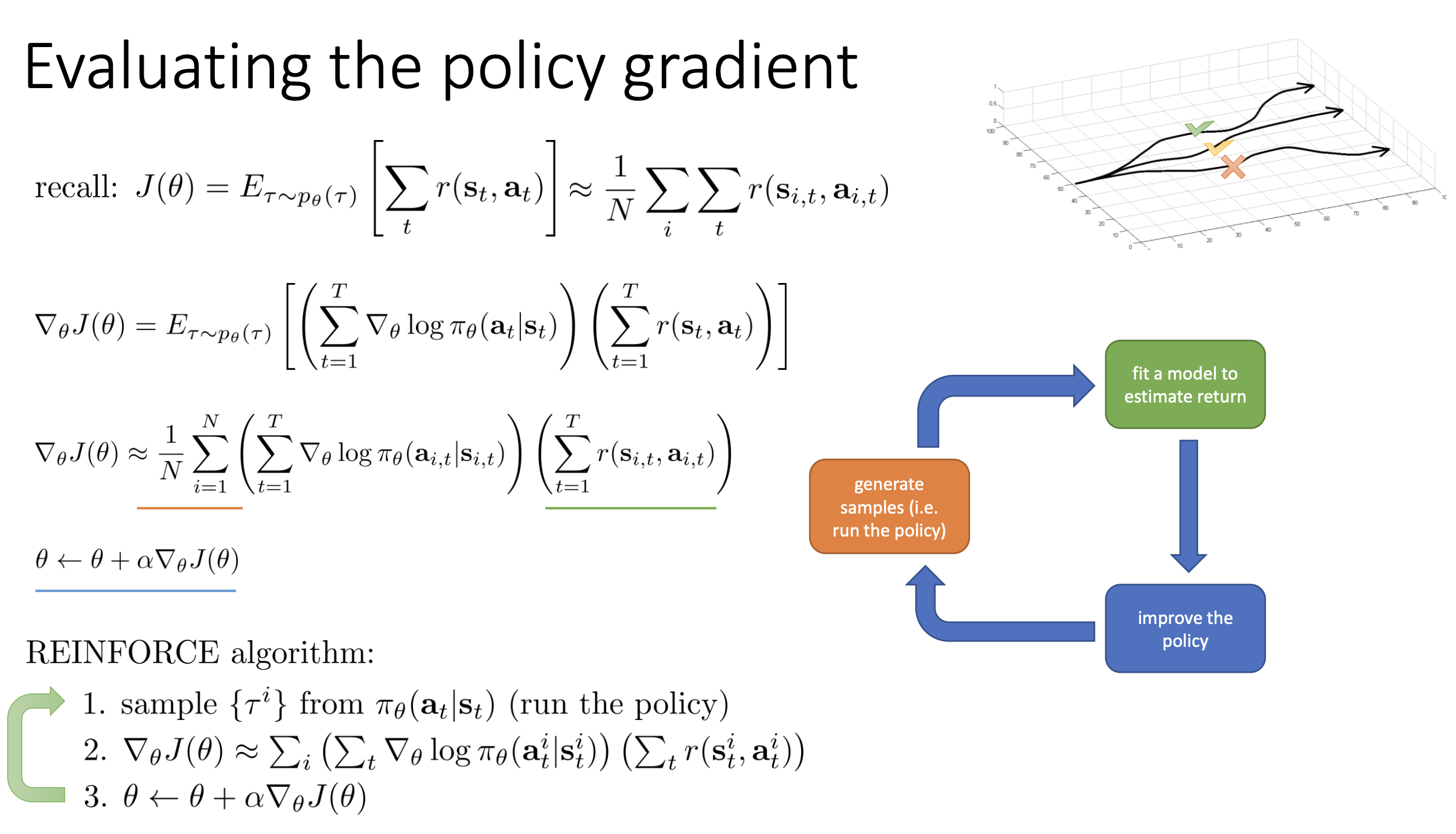
Estimate $J(\theta)$ by collecting $N$ sampled trajectories $\tau_i$:
\[J(\theta) \approx \frac{1}{N} \sum_{i=1}^N \sum_{t=1}^T R(s_{i,t}, a_{i,t})\]More samples lead to a more accurate estimate.
2.2. Evaluating the Policy Gradient
We aim to estimate the gradient $\nabla_\theta J(\theta)$ without access to transition probabilities.
Log-Gradient Trick (Likelihood Ratio Trick):
\[\nabla_\theta P_\theta(\tau) = P_\theta(\tau) \nabla_\theta \log P_\theta(\tau)\]Applying it:
\[\nabla_\theta J(\theta) = \mathbb{E}_{\tau \sim P_\theta(\tau)} [\nabla_\theta \log P_\theta(\tau) \cdot R(\tau)]\]Since only the policy depends on $\theta$:
\[\log P_\theta(\tau) = \log P(s_1) + \sum_{t=1}^T \left(\log \pi_\theta(a_t \mid s_t) + \log P(s_{t+1} \mid s_t, a_t)\right)\] \[\nabla_\theta \log P_\theta(\tau) = \sum_{t=1}^T \nabla_\theta \log \pi_\theta(a_t \mid s_t)\]So:
\[\nabla_\theta J(\theta) = \mathbb{E}_{\tau \sim P_\theta(\tau)} \left[\left(\sum_{t=1}^T \nabla_\theta \log \pi_\theta(a_t \mid s_t)\right) \cdot R(\tau)\right]\]REINFORCE Algorithm Steps:
- Sample trajectories from current policy.
- Evaluate the policy gradient.
- Gradient ascent: $\theta \leftarrow \theta + \alpha \nabla_\theta J(\theta)$
3. Understanding Policy Gradients Intuitively
3.1. Comparison to Maximum Likelihood
- Supervised learning increases log probs of all actions.
- Policy gradient weights log probs by total reward.
- High-reward trajectories get reinforced more than low-reward ones.
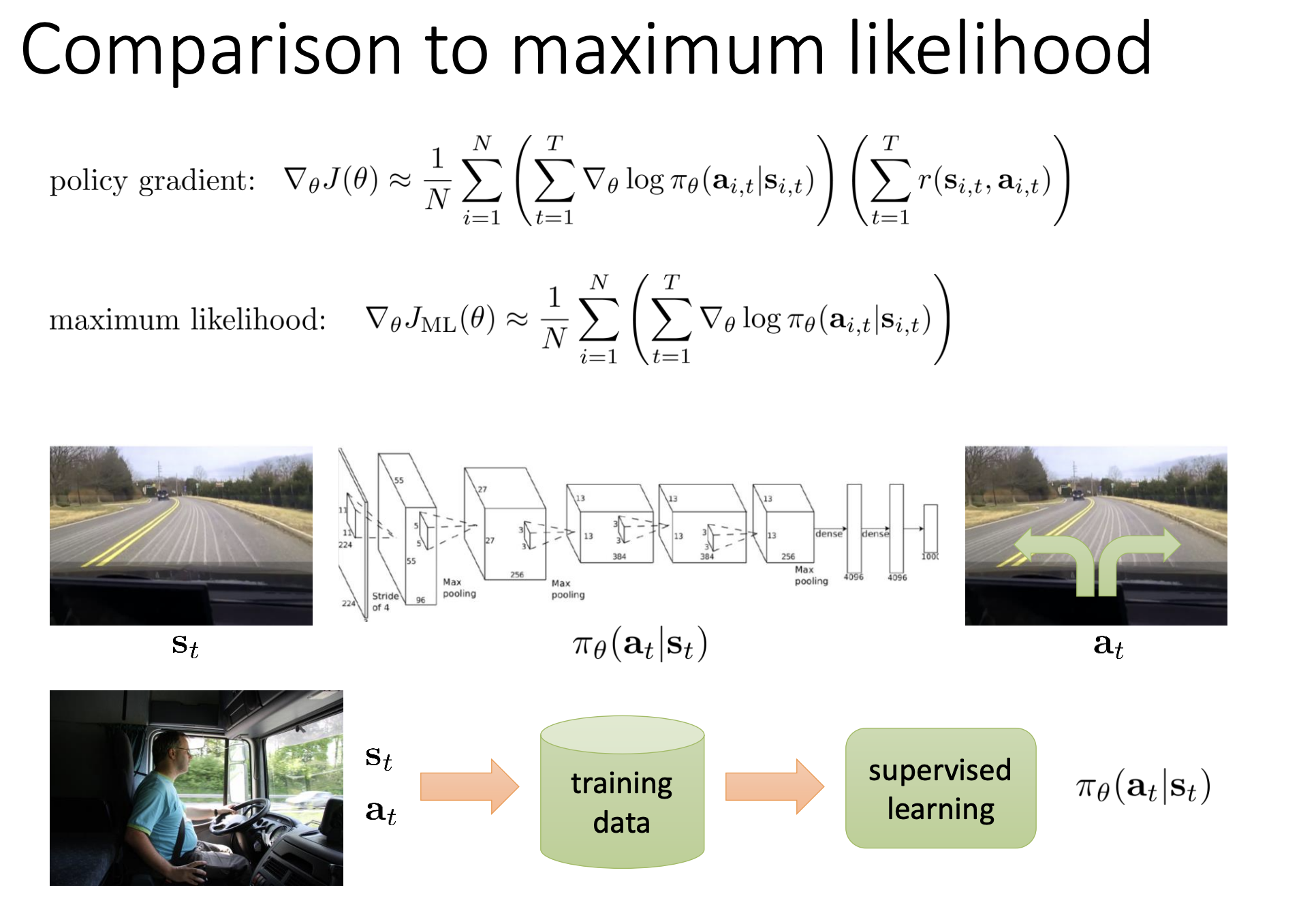
📌 Policy gradients can be intuitively understood as a weighted version of the maximum likelihood gradient, where the weights are determined by the rewards of the trajectories.
Here’s a breakdown:
-
🎯 Reinforcement Learning Objective:
The goal of reinforcement learning (RL) is to find policy parameters (theta, $\theta$) that maximize the expected value of the sum of rewards under the trajectory distribution $P_\theta(\tau)$.
A trajectory ($\tau$) is a sequence like $(s_1, a_1, s_2, a_2, \dots)$, and its total reward is denoted as $r(\tau)$. -
📐 Policy Gradient Calculation:
\[\nabla_\theta J(\theta) = \mathbb{E}_{\tau \sim P_\theta(\tau)} \left[ \left( \sum_t \nabla_\theta \log \pi_\theta(a_t \mid s_t) \right) \cdot r(\tau) \right]\]
The policy gradient algorithm directly differentiates the RL objective and performs gradient ascent to improve the policy.
The REINFORCE formula: - 🔍 Comparison to Maximum Likelihood:
- In maximum likelihood (e.g. supervised/imitation learning), the goal is to maximize $\log \pi(a_t \mid s_t)$ for observed actions.
- The gradient simply sums $\nabla \log \pi(a_t \mid s_t)$ over all actions, increasing the probability of everything observed.
-
In policy gradients, actions are sampled by the policy itself, and their gradient is weighted by the reward — i.e.,
\[\nabla \log \pi(a_t \mid s_t) \cdot r(\tau)\]rather than being treated equally.
- ⚖️ The “Weighted” Aspect:
- High-reward trajectories → 📈 increase their log probabilities → make them more likely.
- Low-reward trajectories → 📉 decrease their log probabilities → make them less likely.
- This is like a weighted version of the max-likelihood gradient, where each action’s contribution is scaled by how good the outcome was.
- This intuitively captures trial and error learning:
“Good stuff is made more likely, and bad stuff is made less likely.” 💡
3.2. Trial and Error Learning
Policy gradients formalize trial-and-error learning: “Make good stuff more likely, bad stuff less likely.”
3.3. Partial Observability
Policy gradients apply to POMDPs with minimal change (replace states $s$ with observations $o$).
4. Challenges: High Variance
Policy gradient estimators have high variance.
4.1. The Problem
- Adding a constant to all rewards affects sample estimates.
- Rare high-reward or negative-reward trajectories distort gradients.
- Variance increases with reward scale.
5. Reducing Variance: Practical Tricks
5.1. Causality (Reward-to-Go)
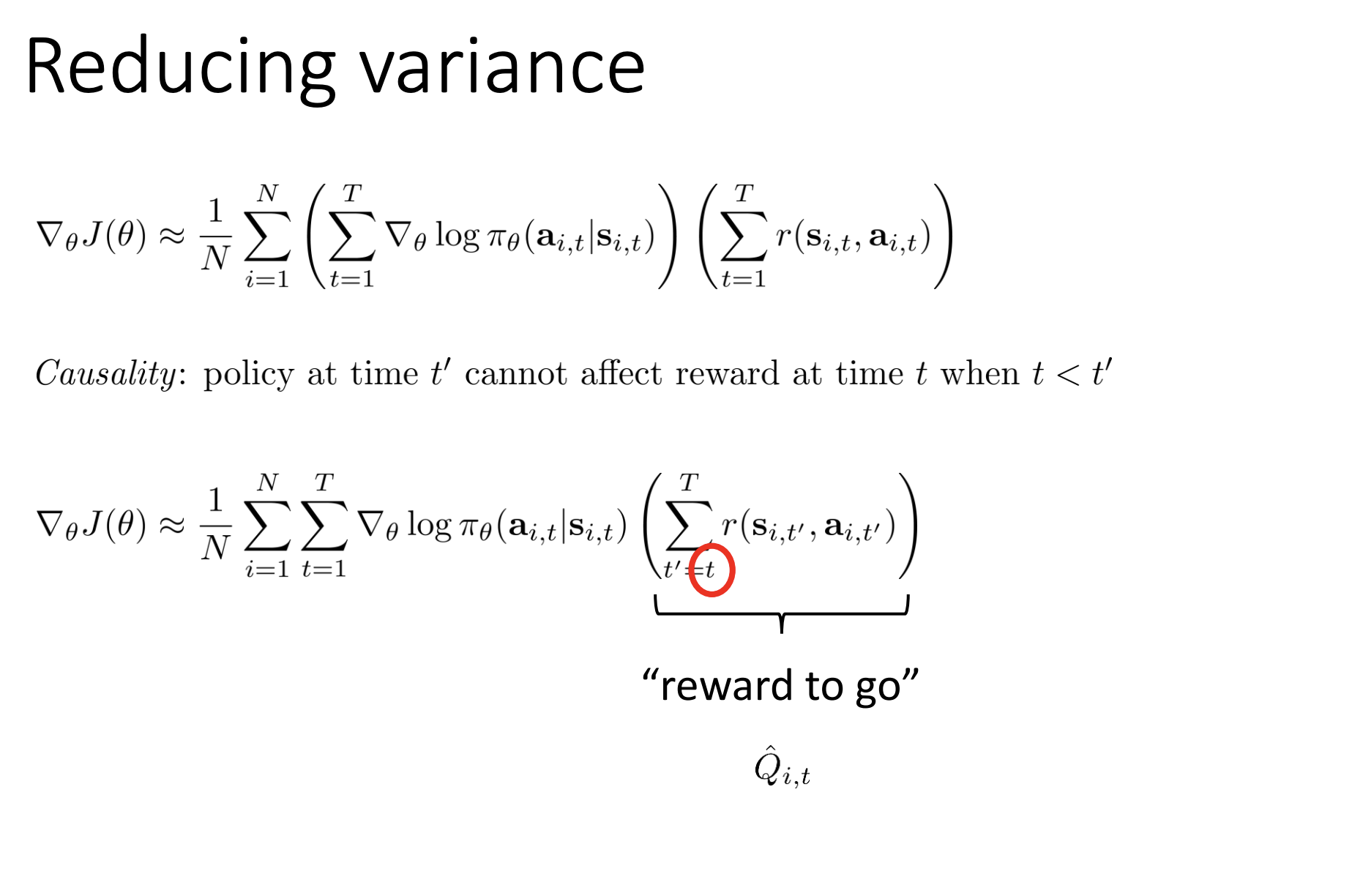
Use only future rewards at each step $t$:
\[Q_{i,t} = \sum_{t'=t}^T R(s_{i,t'}, a_{i,t'})\]Reduces variance while maintaining unbiasedness.
5.2. Baselines
Subtract a baseline $b$ from the reward:
\[\nabla_\theta J(\theta) = \mathbb{E}_{\tau \sim P_\theta(\tau)} \left[\left(\sum_{t=1}^T \nabla_\theta \log \pi_\theta(a_t \mid s_t)\right) \cdot (R(\tau) - b)\right]\]- Helps center rewards: above-average trajectories get boosted.
- Average reward is a decent baseline.
- Optimal baseline involves gradient magnitude but is rarely used.
🎯 The concept of an optimal baseline in policy gradient algorithms addresses the challenge of high variance in the gradient estimator — a major hurdle in making these methods practical.
Here’s a detailed breakdown:
- 🧠 Purpose of a Baseline:
- Policy gradients aim to increase the log-probabilities of actions with high rewards, and decrease those with low rewards — mimicking trial-and-error learning.
- But if all rewards are positive ➕, even “bad” trajectories might still get their probabilities slightly increased 🤨.
- A baseline (denoted as
b) is subtracted from the reward in the policy gradient formula:
\(\nabla_\theta J(\theta) = \mathbb{E}_{\tau \sim P_\theta(\tau)} \left[\sum_{t=1}^T \nabla_\theta \log \pi_\theta(a_t \mid s_t) \cdot (r(\tau) - b)\right]\) - This centers the reward:
- Better-than-average rewards ⬆️ get reinforced.
- Worse-than-average rewards ⬇️ get discouraged.
- Subtracting a constant baseline does not bias the estimator — it changes variance but not expectation ✔️.
- 📐 Deriving the Optimal Baseline:
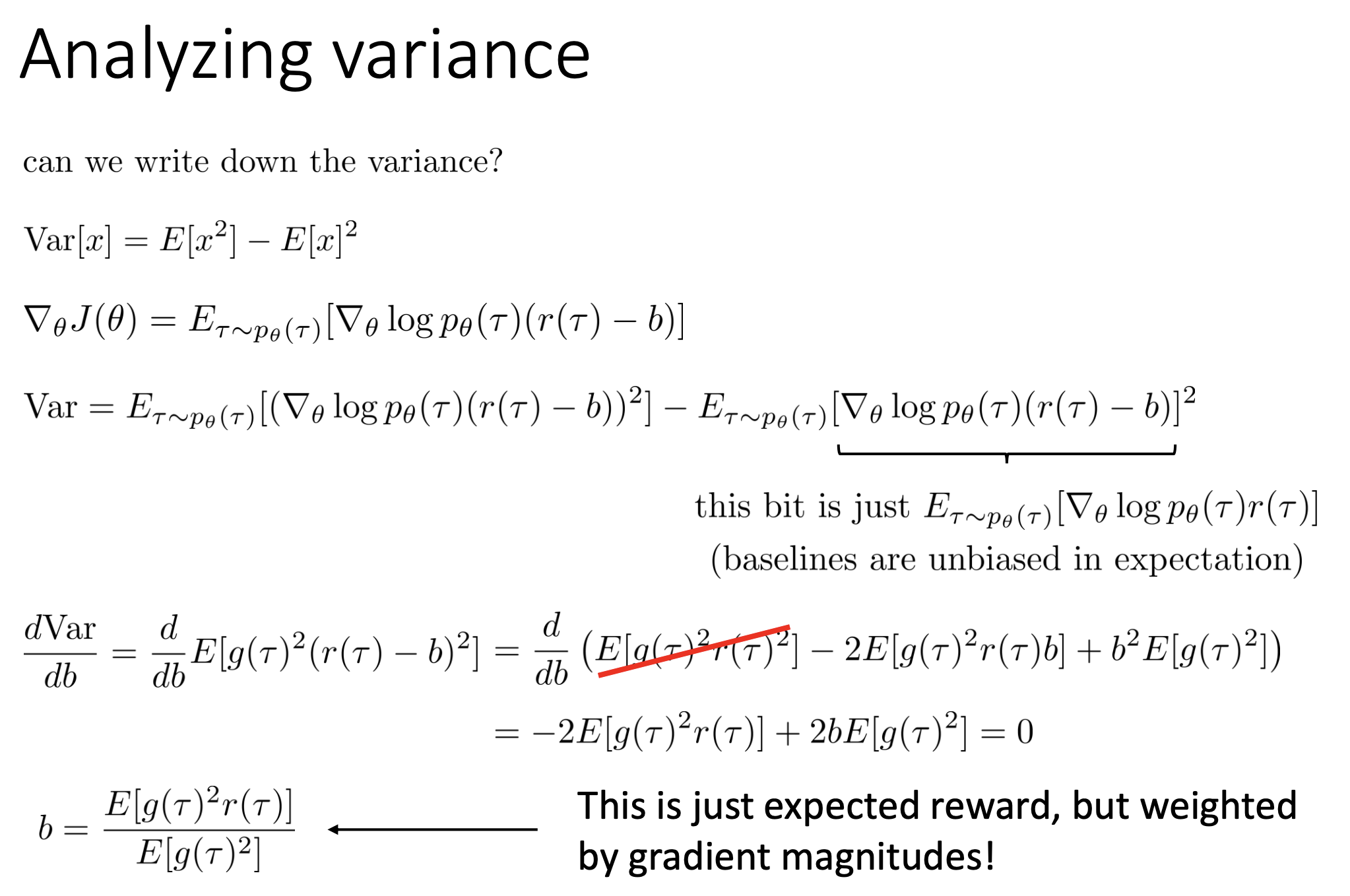
- Goal: Minimize the variance of the policy gradient estimator.
- Take the derivative of the variance w.r.t.
b, set it to zero, solve forb. - Use the identity:
\(P(\tau) \cdot \nabla \log P(\tau) = \nabla P(\tau)\) - Result:
\(b^* = \frac{\mathbb{E}[g^2 \cdot r]}{\mathbb{E}[g^2]}\)
where:- $g = \sum_t \nabla_\theta \log \pi_\theta(a_t \mid s_t)$
- $r = r(\tau)$ (total reward)
- 🧮 Interpretation of the Optimal Baseline:
- This formula shows that the optimal baseline is a reweighted average of rewards.
- The weights are based on the squared magnitude of the gradient $g^2$.
- For policies with many parameters, this suggests:
- 🧩 Each parameter could have its own separate optimal baseline, depending on the gradient magnitude for that parameter.
- 🛠️ Practical Considerations:
- The average reward is a good (but suboptimal) baseline — widely used.
- The theoretically optimal baseline is rarely used because:
- It requires computing the gradient before computing the baseline 😵
- Adds complexity with limited practical benefit.
- Still, reducing variance is critical to make policy gradients work well:
- Helps with smaller batch sizes
- Stabilizes training
- Improves learning rate robustness
- ✅ Combine baselines with tricks like reward-to-go for better performance.
6. Off-Policy Policy Gradients
6.1. Why On-Policy
Standard gradients require new samples after every parameter update, which is inefficient.
📌 Policy gradients are generally considered on-policy algorithms — they require new samples every time the policy changes because the gradient is an expectation under the current policy, $P_\theta(\tau)$.
If $\theta$ changes, the distribution $P_\theta(\tau)$ changes, and old samples are no longer valid ➡️ extremely inefficient when sampling is expensive (e.g., real-world robots or slow simulators).
⚡ Off-policy policy gradients solve this by allowing reuse of data collected from previous policies or external sources like human demonstrations.
- 🚫 The Problem with On-Policy Learning:
- Neural networks usually make tiny parameter updates per step.
- On-policy methods require fresh samples at every update, making training slow and expensive when environment interaction is costly.
- 🔄 Introducing Importance Sampling for Off-Policy Learning:
- Use importance sampling (IS) to reuse off-policy data.
- IS adjusts expectations under the new policy using samples from a different policy:
\(\mathbb{E}_{\tau \sim P_\theta(\tau)}[f(\tau)] = \mathbb{E}_{\tau \sim P_{\bar{\theta}}(\tau)} \left[ \frac{P_\theta(\tau)}{P_{\bar{\theta}}(\tau)} f(\tau) \right]\) - The ratio $\frac{P_\theta(\tau)}{P_{\bar{\theta}}(\tau)}$ is the importance weight, used to correct for sampling bias.
- 🧮 Derivation of Off-Policy Policy Gradient:
- Rewrite the objective using importance weights between new and old policies.
- Transition probabilities and initial states cancel out (they’re shared across policies):
\(\frac{P_{\theta'}(\tau)}{P_{\bar{\theta}}(\tau)} = \prod_{t=1}^T \frac{\pi_{\theta'}(a_t \mid s_t)}{\pi_{\bar{\theta}}(a_t \mid s_t)}\) - The off-policy policy gradient becomes:
\(\mathbb{E}_{\tau \sim P_{\bar{\theta}}} \left[\left(\prod_{t=1}^T \frac{\pi_{\theta'}(a_t \mid s_t)}{\pi_{\bar{\theta}}(a_t \mid s_t)}\right) \cdot \left( \sum_{t=1}^T \nabla_{\theta'} \log \pi_{\theta'}(a_t \mid s_t) \cdot r(\tau) \right) \right]\) - Each gradient term is now weighted by the importance ratio.
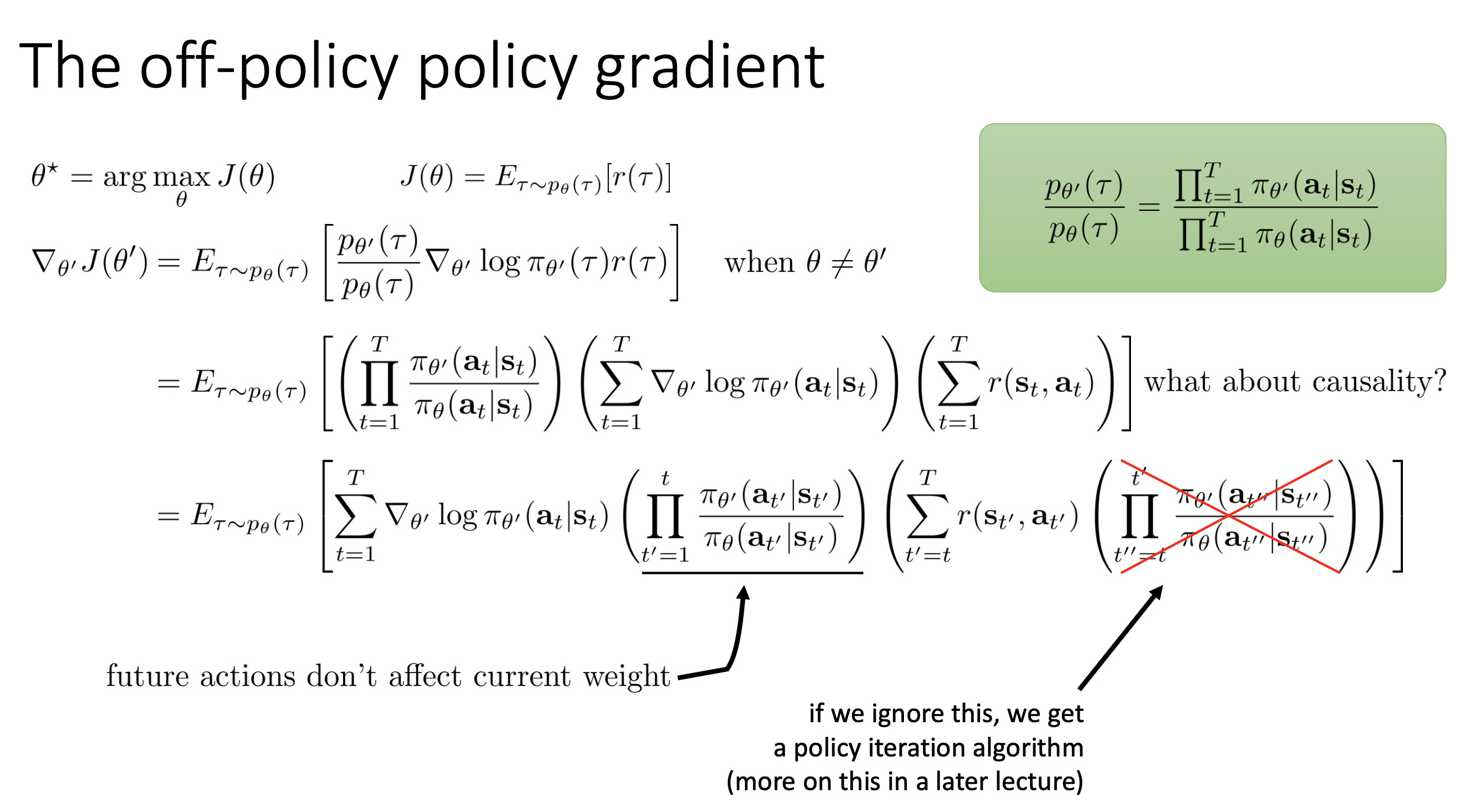
- ⚠️ Challenges: Variance Explosion:
- Importance weights are products over many time steps → risk of exploding or vanishing values.
- If $\pi_{\theta’}(a_t \mid s_t)$ is very small, the product becomes near-zero → noisy, high-variance estimates.
- This makes off-policy policy gradients even more unstable than standard ones.
-
🔧 Approximations to Reduce Variance:
- 🕒 Reward-to-Go (Causality Trick):
- Only sum future rewards at time $t$:
\(\hat{Q}_{i,t} = \sum_{t'=t}^T r(s_{t'}, a_{t'})\) - Actions cannot affect past rewards → lowers variance.
- Only sum future rewards at time $t$:
- 📉 Ignore State Marginal Probabilities:
- Common approximation: ignore full trajectory weighting, and only reweight based on action probabilities at each step.
- Reduces variance from exponential blowup.
- This approximation is valid when $\theta’$ is not too different from $\bar{\theta}$.
- 🕒 Reward-to-Go (Causality Trick):
- 🧪 Practical Algorithms:
- 🔁 TRPO (Trust Region Policy Optimization) and PPO (Proximal Policy Optimization):
- Use importance sampling with smart constraints and approximations.
- Add techniques like KL-divergence penalties, clipped ratios, and natural gradients for stability.
- 🧑🏫 Incorporating Demonstrations:
- Guided Policy Search (Levine & Koltun, 2013) uses off-policy gradients + importance sampling to integrate human or demonstration data.
- 🔁 TRPO (Trust Region Policy Optimization) and PPO (Proximal Policy Optimization):
📚 Summary:
Off-policy policy gradients extend the flexibility of policy gradient methods by reusing past data, but introduce high variance due to importance weights.
By applying reward-to-go, ignoring marginal states, and using algorithms like PPO/TRPO, we can make off-policy policy gradients practical and scalable in deep reinforcement learning.
6.2. Importance Sampling (IS)
To evaluate expectations with off-policy samples:
\[J(\theta') = \mathbb{E}_{\tau \sim P_{\bar{\theta}}(\tau)} \left[\frac{P_{\theta'}(\tau)}{P_{\bar{\theta}}(\tau)} \cdot R(\tau)\right]\]Importance weight:
\[\frac{P_{\theta'}(\tau)}{P_{\bar{\theta}}(\tau)} = \prod_{t=1}^T \frac{\pi_{\theta'}(a_t \mid s_t)}{\pi_{\bar{\theta}}(a_t \mid s_t)}\]Policy gradient becomes:
\[\nabla_{\theta'} J(\theta') = \mathbb{E}_{\tau \sim P_{\bar{\theta}}(\tau)} \left[\left(\prod_{t=1}^T \frac{\pi_{\theta'}(a_t \mid s_t)}{\pi_{\bar{\theta}}(a_t \mid s_t)}\right) \cdot \left(\sum_{t=1}^T \nabla_{\theta'} \log \pi_{\theta'}(a_t \mid s_t)\right) \cdot R(\tau)\right]\]Problem: Importance weights can explode or vanish exponentially → high variance.
6.3. Approximations
Ignore marginal state distributions to reduce variance. Works when $\theta’ \approx \bar{\theta}$.
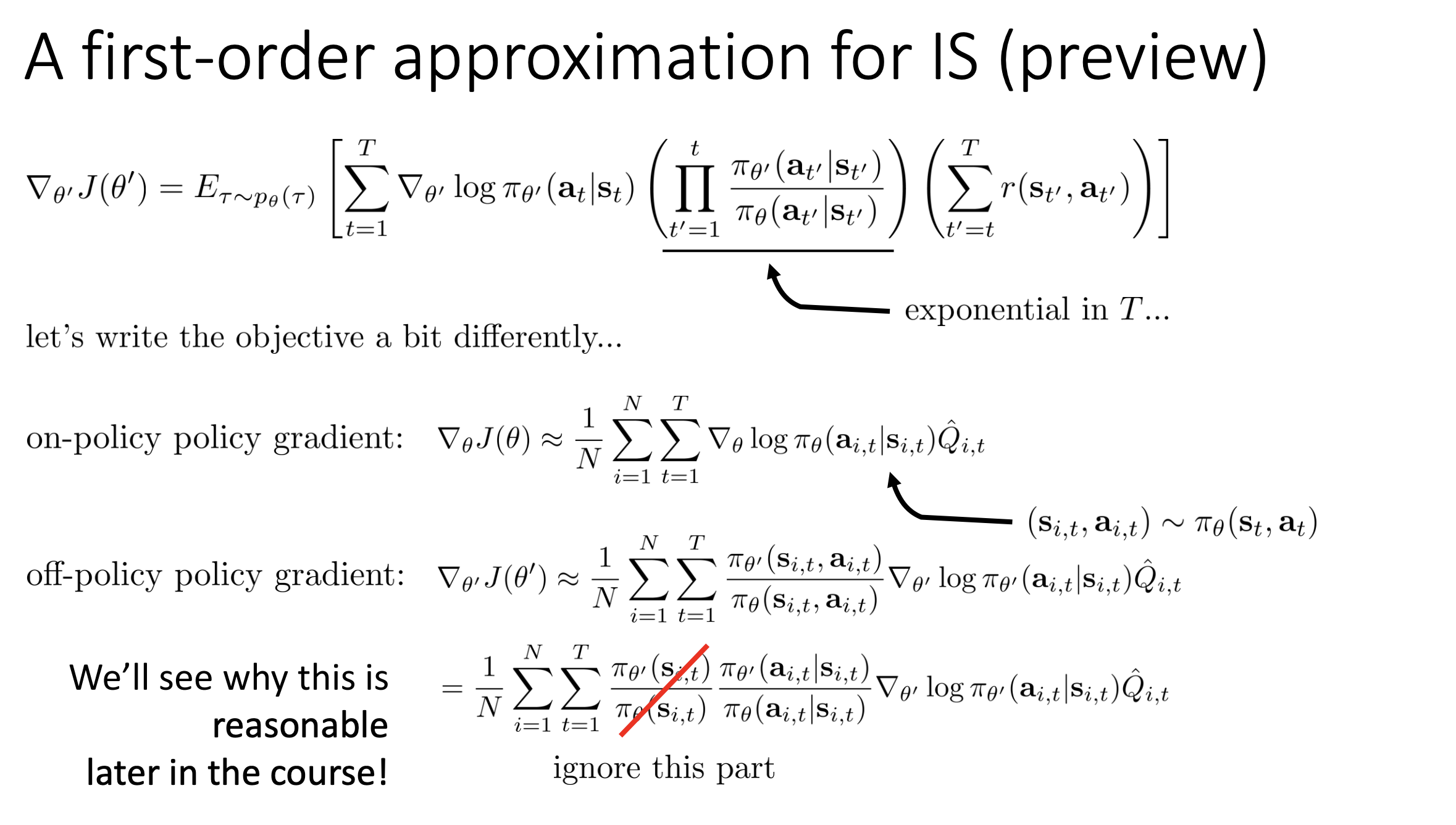
📌 In off-policy policy gradients, a first-order approximation is a crucial trick used to reduce the high variance caused by importance sampling. It makes off-policy learning practically feasible, especially in deep reinforcement learning.
- 🔁 On-Policy Nature of Policy Gradients:
- Policy gradient algorithms are inherently on-policy — they require new samples from the current policy after each parameter update.
- Since deep RL uses neural networks, which require many small updates, this can make on-policy learning extremely costly and inefficient when sample generation is expensive.
- 🔄 Enabling Off-Policy Learning via Importance Sampling:
- To reuse samples from previous policies or other sources (e.g., human demos), importance sampling is applied.
- This allows computing expectations under the new policy $\pi_{\theta’}$ using data collected from an old policy $\pi_\theta$.
- The key is the importance weight:
\(\frac{P_{\theta'}(\tau)}{P_\theta(\tau)} = \prod_{t=1}^T \frac{\pi_{\theta'}(a_t \mid s_t)}{\pi_\theta(a_t \mid s_t)}\)
- ⚠️ The Variance Problem:
- While this ratio makes the estimator unbiased, it leads to exponentially large variance.
- If $\pi_{\theta’}$ assigns low probability to actions taken by $\pi_\theta$, the product becomes close to zero, making gradients very noisy.
- This is even worse than the already high variance in on-policy gradients.
- 🧮 The First-Order Approximation:
- To mitigate this, a first-order approximation is applied.
- Idea: Drop the full product over all time steps and use only the per-step ratio of action probabilities:
\(\frac{\pi_{\theta'}(a_t \mid s_t)}{\pi_\theta(a_t \mid s_t)}\) - This approximation ignores the trajectory-level probability ratio, focusing only on the current time step’s action probability.
- 🤔 Rationale and Implications:
- This avoids the exponential blowup in variance, making gradient estimates much more stable.
- It introduces bias (no longer exact in expectation), but:
- The bias is bounded if $\theta’$ is close to $\theta$.
- The resulting update can still improve the policy in practice.
- It’s a practical trade-off: give up some theoretical correctness to gain massive stability and usability in deep RL.
- 🧪 When to Use It:
- Especially useful when:
- Sample collection is expensive.
- Policies change gradually (e.g., small learning rates).
- Many modern RL algorithms (e.g., PPO) implicitly rely on such approximations.
- Especially useful when:
✅ Summary:
The first-order approximation in off-policy policy gradients replaces full importance weights (across trajectories) with step-wise ratios of action probabilities.
This clever simplification controls variance, enabling efficient and stable learning, even at the cost of some bias — a crucial trick in practical deep reinforcement learning.
7. Implementing Policy Gradients with Autodiff
7.1. The Challenge
Backpropagation needs a differentiable computation graph with many parameters.
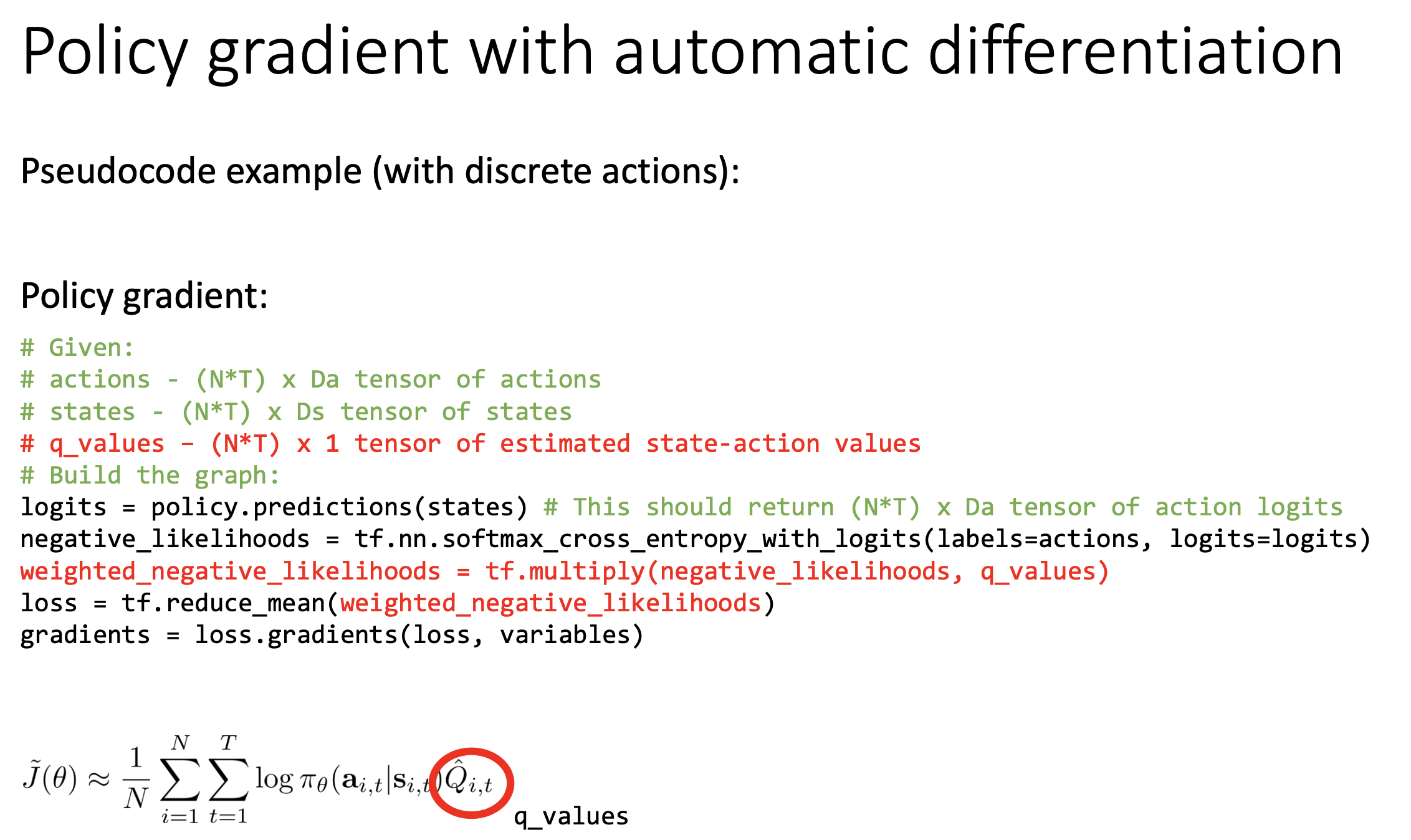
7.2. Pseudo-Loss for Autodiff
Define a pseudo-loss:
\[\tilde{J} = \sum_{i} \sum_{t} \log \pi(a_{i,t} \mid s_{i,t}) \cdot Q_{i,t}\]When autodiff differentiates $\tilde{J}$, it recovers the true policy gradient.
7.3. Practical Tips
- High Variance: Use large batches (thousands).
- Optimizer: Adam is acceptable; SGD is hard to tune.
- Hyperparameter Tuning: Crucial, especially for learning rate.
8. Advanced Policy Gradients
8.1. Poor Conditioning in Continuous Action Spaces
In continuous action policies (e.g., Gaussians), some parameters affect output more. E.g., small $\sigma$ in $\mathcal{N}(k s, \sigma)$ exaggerates gradient wrt $\sigma$.
8.2. Natural Policy Gradient
Rescale gradients so updates are equal in policy space, not parameter space.
-
Constrain divergence (KL) between $\pi_{\theta}$ and $\pi_{\theta’}$:
\[D_{KL}(\pi_{\theta'} \| \pi_{\theta}) \approx \frac{1}{2} (\theta' - \theta)^T F (\theta' - \theta)\] -
Fisher Information Matrix (FIM):
\[F = \mathbb{E}_{\pi_\theta} \left[\nabla_\theta \log \pi_\theta \cdot \nabla_\theta \log \pi_\theta^T\right]\] -
Natural Gradient Update:
\[\theta \leftarrow \theta + \alpha F^{-1} \nabla_\theta J(\theta)\]
Algorithms like TRPO and PPO build on this idea for stable training.
9. Conclusion and Future Topics
Policy gradients are a direct but high-variance method for optimizing policies in RL.
Key techniques to improve performance:
- Use reward-to-go (causality).
- Use baselines to reduce variance.
- Careful off-policy approximations.
- Address conditioning via natural gradients.
Next Topics:
- Actor-Critic methods (combine value functions for variance reduction).
- Advanced natural gradient techniques.
- Automatic step size adaptation.