
Actor-Critic Algorithms in Reinforcement Learning
This lecture focuses on Actor-Critic algorithms in Deep Reinforcement Learning. It covers the evolution from basic policy gradients, the role of value functions, various policy evaluation techniques, practical implementation considerations, and advanced variance reduction methods.
1. Introduction to Actor-Critic Algorithms
Actor-Critic algorithms augment the basic policy gradient framework with learned value functions (or Q-functions) to improve performance.
The core idea is to combine the strengths of policy-based and value-based methods:
- Actor: decides actions
- Critic: evaluates actions to guide policy updates
Anatomy of an RL Algorithm:
- Generate Samples (🟧): Run the current policy in the environment to collect trajectories.
- Estimate Return / Fit Value Function (🟩): Fit a neural network to estimate value functions.
- Improve Policy (🟦): Use estimated values or advantages to update the policy.
2. Improving Policy Gradients with Value Functions
Policy gradient methods like REINFORCE suffer from high variance because the gradient estimate relies on sampled returns, which can be noisy due to the stochastic nature of both the policy and the environment.
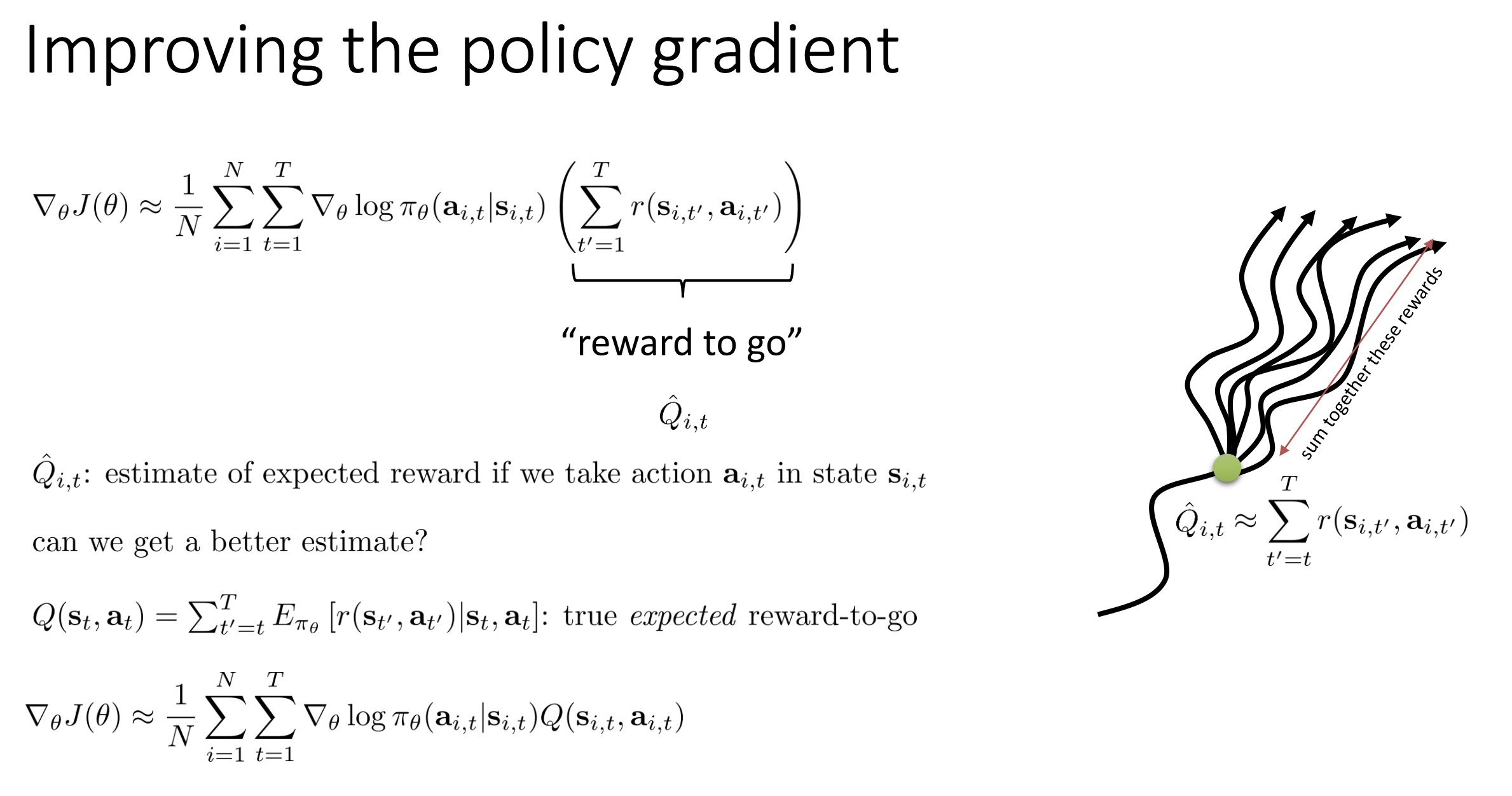
In vanilla policy gradient:
\[\nabla_\theta J(\theta) = \mathbb{E}_{\tau \sim \pi_\theta} \left[ \sum_t \nabla_\theta \log \pi_\theta(a_t \mid s_t) \cdot R_t \right]\]- $R_t$ is the reward-to-go, estimated from a single trajectory.
- This introduces high variance, especially in environments with sparse or delayed rewards.
To reduce variance, we introduce a critic that estimates value functions. This gives us better targets for the policy gradient, trading variance for some bias.
🎭 The Actor
- The policy $\pi_\theta(a_t \mid s_t)$, responsible for selecting actions.
- Learns via gradient ascent on an improved policy gradient estimate.
🧮 The Critic
Estimates value functions to provide low-variance learning signals for the actor.
🔹 Q-function: $Q^\pi(s_t, a_t)$
Expected total reward after taking action $a_t$ in state $s_t$ and following policy $\pi$: \(Q^\pi(s_t, a_t) = \mathbb{E} \left[ \sum_{t'} \gamma^{t'-t} r_{t'} \mid s_t, a_t \right]\)
- In policy gradient: replaces $R_t$ with $Q^\pi(s_t, a_t)$ for lower variance.
🔹 Value Function: $V^\pi(s_t)$
Expected total reward starting from state $s_t$ and following $\pi$: \(V^\pi(s_t) = \mathbb{E}_{a_t \sim \pi} \left[ Q^\pi(s_t, a_t) \right]\)
🔹 Advantage Function: $A^\pi(s_t, a_t)$
Measures how much better an action is compared to the average action at $s_t$: \(A^\pi(s_t, a_t) = Q^\pi(s_t, a_t) - V^\pi(s_t)\)
- Crucial for variance reduction.
- Encourages actions that are better-than-average: \(\nabla_\theta J(\theta) = \mathbb{E} \left[ \nabla_\theta \log \pi_\theta(a_t \mid s_t) \cdot A^\pi(s_t, a_t) \right]\)
🛠️ Why It Works
- High variance in REINFORCE comes from using full returns $R_t$ from a single sample.
- The critic uses function approximation to estimate $V^\pi$ and $Q^\pi$, smoothing out the randomness over many experiences.
- This introduces some bias but massively reduces variance, improving learning stability.
✅ Summary
| Component | Role | Benefit |
|---|---|---|
| Actor | Learns the policy | Selects optimal actions |
| Critic | Estimates value functions | Reduces variance of gradients |
| $Q^\pi(s, a)$ | Expected return of action | More accurate feedback |
| $V^\pi(s)$ | Baseline value | Helps define advantages |
| $A^\pi(s, a)$ | Action quality vs average | Sharpens learning signal |
The Advantage Actor-Critic (A2C) method uses $A^\pi(s_t, a_t)$ instead of raw returns, striking a powerful balance between bias and variance, and accelerating training by focusing updates on actions that exceed expectations.
3. Policy Evaluation: Fitting Value Functions
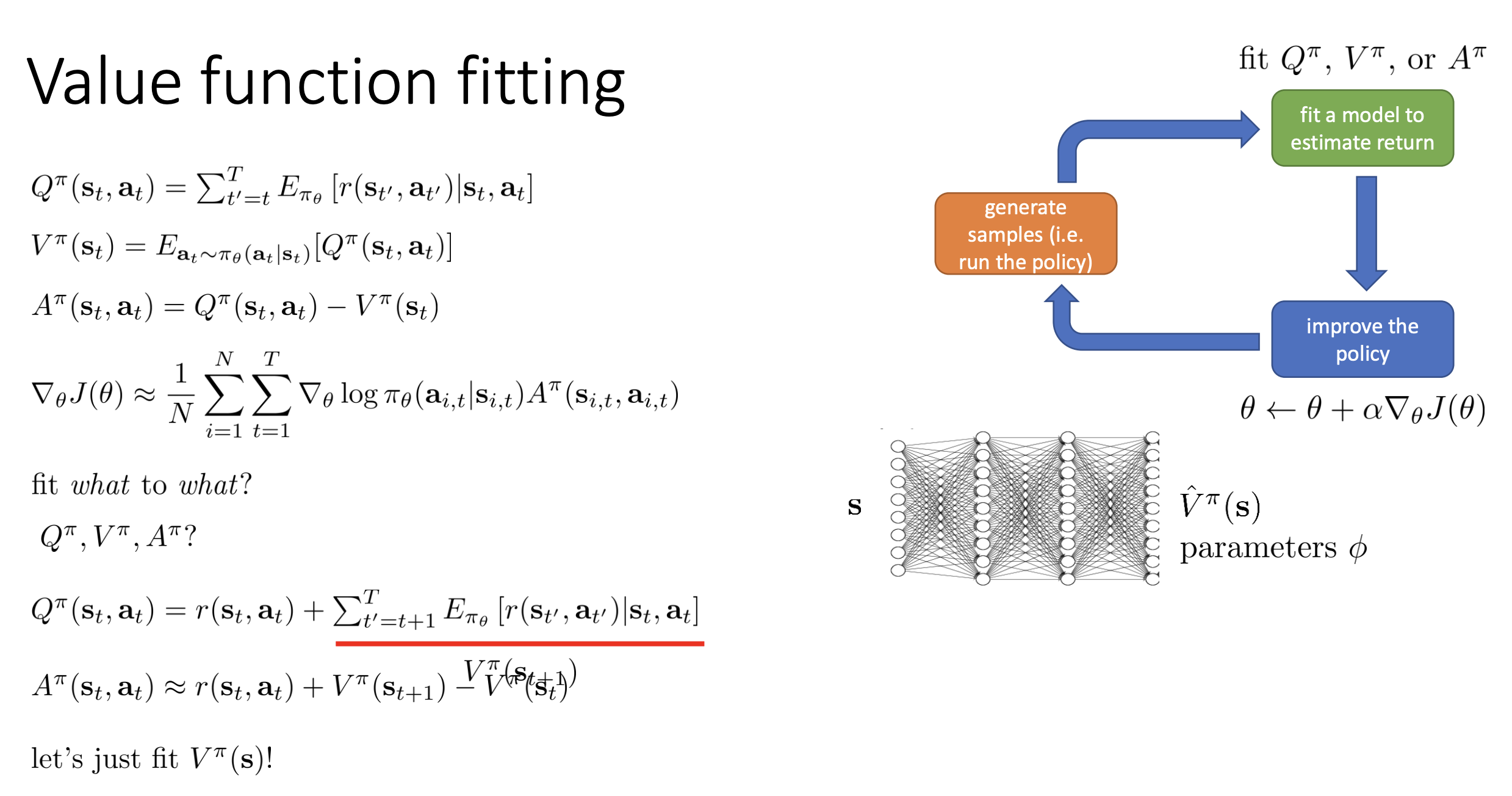
3.1. Monte Carlo Evaluation with Function Approximation
🔍 Core Idea
-
Estimate value of state $s_t$ by rolling out full episodes and computing:
\[y_{i,t} = \sum_{t'=t}^{T} r(s_{i,t'}, a_{i,t'})\] - This is called reward-to-go.
- It’s unbiased, but has high variance due to randomness in trajectories.
🤖 With Function Approximation
-
Train a neural network $\hat{V}^\pi_\phi(s)$ to fit:
\[\min_\phi \sum_i \left( \hat{V}^\pi_\phi(s_{i,t}) - y_{i,t} \right)^2\] - Inputs: states $s_{i,t}$
- Targets: Monte Carlo returns $y_{i,t}$ from sample rollouts
✅ Benefits
- Learns to generalize: nearby or similar states share value estimates.
- Reduces variance by averaging over noisy returns.
⚠️ Downside
- May introduce bias if value function is inaccurate.
- Trade-off: Slight bias is often worth the large variance reduction.
💡 Example
Suppose two trajectories start from the same state $s_t$:
- Traj 1: reward-to-go = 100
- Traj 2: reward-to-go = 20
Neural net learns that $s_t$ likely has a value ≈ 60.
3.2. Bootstrap Estimates
🔍 Core Idea
-
Use a 1-step TD estimate instead of full return:
\[y_t = r_t + \gamma \hat{V}^\pi_\phi(s_{t+1})\] -
Only look one step ahead, then use the critic’s prediction.
✅ Benefits
- Much lower variance than Monte Carlo
- Doesn’t require waiting until episode ends
⚠️ Downside
- Introduces bias because $\hat{V}$ is imperfect.
- Error at $s_{t+1}$ affects $s_t$ → error propagation
💡 Example
From $s_t$:
- Reward $r_t = 1$
- $\hat{V}(s_{t+1}) = 5$
- Target: $1 + 0.99 * 5 = 5.95$
3.3. Bias-Variance Trade-Off
| Method | Bias | Variance | Notes |
|---|---|---|---|
| Monte Carlo | ❌ None | 🔺 High | True expectation, but noisy |
| Bootstrap (TD) | ✅ Yes | 🔻 Low | Fast updates, but relies on learned $\hat{V}$ |
| Function Approx MC | ✅ Small | 🔻 Lower | Reduced variance from generalization |
🎯 Goal: Find a balance between bias and variance
➡ Techniques like N-step returns or Generalized Advantage Estimation (GAE) achieve this.
Let’s walk through both methods with a short trajectory:
Assume a trajectory from time steps $t = 0, 1, 2$ with:
- States: $s_0, s_1, s_2$
- Rewards: $r_0 = 1$, $r_1 = 2$, $r_2 = 3$
- Discount: $\gamma = 0.9$
🎲 Monte Carlo (MC):
- At $s_0$, reward-to-go = $1 + 0.9 \cdot 2 + 0.9^2 \cdot 3 = 1 + 1.8 + 2.43 = 5.23$
- At $s_1$, reward-to-go = $2 + 0.9 \cdot 3 = 2 + 2.7 = 4.7$
- At $s_2$, reward-to-go = $3$
So training data is: (s_0, 5.23), (s_1, 4.7), (s_2, 3.0) Train value network to predict those returns from the input states.
⚡ Bootstrap (TD(0)):
- At $s_2$, there’s no $s_3$, so maybe: $y_2 = r_2 = 3$
- At $s_1$, bootstrap target: $y_1 = 2 + 0.9 \cdot \hat{V}(s_2)$
- At $s_0$, bootstrap target: $y_0 = 1 + 0.9 \cdot \hat{V}(s_1)$
So you use the network’s own prediction to estimate value targets.
3.4. Discount Factor ($\gamma$)
🧠 Why use $\gamma \in (0,1)$?
- Prefers sooner rewards (time preference)
- Prevents infinite returns in infinite-horizon settings
- Can be viewed as “probability of death” each step
📉 Variance Reduction
- Distant rewards contribute less due to $\gamma^k$
- Helps stabilize learning
💡 Example
Compare full returns with and without discounting:
Un-discounted: \(G = 1 + 1 + 1 + \cdots = \infty\)
Discounted ($\gamma = 0.9$): \(G = 1 + 0.9 + 0.9^2 + \cdots = \frac{1}{1 - 0.9} = 10\)
🧠 Summary
- Monte Carlo (MC) methods estimate true returns but are noisy.
- Bootstrap methods are biased but efficient and low variance.
- Function approximation helps generalize and reduce variance.
- Discount factors stabilize training and make distant rewards less influential.
- All these tools aim to produce a more reliable critic to improve policy gradients.
4. Actor-Critic Training Regimes (Online, Batch, Offline)
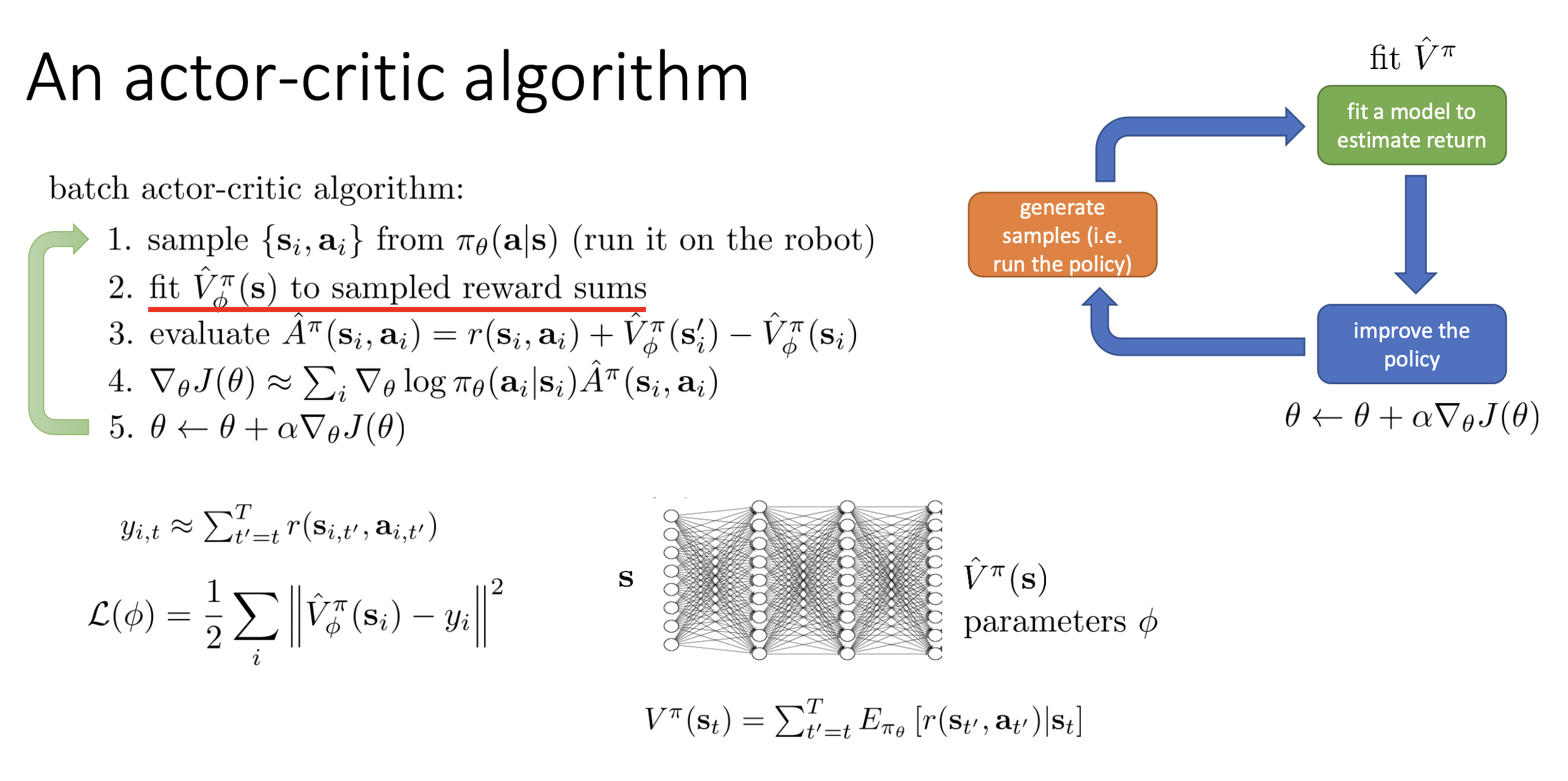
Many terms are overloaded. A clean way is to separate three axes:
- Data source: current policy data vs replay data vs fixed offline dataset
- Update schedule: per-step update vs mini-batch update vs large-batch/epoch update
- Target type: Monte Carlo vs bootstrap (or in-between n-step / GAE)
4.1 Batch Actor-Critic (On-Policy)
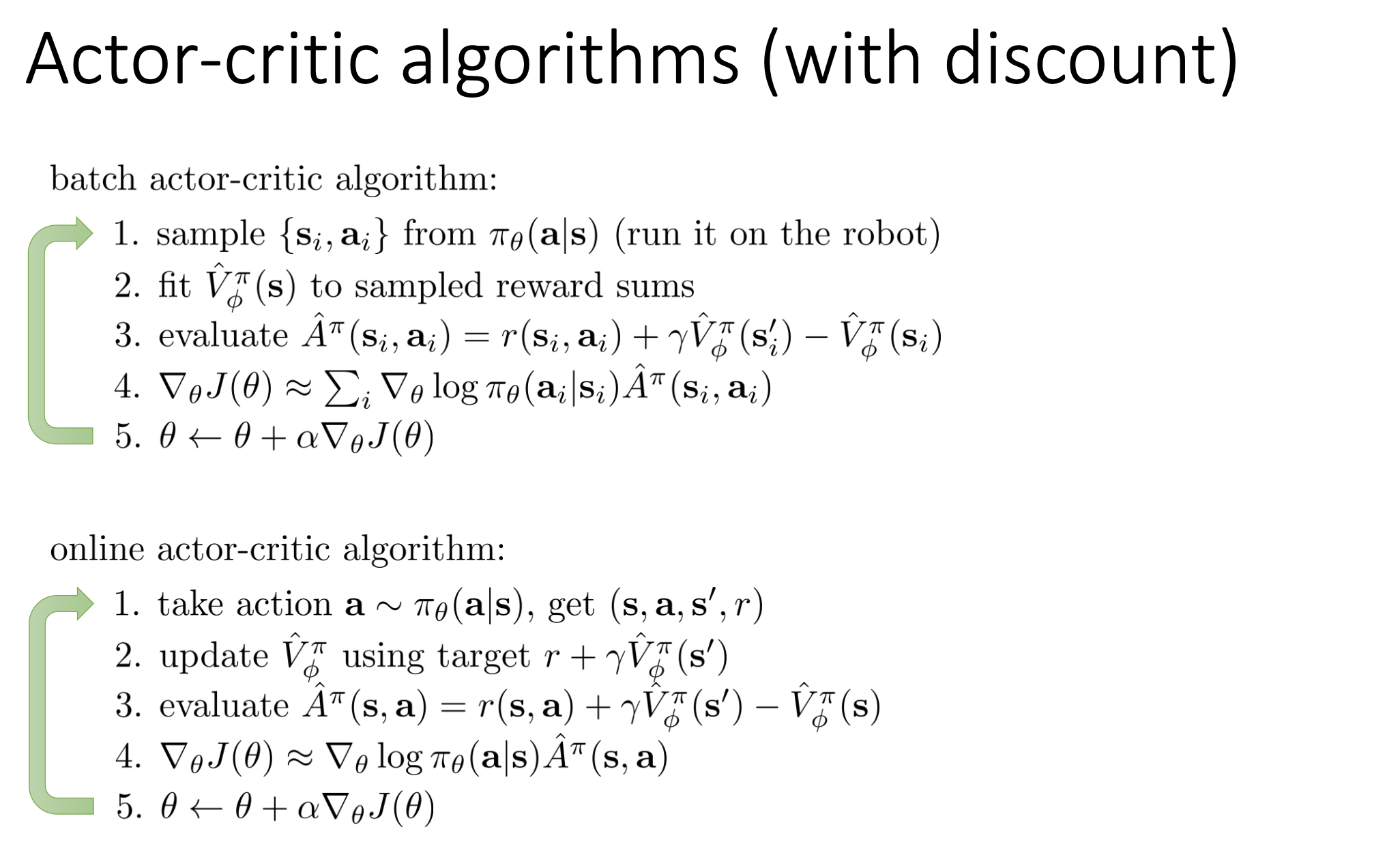
Typical loop:
- Roll out current policy
pi_thetaforNtrajectories. - Fit critic
V_phi(or a Q-critic) on this fresh batch. - Compute advantages (often GAE / n-step).
- Update actor with policy gradient.
- Discard old batch (or use only a few epochs, then recollect data).
Policy gradient form:
\(\nabla_\theta J(\theta) \approx \frac{1}{N}\sum_{i,t}\nabla_\theta \log \pi_\theta(a_{i,t}\mid s_{i,t})\hat{A}_{i,t}\)
Plain text fallback: grad J(theta) ~= (1/N) * sum_{i,t} grad log pi_theta(a_{i,t}|s_{i,t}) * Ahat_{i,t}.
Properties:
- ✅ Stable updates, easy to reason about
- ✅ Strong with trust-region style methods (TRPO/PPO)
- ❌ Lower sample efficiency (data is used briefly)
4.2 Online Actor-Critic (Streaming, Step-Wise)
Online AC updates immediately after each transition:
- Observe transition
(s_t, a_t, r_t, s_{t+1}) - TD target:
\(y_t = r_t + \gamma \hat{V}_\phi(s_{t+1})\)
Plain text fallback:
y_t = r_t + gamma * V_phi(s_{t+1}). - Advantage:
\(\hat{A}_t = y_t - \hat{V}_\phi(s_t)\)
Plain text fallback:
Ahat_t = y_t - V_phi(s_t). - Update actor and critic right away
Properties:
- ✅ Fast reaction to new experience
- ✅ Low memory requirement
- ❌ High gradient noise with deep nets if truly one-sample updates
4.3 “Online-Batch” Actor-Critic (Most Practical Deep RL)
This phrase means: data is collected online, but training is done in batches.
Common pipeline (A2C/PPO-style):
- Run $K$ environments in parallel for $T$ steps
- Build one batch of size $K \times T$
- Compute returns/advantages (often GAE)
- Train with SGD mini-batches
So it is “online” in data collection, but “batch” in optimization.
4.4 Monte Carlo vs Bootstrap Inside Actor-Critic
These are target estimators, not separate algorithm families.
Monte Carlo target: \(y_t^{MC}=\sum_{l=0}^{T-t}\gamma^l r_{t+l}\)
Bootstrap (TD(0)) target: \(y_t^{TD}=r_t+\gamma\hat{V}_\phi(s_{t+1})\)
n-step target: \(y_t^{(n)}=\sum_{l=0}^{n-1}\gamma^l r_{t+l}+\gamma^n \hat{V}_\phi(s_{t+n})\)
Comparison:
| Target | Bias | Variance | Typical use |
|---|---|---|---|
| Monte Carlo | Low | High | Short episodes, low noise tasks |
| TD(0) bootstrap | Higher | Low | Online AC, fast continual updates |
| n-step / GAE | Medium | Medium | PPO/A2C default in practice |
4.5 Off-Policy vs Offline Actor-Critic
These two are related but not identical:
- Off-policy actor-critic (online):
- Still interacts with environment
- Also reuses replay data from older behavior policies
- Examples: DDPG, TD3, SAC
- Offline actor-critic:
- No environment interaction during training
- Learns only from a fixed dataset
- Must handle out-of-distribution action errors very carefully
- Examples: CQL, IQL, AWAC-style pipelines
So: offline RL is a stricter setting than off-policy RL.
5. Design Decisions & Practical Implementations
5.1 Neural Network Architectures
| Design | Pros | Cons | Typical choice |
|---|---|---|---|
| Separate actor/critic networks | Stable optimization, less gradient interference | More parameters, no shared representation | Default when training is unstable |
| Shared backbone + two heads | Better compute efficiency, shared features | Actor and critic gradients can conflict | Common in on-policy vision/state encoders |
| Partially shared (early shared, late separate) | Balance efficiency and stability | More tuning complexity | Good compromise in larger models |
Rule of thumb:
- If critic loss dominates and policy collapses, move toward more separation.
- If compute is tight and features overlap strongly, use shared trunk + loss balancing.
5.2 Batch Sizes and Parallelism
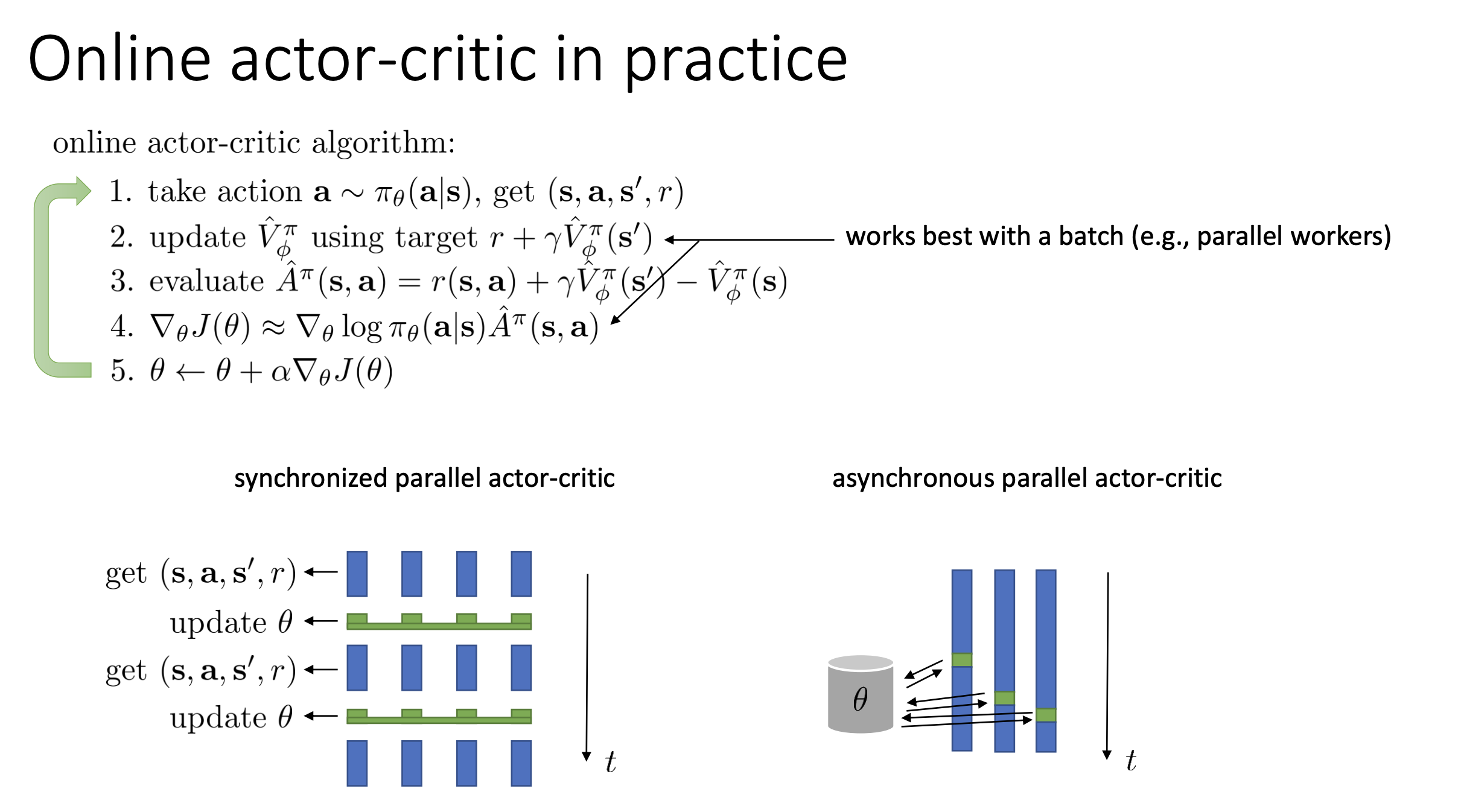
Synchronous Parallel (A2C-style)
- Workers collect data, then all wait for joint update.
- ✅ Consistent policy version per batch (cleaner gradients)
- ✅ Better reproducibility and debugging
- ❌ Idle waiting on slow workers, higher wall-clock cost
Asynchronous Parallel (A3C-style)
- Workers update without global synchronization.
- ✅ High throughput
- ✅ Better hardware utilization
- ❌ Policy-lag / stale-gradient bias (worker data may be slightly old)
Practical guidance:
- Prefer synchronous if you care about stability and ablations.
- Prefer asynchronous when throughput is the top constraint.
5.3 Replay Buffer System Design (Core for Off-Policy / Offline AC)
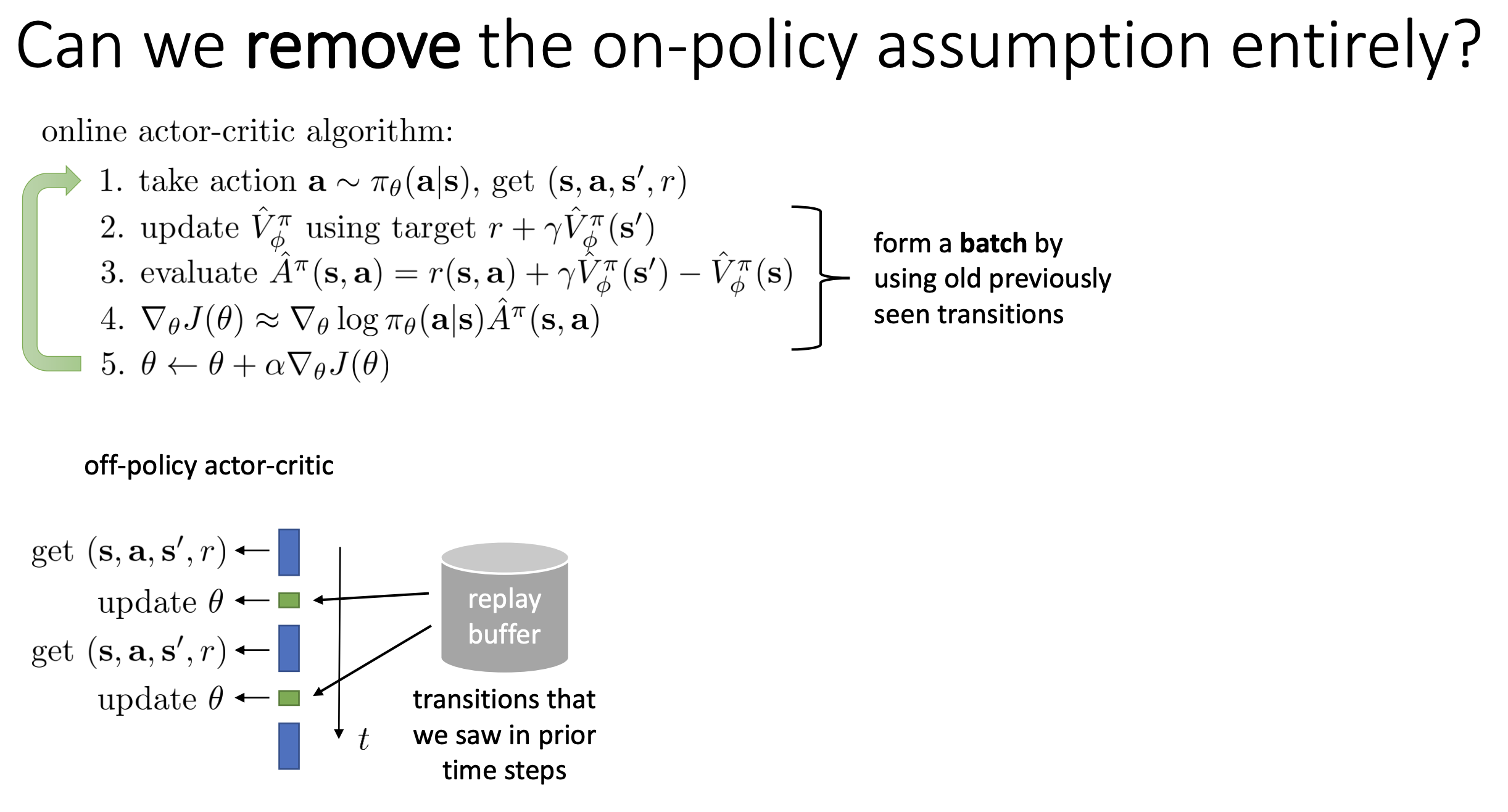
Store per transition: \((s_t, a_t, r_t, s_{t+1}, d_t)\) Optional: behavior log-prob, episode id, n-step cumulative reward.
Key design choices:
- Capacity
- Small buffer: fresher but less diverse
- Large buffer: diverse but may contain stale behavior
- Sampling
- Uniform sampling: simple and stable baseline
- Prioritized replay: faster learning on high-TD-error samples, but needs importance correction
- Update-to-data ratio (UTD)
- Number of gradient steps per env step
- Too high UTD can overfit stale data and destabilize critic
- Target stabilization
- Use target networks and soft update ($\tau$) to reduce bootstrapping instability
- Offline-specific safeguards
- Penalize OOD actions (conservative Q-learning ideas)
- Constrain actor toward dataset support (behavior regularization / expectile-style methods)
Off-Policy Actor-Critic Objective (High-Level)
Critic target: \(y_i = r_i + \gamma \hat{Q}_{\bar{\phi}}(s'_i, a'_i),\quad a'_i \sim \pi_\theta(\cdot\mid s'_i)\)
Actor objective (maximize Q, optionally with entropy regularization): \(J_{\text{actor}}(\theta)=\mathbb{E}_{s_i\sim \mathcal{D}}\!\left[\hat{Q}_\phi\!\left(s_i,\pi_\theta(s_i)\right)\right]+\alpha\,\mathbb{E}_{s_i\sim \mathcal{D}}\!\left[\mathcal{H}\!\left(\pi_\theta(\cdot\mid s_i)\right)\right]\)
6. Critics as Baselines (Unbiased Variance Reduction)
6.1 State-Dependent Baselines
Unbiased if the baseline only depends on state:
\[\nabla_\theta J(\theta) \approx \frac{1}{N} \sum_{i,t} \nabla_\theta \log \pi_\theta(a_{i,t} \mid s_{i,t}) (Q - V)\]- ✅ Unbiased
- ✅ Lower variance than constant
- ❌ Still high variance vs actor-critic
6.2 Control Variates: Action-Dependent Baselines
Baseline $( b(s,a) )$ introduces bias, but can correct it:
\[\nabla_\theta J(\theta) = \mathbb{E}[\nabla_\theta \log \pi(a \mid s) (Q - b(s,a))] + \mathbb{E}[\nabla_\theta \mathbb{E}[b(s,a)]]\]- ✅ Very low variance with good $( b(s,a) )$
6.3 Eligibility Traces & N-Step Returns
🎯 Motivation for N-Step Returns
Policy gradient methods face a bias-variance trade-off:
- Monte Carlo (MC) estimates (full trajectory return) are unbiased but have high variance.
- Actor-Critic (1-step) estimates use a learned value function to reduce variance, but introduce bias due to function approximation errors.
N-Step Returns provide a middle ground by using a mix of real rewards and estimated values.
🔁 N-Step Return: Concept
The n-step return is defined as:
\[\hat{A}^{(n)}_t = \sum_{t'=t}^{t+n-1} \gamma^{t'-t} r(s_{t'}, a_{t'}) + \gamma^n \hat{V}_\phi(s_{t+n}) - \hat{V}_\phi(s_t)\]- First term: Actual discounted rewards over $n$ steps (adds variance)
- Second term: Estimated value at $s_{t+n}$ (adds bias if $\hat{V}_\phi$ is inaccurate)
- Third term: Baseline subtraction (for variance reduction)
⚖️ Bias-Variance Trade-Off
| Parameter | Effect |
|---|---|
| Large n | ✅ Lower bias (less reliance on $\hat{V}$) ❌ Higher variance (more sample noise) |
| Small n | ✅ Lower variance (less noisy estimate) ❌ Higher bias (more reliance on possibly inaccurate $\hat{V}$) |
Optimal n is typically intermediate — not 1 (pure TD), not $\infty$ (pure MC).
🧠 Intuition
- Early rewards are less noisy → estimate them using real rewards.
- Far-future rewards are more uncertain → use value function estimate.
This strategy reduces variance while keeping bias manageable.
6.4 Generalized Advantage Estimation (GAE)
Instead of choosing a fixed $n$ for n-step return, GAE computes a weighted sum of all possible n-step estimators, providing a smoother bias-variance trade-off.
📐 GAE Definition
GAE advantage estimator:
\[\hat{A}^{GAE}_t = \sum_{l=0}^{\infty} (\gamma \lambda)^l \delta_{t+l}\]Where:
\[\delta_t = r(s_t, a_t) + \gamma \hat{V}_\phi(s_{t+1}) - \hat{V}_\phi(s_t)\]- $\delta_t$ is the TD error
- $\lambda \in [0, 1]$ controls the bias-variance trade-off
⚙️ Lambda ($\lambda$) in GAE
| Lambda ($\lambda$) | Behavior |
|---|---|
| $\lambda \approx 0$ | → 1-step TD → Low variance, high bias |
| $\lambda \approx 1$ | → Full MC return → Low bias, high variance |
GAE allows smooth interpolation between TD(0) and MC using $\lambda$.
🎛 Gamma ($\gamma$) for Discounting
- Smaller $\gamma$:
- Reduces weight on far-future rewards → less variance, more bias
- Often interpreted as shorter planning horizon or risk aversion
🧪 Practical Use
- GAE is used in modern actor-critic methods like PPO and TRPO.
- Introduced in:
📝 High-Dimensional Continuous Control with Generalized Advantage Estimation, Schulman et al., 2016
🔚 Summary
| Technique | Purpose | Trade-Off |
|---|---|---|
| N-step returns | Mix real rewards + value estimate | Adjust $n$ for bias-variance |
| GAE | Blend all $n$ with weighted sum | Tune $\lambda$ for smooth trade-off |
7. Summary & Examples
Actor-Critic combines actor and critic for reduced variance and efficient learning.
Key Takeaways:
- Policy Evaluation: Fit $( V^\pi )$, $( Q^\pi )$, or $( A^\pi )$
- Training Regimes: Distinguish online, batch-on-policy, online-batch, and offline
- Discounting: Enables infinite horizon, lowers variance
- Architecture: Shared vs separate networks
- Batching + Systems: Sync/async workers, replay buffer design, UTD ratio
- Baselines: Reduce variance (state-dependent = no bias)
- GAE / Traces: Bias-variance tuning
Examples in Literature:
- TD-Gammon (1992), AlphaGo (2016)
- GAE: Continuous control
- A3C: Asynchronous, online
- SAC: Off-policy with entropy regularization
- Q-Prop: Control variates for sample-efficient learning
8. Worked Summary Example (One Trajectory, All Update Styles)
This final section uses one shared trajectory and shows how each training style updates differently.
8.1 Shared Setup
- Discount:
gamma = 0.9 - Trajectory:
t=0:(s0, a0, r1=1, s1)t=1:(s1, a1, r2=2, s2)t=2:(s2, a2, r3=3, terminal)
- Critic snapshot before updates:
V(s0)=4.0,V(s1)=3.0,V(s2)=1.0,V(terminal)=0
1-step TD targets and advantages: \(y_0 = 1 + 0.9\cdot 3.0 = 3.7,\quad \hat{A}_0 = 3.7 - 4.0 = -0.3\) \(y_1 = 2 + 0.9\cdot 1.0 = 2.9,\quad \hat{A}_1 = 2.9 - 3.0 = -0.1\) \(y_2 = 3 + 0.9\cdot 0 = 3.0,\quad \hat{A}_2 = 3.0 - 1.0 = 2.0\)
Monte Carlo returns: \(G_2=3,\quad G_1=2+0.9\cdot 3=4.7,\quad G_0=1+0.9\cdot 2+0.9^2\cdot 3=5.23\)
8.2 On-Policy Batch (single update cycle)
Assume one training iteration k starts from parameters (theta_k, phi_k).
Detailed workflow on this exact trajectory:
- Collect fresh data with current policy
- Run
pi_{theta_k}in the environment. - We get
(s0,a0,r1,s1), (s1,a1,r2,s2), (s2,a2,r3,terminal). - This data is on-policy because it was generated by
theta_k.
- Run
- Build learning targets from this same batch
- TD(0) targets from Section 8.1:
y0=3.7, y1=2.9, y2=3.0
- Advantages:
Ahat=[-0.3, -0.1, +2.0]
- If using n-step or GAE, only this computation changes; the pipeline is the same.
- TD(0) targets from Section 8.1:
- Critic update on this batch
- Fit
V_phiby minimizing: \(L_V(\phi)=\frac{1}{3}\sum_{t=0}^2\left(V_\phi(s_t)-y_t\right)^2\) - Intuition with our numbers:
V(s2)=1.0is far below target3.0, so critic strongly increases value arounds2.V(s0)=4.0is above3.7, andV(s1)=3.0is above2.9, so those tend to move slightly down.
- Fit
- Actor update using same transitions
- Policy loss (gradient ascent form): \(L_\pi(\theta)=-\frac{1}{3}\sum_{t=0}^2 \log \pi_\theta(a_t\mid s_t)\,\hat{A}_t\)
- Effect of signs:
Ahat_0<0,Ahat_1<0: decrease probability of(a0|s0)and(a1|s1).Ahat_2>0: increase probability of(a2|s2).
- End of cycle: discard rollout and recollect
- After updates, parameters become
(theta_{k+1}, phi_{k+1}). - Old rollout is no longer strictly on-policy for
theta_{k+1}, so we recollect new data. - This is why on-policy batch methods are stable but less sample-efficient.
- After updates, parameters become
8.3 Synchronous Parallel (A2C-style)
Assume K=2 workers, each collects T=3 steps with the same parameter snapshot theta_k.
Detailed workflow with shared example:
- Parameter broadcast
- Global learner sends the same
(theta_k, phi_k)to Worker 1 and Worker 2.
- Global learner sends the same
- Parallel rollout
- Worker 1 collects our shared trajectory (3 steps).
- Worker 2 collects another 3-step trajectory from its own environment instance.
- No one updates model weights during collection.
- Barrier synchronization
- Both workers stop and wait.
- Combined batch size is
K*T=6transitions.
- Compute targets/advantages on aggregated batch
- Worker 1 samples contribute
Ahat=[-0.3,-0.1,+2.0]. - Worker 2 contributes its own advantages.
- Learner averages losses across all 6 transitions.
- Worker 1 samples contribute
- Single synchronized update
- One optimizer step produces
(theta_{k+1}, phi_{k+1}). - This gradient is consistent with one parameter snapshot, so variance is lower and training is easier to reason about.
- One optimizer step produces
- Broadcast new weights and repeat
- All workers start the next rollout with the same fresh parameters.
Key difference vs 8.2:
- Same on-policy logic, but larger, more stable batches from parallel environments.
- Cost: faster workers can idle at the barrier waiting for slow workers.
8.4 Asynchronous Parallel (A3C-style)
Detailed timeline on the same trajectory:
- Start from global params
- Worker A pulls
theta_kand begins collecting our shared trajectory. - Worker B also pulls
theta_kbut in a different environment instance.
- Worker A pulls
- No barrier; workers update independently
- Worker B finishes first, computes gradients, and applies them to global weights.
- Global model is now closer to
theta_{k+1}.
- Worker A is now stale
- Worker A is still finishing rollout produced under old
theta_k. - It computes advantages from that rollout (including
[-0.3,-0.1,+2.0]for our shared path).
- Worker A is still finishing rollout produced under old
- Stale gradient applied to newer global model
- Worker A pushes gradient to global parameters that already changed.
- So gradient was computed at old policy but applied at newer policy.
- Pull-latest and continue
- Worker A refreshes local weights and starts next rollout.
Why it behaves differently:
- Throughput is high because no waiting.
- Bias appears from policy lag (stale gradients), which can hurt stability if lag is large.
8.5 Online-Batch (PPO/A2C practical loop)
This is the common deep RL production pattern: online data collection, but SGD in mini-batches.
Why it can look similar to 8.3:
- Both often collect
K*Ton-policy transitions from parallel environments. - Both can pause collection, compute advantages, then update parameters.
Core distinction:
- 8.3 (sync parallel) describes a systems topology: workers are synchronized by a barrier and produce one aligned batch snapshot.
- 8.5 (online-batch) describes an optimization protocol: what you do with a collected rollout buffer (mini-batches, number of epochs, clipping, normalization).
When they are effectively the same:
- If you do synchronized collection and then only one full-batch update (
1epoch, no mini-batch reuse), 8.5 almost collapses to 8.3 behavior.
When they differ in practice (most PPO code):
- 8.3-style collection is used, but 8.5 optimization performs multiple SGD epochs over the same rollout.
- So one rollout can drive many optimizer steps before recollection.
- This improves hardware efficiency and learning speed, but pushes data farther from perfectly on-policy as epochs increase.
Detailed workflow:
- Rollout phase (online)
- Run
Kenvironments with currenttheta_k. - Store transitions in a short-lived rollout buffer until size
K*T. - Our shared 3-step trajectory is one slice inside this rollout buffer.
- Run
- Freeze rollout and compute training signals
- Compute
y_t,Ahat_t, returns (often with GAE). - Optionally normalize advantages across the whole rollout buffer.
- Compute
- Optimization phase (batch SGD)
- Shuffle rollout buffer into mini-batches.
- Run several epochs over the same collected data (for PPO, usually clipped objective).
- Our shared trajectory can be reused multiple optimizer passes in this phase.
- Clear rollout buffer and recollect
- After fixed epochs, discard this rollout data.
- Continue stepping env with updated policy and build the next on-policy batch.
Why it works well:
- More stable than pure step-wise online updates.
- Better hardware utilization via matrix mini-batches.
- Still near on-policy because data lifetime is short.
Concrete contrast on our shared trajectory:
- In 8.3, Worker 1’s
[-0.3,-0.1,+2.0]usually contributes once in one synchronized update. - In 8.5 (PPO-style), the same three samples may be revisited across multiple mini-batches/epochs before being dropped.
8.6 Off-Policy with Replay Buffer (SAC/TD3-style)
Now behavior policy and update policy are different:
- Behavior policy that generated stored data:
mu - Current policy being optimized:
pi_theta - Replay stores:
(s,a,r,s',d)and optionally behavior log-problog mu(a|s)
Per update:
- Interact and store
- Environment step is generated by behavior policy
mu(could be old actor + exploration noise). - Push transition tuple to replay.
- Our shared trajectory transitions become replay rows that may be sampled many times later.
- Environment step is generated by behavior policy
- Sample random mini-batch from replay
- Batch can contain very old and very new transitions.
- This breaks temporal correlation and increases sample reuse.
- Critic target uses next action from current/target policy, not necessarily stored action:
\(y = r + \gamma Q_{\text{target}}(s', a'),\quad a' \sim \pi_{\text{target}}(\cdot\mid s')\)
- For our shared transition
(s1,a1,r2,s2), storeda1came from oldmu, but target usesa'drawn from current target policy ats2.
- For our shared transition
- Critic update
- Regress
Q_\phi(s,a)towardyon sampled replay actionsa. - This learns from historical behavior while tracking current policy value.
- Regress
- Actor update uses current policy actions on sampled states
\(J_{\text{actor}}(\theta)=\mathbb{E}_{s\sim D}\left[Q_\phi\!\left(s,\pi_\theta(s)\right)\right]\)
- States come from replay; actions are regenerated by current actor.
- This avoids direct dependence on old behavior action probabilities in many implementations.
- Target-network update
- Soft update target critics (and target actor in TD3/DDPG) for stability.
How policy change affects target/action:
- Stored action
awas from oldmu; target actiona'is from new/target policy. - So target value tracks current policy improvement, while still reusing old states/transitions.
Action-space note:
- Discrete stochastic: expectation/sampling over action probabilities.
- Continuous stochastic (e.g., SAC): sample
a'from Gaussian policy. - Continuous deterministic (DDPG/TD3):
a' = pi_target(s').
If you explicitly reuse behavior action in policy gradient form, you need correction ratios like: \(\rho_t = \frac{\pi_\theta(a_t \mid s_t)}{\mu(a_t \mid s_t)}\) but many modern off-policy actor-critic methods avoid direct importance-weighted log-prob gradients by using the Q-maximization actor objective above.
8.7 Offline Actor-Critic (fixed dataset)
Detailed workflow:
- Freeze dataset
- No simulator interaction during training.
- Dataset
D_offlineis fixed before optimization starts. - Our shared trajectory appears as static rows in this dataset.
- Offline mini-batch sampling
- Every gradient step samples only from
D_offline. - Same rows can be replayed many times across epochs.
- Every gradient step samples only from
- Critic training (off-policy)
- Similar Bellman-style targets as replay methods.
- But because we cannot collect corrective data, extrapolation error is dangerous.
- Conservative / behavior-regularized actor training
- Penalize actions far from dataset support, or regularize toward behavior policy.
- Goal: prevent actor from exploiting critic errors on unseen actions.
- Iterate until convergence; deploy carefully
- Validation is typically done with held-out offline metrics and cautious online testing.
How shared example is used:
- It keeps reappearing during training because data is fixed.
- Main failure mode is OOD action overestimation: critic assigns high values to actions not supported by dataset.
8.8 Control Variates, N-step, and GAE on This Same Trajectory
A) Control Variates (Baselines)
Without baseline (REINFORCE-style weights): use G_t directly:
- weights:
[5.23, 4.7, 3.0]
With state baseline V(s_t), use advantage G_t - V(s_t):
- weights:
[1.23, 1.7, 2.0]
Interpretation:
- Mean shift removed, variance reduced, gradient direction kept unbiased for state-only baseline.
B) N-step Returns from t=0
1-step advantage: \(\hat{A}^{(1)}_0 = r_1 + \gamma V(s_1) - V(s_0) = 1 + 0.9\cdot 3 - 4 = -0.3\)
2-step advantage: \(\hat{A}^{(2)}_0 = r_1 + \gamma r_2 + \gamma^2 V(s_2) - V(s_0) = 1 + 0.9\cdot 2 + 0.9^2\cdot 1 - 4 = -0.39\)
3-step (MC) advantage: \(\hat{A}^{(3)}_0 = G_0 - V(s_0) = 5.23 - 4 = 1.23\)
Interpretation:
- Small
n: more bootstrap bias, lower variance. - Large
n: less bootstrap bias, more sample variance.
C) GAE on the same deltas
TD deltas: \(\delta_0=-0.3,\quad \delta_1=-0.1,\quad \delta_2=2.0\)
GAE at t=0:
\(\hat{A}^{GAE}_0(\lambda)=\delta_0+\gamma\lambda\delta_1+(\gamma\lambda)^2\delta_2\)
Examples:
lambda = 0: $\hat{A}^{GAE}_0 = -0.3$ (pure TD(0)-like)lambda = 0.95: $\hat{A}^{GAE}_0 \approx 1.0766$lambda = 1: $\hat{A}^{GAE}_0 = -0.3 + 0.9(-0.1) + 0.9^2(2.0) = 1.23$ (MC-like)
Interpretation:
lambdasmoothly moves from low-variance TD to high-fidelity Monte Carlo.
8.9 Final Comparison Table
| Method | Uses fresh policy data only? | Reuses old data? | Main practical trade-off |
|---|---|---|---|
| On-policy batch | Yes | No (or very limited) | Stable but sample-hungry |
| Sync parallel | Yes (per synchronized batch) | Limited | Stable, but worker idle time |
| Async parallel | Mostly, but can be stale | Limited | Higher throughput, policy-lag bias |
| Off-policy replay | No | Yes (high reuse) | Efficient, but target/replay tuning critical |
| Offline actor-critic | No interaction | Yes (fixed only) | OOD extrapolation risk |