
🤖 Basic Pick and Place - Differential kinematics
The fundamental goal is to move a “red brick from one bin to the second bin” using a robot. This requires:
- Defining target poses: Ideal gripper positions/orientations for picking and placing
- Generating trajectories: Compose keyframes into smooth paths
- Robot control: Convert desired gripper motion into joint commands
1. 🏛️ Recap: Monogram Notation and Spatial Algebra
A robust notation helps prevent errors. “Monogram Notation” is used for clarity.
• Points and Positions
- $(^A p^C_F)$: Position of point C, measured from A, expressed in frame F
- Shorthand:
- $( ^F p^A \equiv {}^F p^A_F )$ (if measured & expressed in F)
- $( p^A \equiv {}^W p^A_W )$ (if measured from world)
• Frames
- World frame (W): Global reference (x-forward, y-left, z-up)
- Body frames (B_i): Attached to each physical body
• Rotations
- $(^B R^A)$: Orientation of frame A measured from B
• Spatial Pose/Transform
- $(^B X^A)$: Pose of frame A from B
- Drake:
RigidTransform, denoted by $(X)$ - $(X^O \Rightarrow {}^W X^O)$
• Spatial Algebra Rules
- Position Addition: $(^A p^B_F + {}^B p^C_F = {}^A p^C_F)$
- Change Expressed Frame: $(^A p^B_G = {}^G R^F {}^A p^B_F)$
- Rotation Composition:
- $(^A R^B \cdot {}^B R^C = {}^A R^C)$
- $(({}^A R^B)^{-1} = {}^B R^A = {}^B R^{A^T})$
- Transform Composition:
- $(^A X^B \cdot {}^B X^C = {}^A X^C)$
- $(({}^A X^B)^{-1} = {}^B X^A)$
2. 🔄 Representations for 3D Rotations
◻ Rotation Matrices (3x3)
- Pros: Fast, GPU optimized
- Cons: 9 values, must maintain orthonormality
◻ Euler Angles (Roll-Pitch-Yaw)
- Pros: Intuitive, only 3 numbers
- Cons: Gimbal lock at $(\frac{\pi}{2})$ pitch
◻ Axis-Angle (Exponential Coordinates)
- Pros: 3 numbers, intuitive
- Cons: Undefined axis at 0 rotation
◻ Unit Quaternions (wxyz)
- Pros: 4 numbers, singularity-free, good for interpolation
- Cons: Less intuitive; $((w,x,y,z) \equiv -(w,x,y,z))$
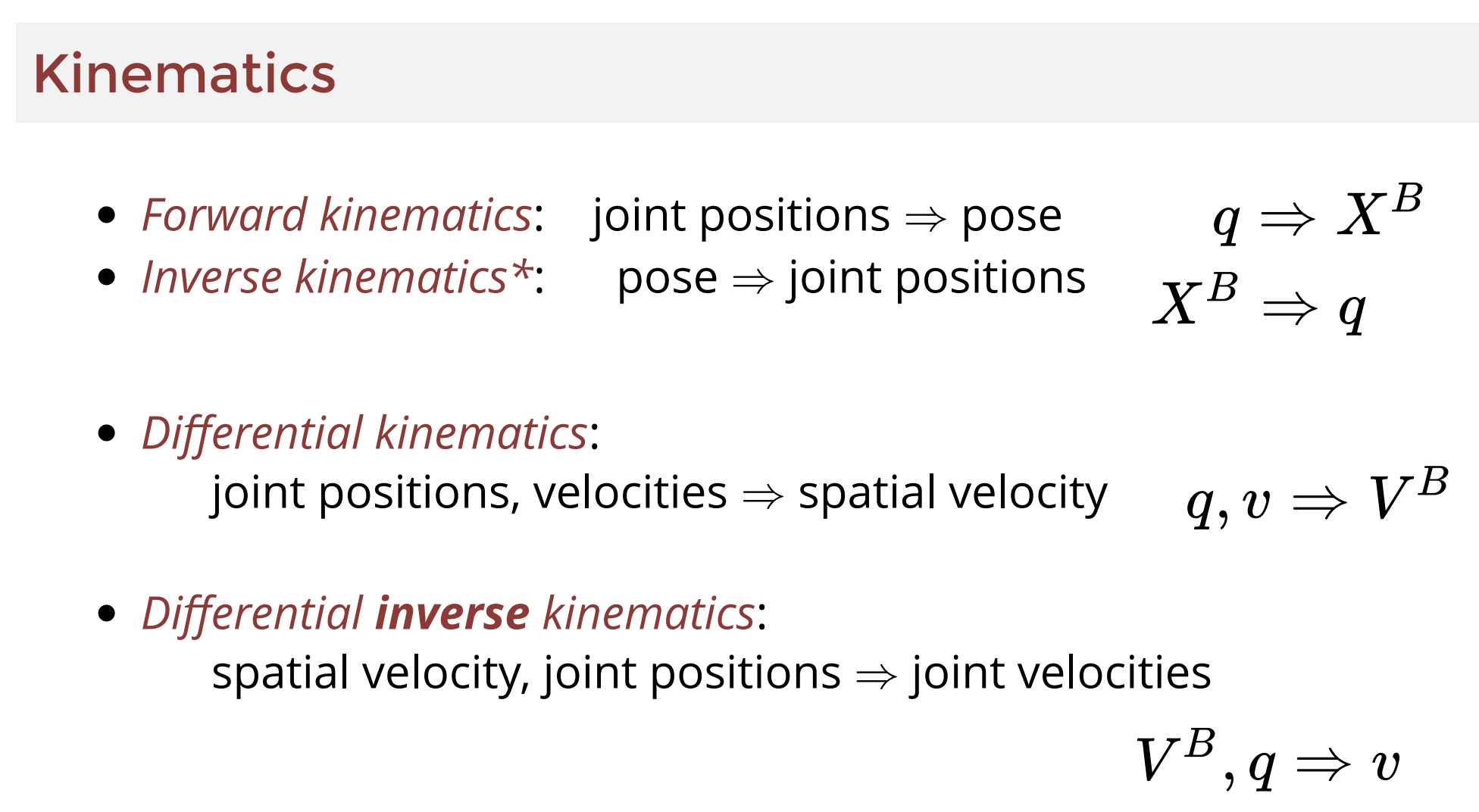
3. 📉 Forward and Differential Kinematics
✨ Forward Kinematics (FK)
Mapping joint angles $((q))$ to gripper pose $((X^G))$:
\[X^G = f_{\text{kin}}^G(q)\]- Drake uses
MultibodyPlantfor efficient FK.
✳ Kinematic Tree
- Robot bodies connected by joints removing DoF
Differential Kinematics in Robotics
Differential kinematics is a crucial concept in robotics that describes the relationship between the velocities of a robot’s joints and the resulting spatial velocity of its end-effector (or any other frame of interest). It’s a fundamental step in converting a high-level task, like moving a gripper to a specific pose, into the low-level joint commands that a robot can execute.
- Forward kinematics: Given joint positions, where is the end-effector? Think: “If I bend my arm this way, where’s my hand?”
- Differential kinematics: Given joint velocities, how fast is the end-effector moving? Think: “If I move my elbow and shoulder at certain speeds, how is my hand moving in space?”
Core Concept and Relationship to Kinematics
-
From Forward Kinematics:
\[X^G = f_{\text{kin}}^G(q)\]
Differential kinematics is derived directly from forward kinematics. Forward kinematics is the function that maps the robot’s joint angles ($q$) to the pose ($X$) of its end-effector in the world frame:Differential kinematics then describes how changes in joint positions relate to changes in gripper pose. Mathematically:
\[dX^B = \frac{\partial f_{\text{kin}}^B(q)}{\partial q} \, dq = J^B(q) \, dq\] -
The Jacobian Matrix:
This partial derivative is known as the kinematic Jacobian, denoted as $J(q)$. It’s a matrix that provides a linear relationship between generalized velocities (joint velocities) and spatial velocities.
Representations for Differential Rotations
While 3D rotations themselves can be represented in various ways (rotation matrices, Euler angles, unit quaternions), which often have singularities or over-parameterization, differential rotations have a canonical, singularity-free representation: spatial velocity.
A: Spatial Velocity:
This is a six-component vector:
comprising:
B: Angular Velocity: Angular velocity tells you how fast and around which axis something is rotating. Represented by three numbers (e.g., $w_x, w_y, w_z$). Its direction indicates the instantaneous axis of rotation, and its magnitude represents the rate of rotation around that axis.
- Angular velocities are unbounded ($-\infty$ to $\infty$), avoiding “wrap-around” effects or singularities like Euler angles (e.g., gimbal lock).
- This makes them efficient and sufficient for representing rotational derivatives everywhere.
- It is a vector:
- Direction = axis of rotation (right-hand rule)
- Magnitude = how fast it’s spinning (in radians per second)
- Units: Radians per second (rad/s)
- Angular velocity is like a spin speed.
- It doesn’t tell you how far a point moves, only how the orientation is changing.
Example:
Imagine a robot wrist spinning like a screwdriver:
If it rotates once per second around the z-axis, its angular velocity is:
\[\omega = \begin{bmatrix} 0 \\ 0 \\ 2\pi \end{bmatrix} \text{ rad/s}\]Meaning: rotating at 1 revolution/second about the z-axis.
C: Translational Velocity:
Also a three-component vector representing linear velocity. Translational velocity tells you how fast a point is moving in space — i.e., linear motion.
It is also a vector:
- Direction = direction of movement
- Magnitude = speed
- Meters per second (m/s)
Example: A robot gripper is moving straight forward (in the x-direction) at 10 cm/s:
\[v = \begin{bmatrix} 0.1 \\ 0 \\ 0 \end{bmatrix} \text{ m/s}\]D: Generalized Velocities vs. Time Derivative of Positions:
A subtle point arises because Drake uses unit quaternions (4 numbers) to represent orientations within the configuration vector $q$ of floating bodies (e.g., a foam brick or floating hand) to avoid singularities. But for velocities, it uses the 3-component angular velocity.
- For a free body:
- $q$ (pose) has 7 components: 3 (position) + 4 (quaternion)
- Generalized velocity $v$ has 6 components: 3 (translation) + 3 (angular velocity)
-
Therefore, in general:
\[\dot{q} \neq v\]
- Drake provides:
MapQDotToVelocityMapVelocityToQDot
to convert between these representations.
⚙️ Algebraic Rules for Spatial Velocities
A. 🔄 Changing “Expressed-In” Frames: Rotations can be used to convert spatial velocities from one “expressed-in” frame to another.
If you have:
- $( {}^A\text{v}^B_F )$: translational velocity expressed in frame F
- $( {}^A\omega^B_F )$: angular velocity expressed in frame F
Then to express them in frame G, use the rotation matrix $( {}^G R^F )$:
\[{}^A\text{v}^B_G = {}^G R^F \, {}^A\text{v}^B_F\] \[{}^A\omega^B_G = {}^G R^F \, {}^A\omega^B_F\]B: ➕ Addition of Angular Velocities
Angular velocities can be added when they are expressed in the same frame.
Example: If you have:
- $( {}^A\omega^B_F )$: angular velocity of B relative to A
- $( {}^B\omega^C_F )$: angular velocity of C relative to B
Both expressed in frame F, then:
Angular velocities also have an additive inverse:
\[{}^A\omega^C_F = -{}^C\omega^A_F\]C: 🔗 Composition of Translational Velocities
Composing translational velocities involves a cross-product term:
\[{}^A\text{v}^C_F = {}^A\text{v}^B_F + {}^B\text{v}^C_F + {}^A\omega^B_F \times {}^B p^C_F\]This arises from differentiating the position transform rule.
D: Additive Inverse for Translational Velocities
Unlike angular velocities, translational velocity inverses are not symmetric:
\[-{}^A\text{v}^B_F \neq {}^B\text{v}^A_F\]Instead, the correct relationship is:
\[-{}^A\text{v}^B_F = {}^B\text{v}^A_F + {}^A\omega^B_F \times {}^B p^A_F\]Geometric vs. Analytic Jacobian
Due to these different representations, there are many possible kinematic Jacobians.
- Geometric Jacobian (used in Drake):
Outputs spatial velocities, e.g., via:CalcJacobianSpatialVelocity - Analytic Jacobian:
A more literal partial derivative of forward kinematics, often used with specific rotation representations (Euler angles, etc.).
4. 🚀 Differential Inverse Kinematics (DIK)
🔝 Core Idea
From desired gripper velocity $(V^{G_d})$ to joint velocity $(v)$:
\[v = [J^G(q)]^{-1} V^{G_d}\]✴ Jacobian Pseudo-Inverse $(J^+)$
The pseudo-inverse, often referred to as the Moore-Penrose pseudo-inverse, is a powerful mathematical concept used to “invert” matrices that are not square or not full-rank. It provides a robust way to solve linear equations when a traditional inverse does not exist.
- Used when $(J)$ not square (e.g., 6x7)
- Moore-Penrose inverse returns:
- Least-norm solution (if redundant)
- Best-fit (if no exact solution)
🤖 Core Idea and Application in Robotics
- In robotics, the pseudo-inverse is primarily used in Differential Inverse Kinematics (DIK).
- DIK relates desired changes in the end-effector’s pose (spatial velocity) to required joint velocities:
Where:
- $( V^G )$: desired spatial velocity of the gripper
- $( J^G(q) )$: Jacobian matrix
- $( v )$: generalized joint velocity
Non-square Jacobian Case:
For a robot like the KUKA iiwa (7-DOF), the Jacobian is:
\[J^G(q) \in \mathbb{R}^{6 \times 7}\]It’s not square → no traditional inverse exists.
Solution: Use the pseudo-inverse:
\[v = [J^G(q)]^+ V^{G_d}\]✅ Square and Full-Rank:
- If $( J )$ is square and full-rank → pseudo-inverse equals the regular inverse.
🔁 Redundant Robots (More DOF than Tasks):
- If $( \text{cols}(J) > \text{rows}(J) )$ (e.g., 7-DOF robot):
- Infinite solutions for $( v )$
-
Pseudo-inverse returns the minimum-norm solution:
The one with the smallest joint velocity magnitude.
🚫 No Exact Solution (Underactuated or Infeasible):
- If $( V^{G_d} )$ cannot be exactly achieved:
- Pseudo-inverse gives the best-effort solution in a least-squares sense.
⚠️ Invertibility & Kinematic Singularities
- Pseudo-inverse works only if Jacobian has full row rank.
- Danger zone: Near-singular configurations, where the smallest singular value of $( J )$ approaches zero.
Why it matters:
- $( | J^+ | \rightarrow \infty )$
- This causes huge velocity commands, risking:
- Instability
- Joint saturation
- Robot faults
Note:
- A kinematic singularity is a property of the math — not a physical robot failure.
- Robots can pass through singularities in joint space, but task-space control may break down.
🚫 What Basic Pseudo-Inverse Ignores:
- Joint limits
- Velocity/acceleration/torque constraints
- Integrability (closed-loop consistency)
✅ Reframing as Optimization:
Pseudo-inverse solves:
\[\min_v \left\| J^G(q) v - V^{G_d} \right\|_2^2\]This perspective enables generalization:
🔒 Add Constraints:
- Formulate as Quadratic Program (QP):
- Add joint velocity, position, acceleration, or torque constraints
- Solve numerically
🎯 Add Secondary Objectives:
- For example: drive joints toward nominal pose (joint-centering)
- Achieve this by null space projection:
Secondary motion only occurs if it doesn’t interfere with the main task.
🔄 Path Consistency:
- Basic pseudo-inverse doesn’t guarantee returning to same joint state after a closed path.
- Advanced controllers (e.g., in Drake) enforce:
- Same directionality in motion
- Constraint-aware damping
- Component-wise Cartesian saturation
These enhancements improve safety, stability, and operator usability.
⚠ Kinematic Singularities
- When $(\text{rank}(J) < 6)$
- Cause large velocity commands
- Not a failure of robot, but of the $(X \rightarrow q)$ mapping
✪ Redundancy Helps
- 7-DOF arms (like iiwa) can avoid singularities better than 6-DOF
5. FK, DK, IFK, IDK Summary
✅ 1) Forward Kinematics (FK)
What is it?
Forward Kinematics computes the position and orientation (pose) of the robot’s end-effector (gripper/tool) given joint values.
Formula:
$[ \mathbf{x} = f(q) ]$
- $( q )$: joint angles or displacements
- $( \mathbf{x} )$: end-effector pose (position + orientation)
How it works:
- Use a chain of transformation matrices from the base to the end-effector.
- These matrices are defined using the robot’s geometry, typically from Denavit-Hartenberg (DH) parameters.
- For most robots, this is a closed-form computation (no iteration).
Example:
A 2-joint planar robot arm:
- Link 1 length = 1 m
- Link 2 length = 1 m
- Joint angles: $( q_1 = 45^\circ )$, $( q_2 = 45^\circ )$
Then:
$[
x = \cos(q_1) + \cos(q_1 + q_2)
y = \sin(q_1) + \sin(q_1 + q_2)
]$
So: $[ x \approx 1.41,\quad y \approx 1.41 ]$
🌀 2) Differential Kinematics
What is it?
Differential kinematics relates joint velocities $( \dot{q} )$ to end-effector velocities (linear and angular) $( \dot{x} )$.
Formula:
$[ \dot{x} = J(q) \dot{q} ]$
- $( J(q) )$: Jacobian matrix, derived from FK equations
- $( \dot{x} )$: [linear velocity; angular velocity] in Cartesian space
Why it matters:
It tells you:
- How fast the gripper is moving
- In what direction
- Based on joint motor speeds
Example:
If your robot gripper is moving forward at 10 cm/s and rotating at 30°/s, then:
$[
\dot{x} =
\begin{bmatrix}
0.1
0
0
0
0
0.52
\end{bmatrix}
\quad \text{(m/s and rad/s)}
]$
🔁 3) Inverse Kinematics (IK)
What is it?
Given a desired end-effector pose, solve for the joint angles that achieve it.
Formula:
$[ q = f^{-1}(x) ]$
Challenges:
- Often no closed-form solution (e.g., for complex 6-DOF arms)
- May have multiple solutions or no solution
- Requires iterative methods like:
- Newton-Raphson
- Optimization-based solvers (e.g., IKFast, MoveIt!)
Example:
You want your robot hand at position $( x = (1.5, 0.5) )$. What should the joint angles be?
Use an iterative solver to find $( q_1, q_2 )$ such that FK matches the desired pose.
♻️ 4) Inverse Differential Kinematics
What is it?
Given a desired end-effector velocity $( \dot{x} )$, compute the joint velocities $( \dot{q} )$ needed to achieve it.
Formula (Ideal Case):
$[ \dot{q} = J^{-1}(q) \dot{x} ]$
Problem:
- Jacobian $( J )$ might not be square (redundant or under-actuated robots)
- Jacobian might be singular (robot in a bad configuration)
Solution: Use Pseudo-Inverse:
$[ \dot{q} = J^+ \dot{x} ]$
- $( J^+ )$: Moore-Penrose pseudo-inverse
- Handles singularities and redundancy
- Provides the least-squares optimal joint motion
Example:
If you want your robot’s end-effector to move 5 cm/s forward:
$[
\dot{x} =
\begin{bmatrix}
0.05
0
0
0
0
0
\end{bmatrix}
\Rightarrow \dot{q} = J^+ \dot{x}
]$
This gives joint velocities $( \dot{q}_1, \dot{q}_2, …, \dot{q}_n )$ that will make the gripper move as desired.
💡 Summary Table
| Concept | Input | Output | Method | Notes |
|---|---|---|---|---|
| Forward Kinematics | $( q )$ | Pose $( x )$ | Matrix multiplication | Closed-form, geometric model |
| Differential Kinematics | $( \dot{q} )$ | $( \dot{x} )$ | Jacobian $( J )$ | Linear velocity relationship |
| Inverse Kinematics | Pose $( x )$ | $( q )$ | Iterative solver | May not be unique/solvable |
| Inverse Differential Kinematics | $( \dot{x} )$ | $( \dot{q} )$ | Pseudo-inverse $( J^+ )$ | Best effort solution |
- FK gives you the pose of the robot’s hand.
- Differential kinematics gives you the speed and direction of the robot’s hand from joint speeds.
- IK finds joint angles to reach a target point — hard if no solution or too many!
- Inverse differential kinematics figures out how to move joints to follow a motion path.
6. 🤺 Grasp and Pre-Grasp Poses
👊 Grasp Pose:
\[{}^O X^{G_{grasp}} = \text{desired gripper pose relative to object}\]Example:
\[{}^{G_{grasp}} R^O = \text{MakeXRotation}(\frac{\pi}{2}) \cdot \text{MakeZRotation}(\frac{\pi}{2})\]🚕 Pre-Grasp Pose:
\[{}^O X^{G_{pregrasp}} = \text{same orientation, offset along z-axis}\]⏳ 7. Trajectory Generation
🔹 Keyframe Composition:
- initial, pre-pick, pick, post-pick, clearance, pre-place, place, post-place
↔️ Interpolation Techniques
- Position: Linear via
PiecewisePolynomial - Rotation:
PiecewiseQuaternionSlerp - Combining:
PiecewisePose - Can differentiate to obtain spatial velocity for DIK