
🧠 Markov Decision Processes (MDP) Basics and Imitation Learning
This lecture provides a review of key themes and concepts related to Imitation Learning (IL) in the context of Robot Learning
🔑 Key Themes and Concepts
1. Markov Decision Processes (MDPs) and Partially Observed MDPs (POMDPs)
Sequential decision-making in robotics is formalized using MDPs and POMDPs:
-
State Space (S):
$S$ is the state space. $s_t \in S$ is the state at time step $t$. -
Action Space (A):
$A$ is the action space. $a_t \in A$ is the action at time step $t$. -
Observation Space (O):
$O$ is the observation space. $o_t \in O$ is the observation at time $t$. -
Transition Probability (p):
$s_{t+1} \sim p(\cdot \mid s_t, a_t)$ — how the environment evolves given current state and action. -
Observation Model (h):
$o_t \sim h(\cdot \mid s_t)$ — how observations are generated from states. -
Reward Function (r):
$r: S \times A \rightarrow \mathbb{R}$ — evaluates the desirability of state-action pairs.
MDP vs. POMDP
-
MDP: Tuple $(S, A, p, r)$.
Learn policy $\pi(a_t \mid s_t)$ using full state access. -
POMDP: Tuple $(S, A, O, p, h, r)$.
Learn policy $\pi(a_t \mid o_t)$ based only on observations. -
Markov Property:
Once current state is known, history can be discarded: future is conditionally independent of the past given the present. -
Goal of RL/Control:
Maximize cumulative reward: $\sum_t \gamma^t r(s_t, a_t)$ with $0 < \gamma \le 1$.
Can be over finite or infinite time horizons.
2. Introduction to Imitation Learning (IL)
- Main Idea:
- Collect expert data: $(s_t, a_t)$ or $(o_t, a_t)$.
- Train a function to map observations/states to actions.
- Historical Context:
Deep IL dates back to 1989 (CMU).
Modern examples: Mobile ALOHA, Diffusion Policy.
3. Imitation Learning vs. Supervised Learning (Behavior Cloning Challenge)
- Behavior Cloning (BC):
- Policy $\hat{a} = \pi(s_t)$ trained on expert data $(s_t, a_t)$.
- Similar to supervised learning, e.g., image → steering direction.
- Problem:
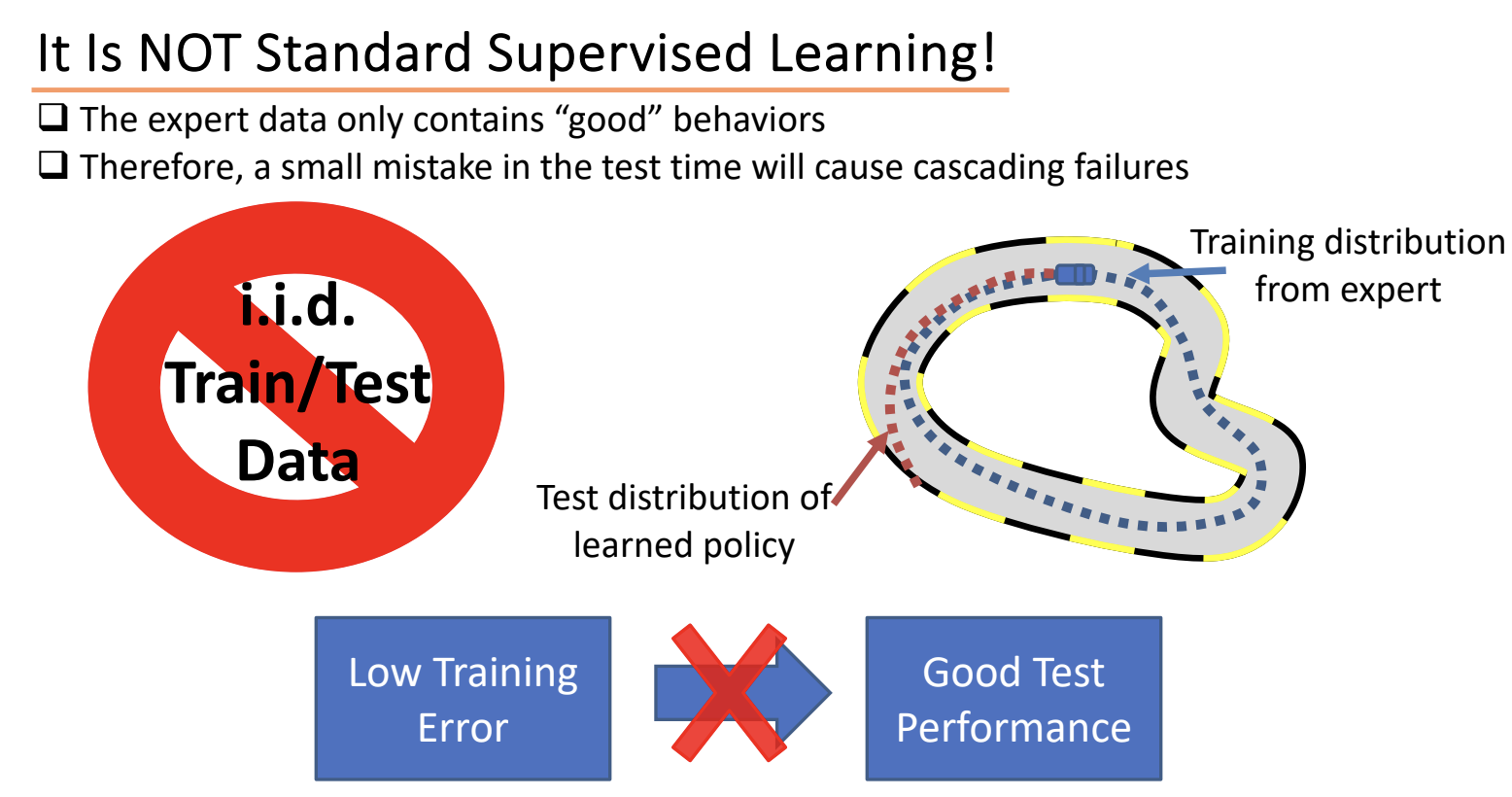
“It is NOT standard supervised learning!”
Key Issues:
- I.I.D. Assumption Violation:
- Test-time inputs come from the learned policy, not the expert.
- Causes distribution mismatch and cascading errors.
- Cascading Failures:
- Policy makes one mistake → enters unseen state → makes more mistakes.
- Domain shift is dynamic and fatal in sequential tasks.
- “Cliff Walking” Problem:
- Small mistake → off-distribution → unrecoverable.
- Test error grows quadratically with time steps.
- Paradox: IL works better with mistake-filled data!
4. Addressing Behavior Cloning Issues
Data Collection and Augmentation
- Add Mistakes and Corrections:
- Train on examples that teach recovery behavior.
- E.g., intentionally perturb expert actions, then correct.
- Synthetic Data Augmentation:
- Fake recovery data (e.g., perturb MPC expert trajectories).
Algorithmic Fix: DAgger (Dataset Aggregation)
-
Core Idea: Collect new expert labels where the learned policy fails.
- Iterative Steps:
- Train initial policy on expert data.
- Run policy to generate trajectories.
- Ask expert to relabel visited states.
- Aggregate new data with old.
- Train new policy and repeat.
- Effectiveness:
- Learns from the distribution induced by the learned policy.
- Reduces compounding errors.
- Developed at CMU (2011), has regret guarantees.
- Main Limitation:
- Requires frequent querying of the expert — can be expensive.
5. Future Directions (Teased in Lecture)
- Use powerful models: Reduce errors inherently.
- Multi-task learning: Shared structure across tasks improves generalization (Lecture 23).
6. Summary: Imitation Learning vs. Continuous Supervised Learning vs. Reinforcement Learning
📘 Imitation Learning (IL)
Imitation Learning is a technique in sequential decision-making where the goal is to mimic expert behavior from demonstrations (e.g., $((s_t, a_t))$ pairs). The most common form is Behavior Cloning (BC), which simply treats IL as a supervised learning problem.
🔄 Is Imitation Learning Just Continuous Supervised Learning?
Not quite. Here’s the distinction:
| Aspect | Continuous Supervised Learning | Imitation Learning |
|---|---|---|
| Training data | Static or streaming i.i.d. samples | Sequences of expert trajectories |
| Prediction mode | Predict each output independently | Predict actions that affect future states |
| Ambiguity | Same input might map to multiple outputs; model may output an average | Averaging can be catastrophic in control (e.g., averaging left and right = crash) |
| Test time behavior | Model generalizes due to i.i.d. assumption | Cascading errors due to distribution shift |
| Sequential impact | Often not considered | Critical — each decision changes future states |
⚠️ Why “Averaging” Fails in IL
In supervised learning, if the same input maps to different outputs during training, the model may learn to output an average (especially in regression).
🧠 Example: Steering a Car
- Suppose the same camera image occurs in two contexts: expert turns left and expert turns right.
- A supervised model may learn to steer straight — the average of left and right — which could drive the car off the road.
Key Insight: In IL, only one of the expert actions will result in a good outcome. Averaging can lead to unsafe or unrecoverable states.
🧱 Sequential Nature & Cascading Errors
- In IL, actions influence future states.
- A small prediction error at time $( t )$ can lead the agent into a state never seen in the training data (since the expert never made that mistake).
- This causes a distribution shift and leads to cascading errors.
🧠 Example: Cliff Walking
- The agent walks along a cliff.
- A tiny mistake (1 pixel drift) pushes it off-path.
- Now it’s in a region it was never trained on.
- More errors accumulate, and it quickly fails catastrophically.
Test-time error can grow quadratically with the number of timesteps.
🤝 Is Imitation Learning a Type of Reinforcement Learning?
Not exactly, but they are closely related and often used together.
| Aspect | Imitation Learning | Reinforcement Learning |
|---|---|---|
| Learning signal | Expert demonstrations (states + actions) | Rewards from interacting with environment |
| Objective | Mimic the expert policy $(\pi(a \mid s))$ | Maximize expected cumulative reward |
| Exploration | None or limited | Essential |
| Data source | Pre-collected demos | Generated through trial and error |
| Training method | Supervised learning on trajectories | Policy gradient, Q-learning, actor-critic, etc. |
| Main challenge | Distribution shift, cascading failures | Credit assignment, sparse/delayed rewards |
🔧 Techniques That Bridge IL and RL
- DAgger (Dataset Aggregation):
- Trains an initial policy on expert data.
- Runs the policy, collects states where it makes mistakes.
- Queries the expert for corrections and adds those to the dataset.
- Retrains on the aggregated dataset.
- Fixes distribution shift by continuously updating the training set to include the learner’s mistakes.
- Inverse Reinforcement Learning (IRL):
- Learns a reward function from expert demonstrations.
- Solves an RL problem using the inferred reward.
- Pretraining with IL + Fine-tuning with RL:
- Learn a reasonable initial policy with BC.
- Fine-tune with RL to improve performance or achieve goals beyond the expert.
🧠 Summary
- Imitation Learning is not standard supervised learning because actions have sequential consequences.
- Imitation Learning is not full RL because it lacks reward-based learning and exploration, but both operate in sequential decision-making settings.
- Simple behavior cloning suffers from distribution shift and cascading errors.
- Techniques like DAgger mitigate this by incorporating interaction and expert feedback.
- Powerful models and hybrid IL+RL approaches are increasingly used to overcome IL limitations.