LLM Training Parallelism Basics
“Parallelism Basics” focuses on the system complexities behind training massive language models (LMs) that exceed a single GPU’s capacity.
Goals:
- Understand different parallelization paradigms.
- Learn why multiple methods are combined.
- See how large-scale training is organized.
Course link
Code Link in the next lecture
⚙️ 1. Limits of Single-GPU Scaling
Training on a single GPU faces two bottlenecks:
🧮 Compute
- Even though GPUs are powerful, exaflop-scale compute (like supercomputers) is needed for huge models.
💾 Memory
- Large models exceed single-GPU memory.
- Training uses ≈5 copies of weights → up to 16 bytes/parameter due to optimizer state.
- Therefore, we use multi-GPU, multi-machine parallelism:
- Intra-node: Fast (within one machine)
- Inter-node: Slower (across machines)
🌐 2. Networking and Communication Basics
🏢 Datacenter as the Unit of Compute
What we want from multi-machine scaling: Scaling targets linear memory and compute growth proportional to GPU count.
- Linear memory scaling (max model params scales with num gpus)
- Linear compute scaling (model flops scale linearly with num gpus)
📡 Collective Communication Primitives
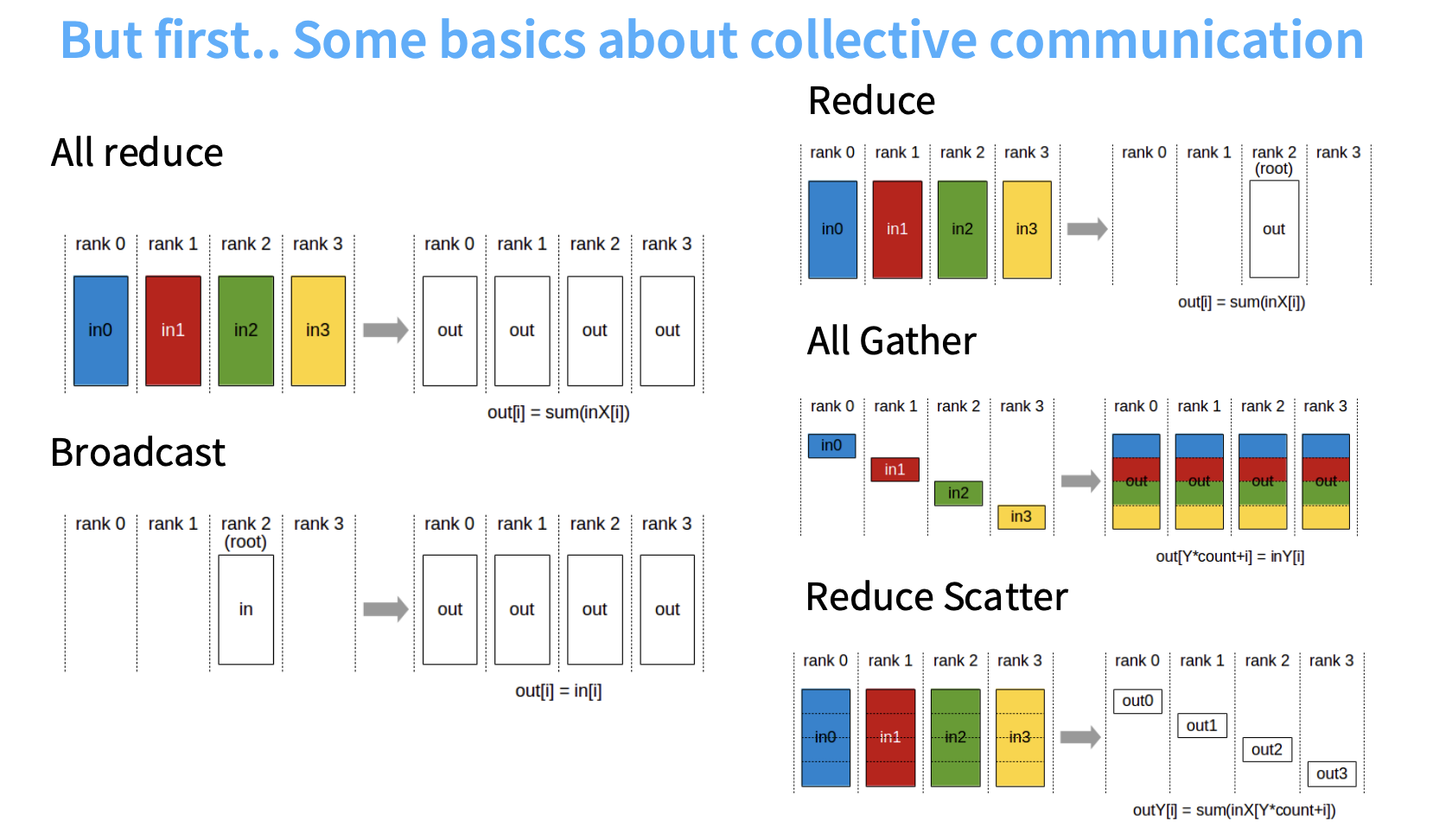
| Primitive | Description | Approx. Cost |
|---|---|---|
| 🟢 All Reduce | Sums inputs → copies to all machines | ≈ 2 × #params |
| 📣 Broadcast | Sends one input to all ranks | — |
| 📦 Reduce | Sums → sends to one machine | — |
| 🔁 All Gather / Reduce Scatter | Key building blocks; All Reduce = Reduce-Scatter + All-Gather |
Efficient in bandwidth-limited settings |
🧩 Hardware Design Differences
| Hardware | Networking | Description |
|---|---|---|
| 🎮 GPU | All-to-all (≤256 devices) | Fast arbitrary communication within limit |
| 🧱 TPU | Toroidal mesh | Efficient local communication; All-Reduce works equally well |
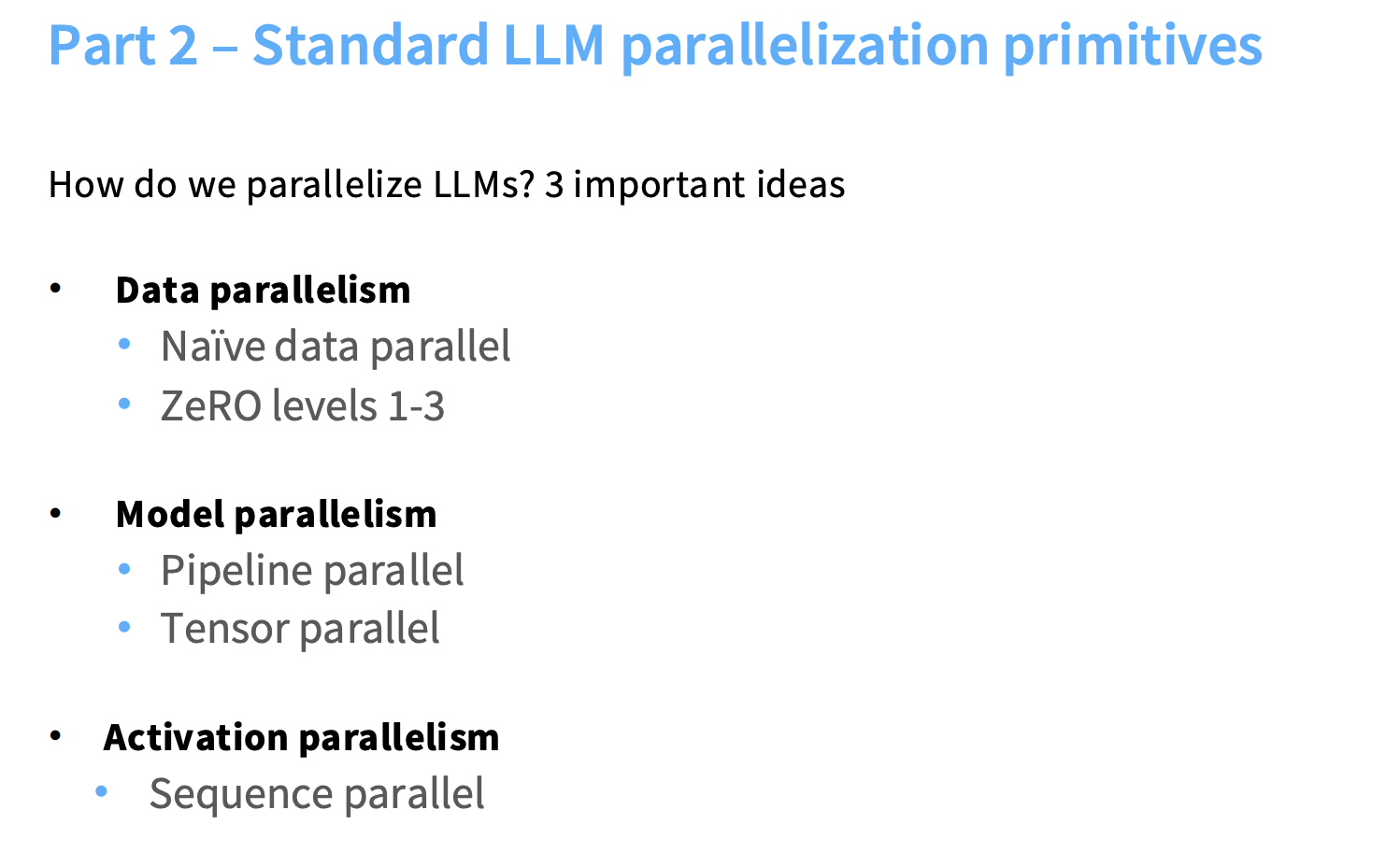
🧩 3. Parallelization Primitives
Three main ideas:
- Data Parallelism (DP)
- Model Parallelism (MP)
- Activation Parallelism
4. Data Parallelism
Splits the data batch B across M machines.
🧰 4.1 Naïve Data Parallelism (DDP)
- ✅ Each GPU processes
B/Msamples. - ⚡ Compute scales well.
- 📡 Communication:
2 × #params(for gradients). - ❌ Memory issue: each GPU replicates all parameters + state (~16 bytes/param).
Breakdown (per parameter):
- FP/BF16 weights: 2B
- Gradients: 2B
- FP32 master weights: 4B
- Adam (m, v): 8B
→ Total: ~16 bytes/parameter
4.2 ZeRO Stage 1: Optimizer State Sharding
Reduce memory overhead by sharding the optimizer state across GPUs.
High-Level Idea
- Sharding: The optimizer state (first + second moments in Adam) is split/sharded across GPUs.
- Replication: Each GPU still maintains a full copy of parameters and gradients.
- Responsibility: Each GPU updates only its assigned shard of optimizer state and corresponding parameters.
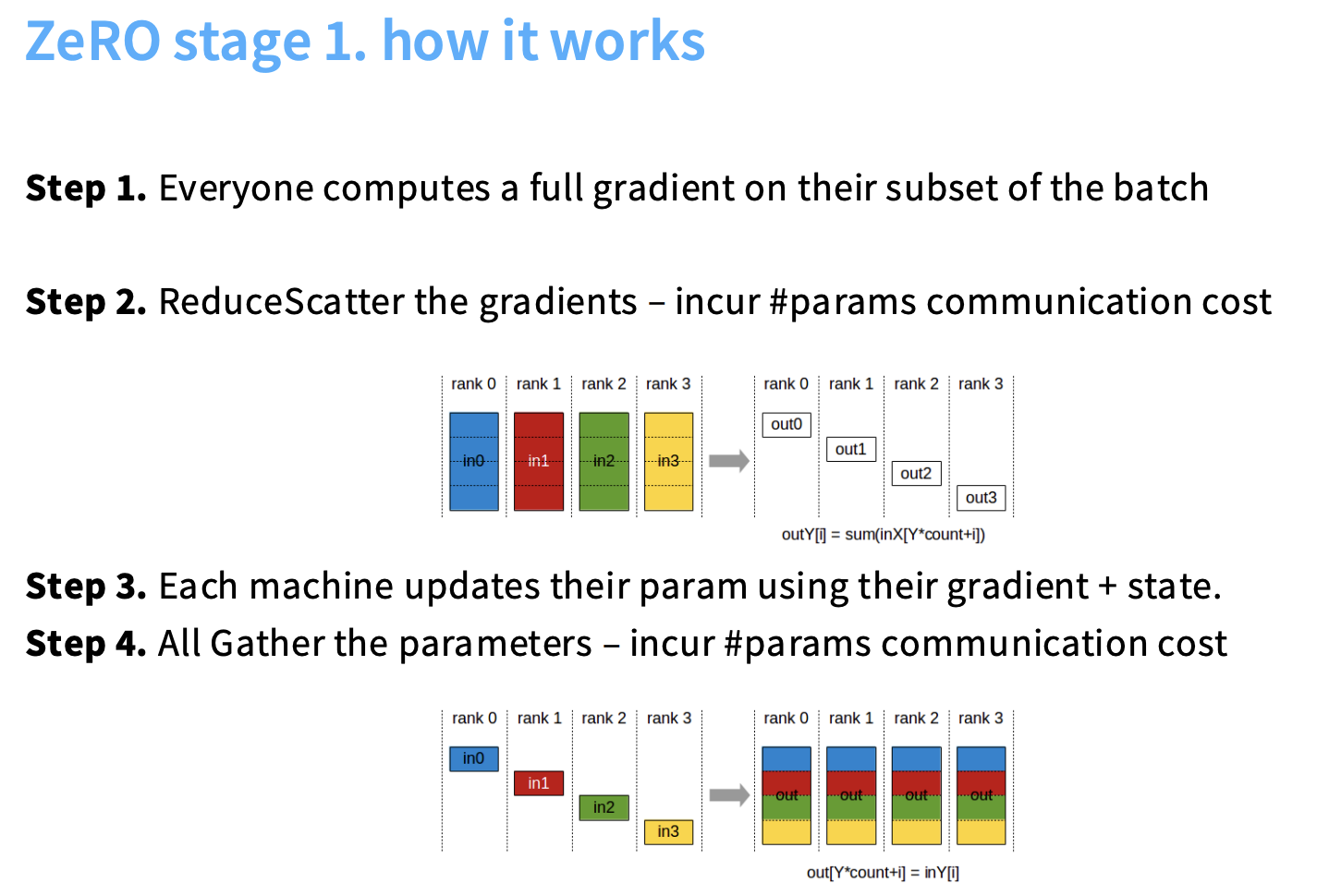
Operational Steps
- Forward/Backward Pass: Each GPU computes a full gradient on its local batch subset.
- Gradient Synchronization (Reduce-Scatter): Gradients are synchronized via Reduce-Scatter (cost:
#params).- Each GPU receives the summed gradient information for its shard.
- Parameter Update: Each GPU updates only its assigned parameters using its optimizer shard.
- Parameter Synchronization (All-Gather): Updated parameters are collected and broadcast to all GPUs (cost:
#params).
Now, ZeRO Stage 1 keeps the same training flow as DDP for most things — but shards the optimizer state only.
🧮 Example
Say your model has 12 layers and you train with 4 GPUs.
| GPU | Model Parameters | Gradients | Optimizer State Responsibility |
|---|---|---|---|
| GPU 0 | ✅ full model | ✅ full grads | Layers 0–2 |
| GPU 1 | ✅ full model | ✅ full grads | Layers 3–5 |
| GPU 2 | ✅ full model | ✅ full grads | Layers 6–8 |
| GPU 3 | ✅ full model | ✅ full grads | Layers 9–11 |
Each GPU holds the optimizer slots (m, v) only for its assigned layers.
🏃♂️ Forward & Backward Pass
- Forward pass: Each GPU runs forward on its batch (same as DDP).
- Backward pass: Each GPU computes full gradients for the model (same as DDP).
So far, memory usage is the same as DDP.
🔁 Gradient Synchronization (Reduce-Scatter)
After backward:
- Instead of doing an All-Reduce, ZeRO uses Reduce-Scatter.
- Each GPU gets the summed gradient for the subset of parameters it owns (its optimizer shard).
- Example: GPU0 receives gradients for Layers 0–2, GPU1 for Layers 3–5, etc.
⚙️ Parameter Update
- Each GPU updates only its assigned parameters (the ones its optimizer shard corresponds to).
- Other GPUs don’t update those layers — they’ll receive the new parameters later.
📤 Parameter Synchronization (All-Gather)
After updating:
- GPUs perform an All-Gather to share their updated parameter shards.
- Now, all GPUs have the full, updated model again.
4.3 ZeRO Stage 2: Gradient Sharding
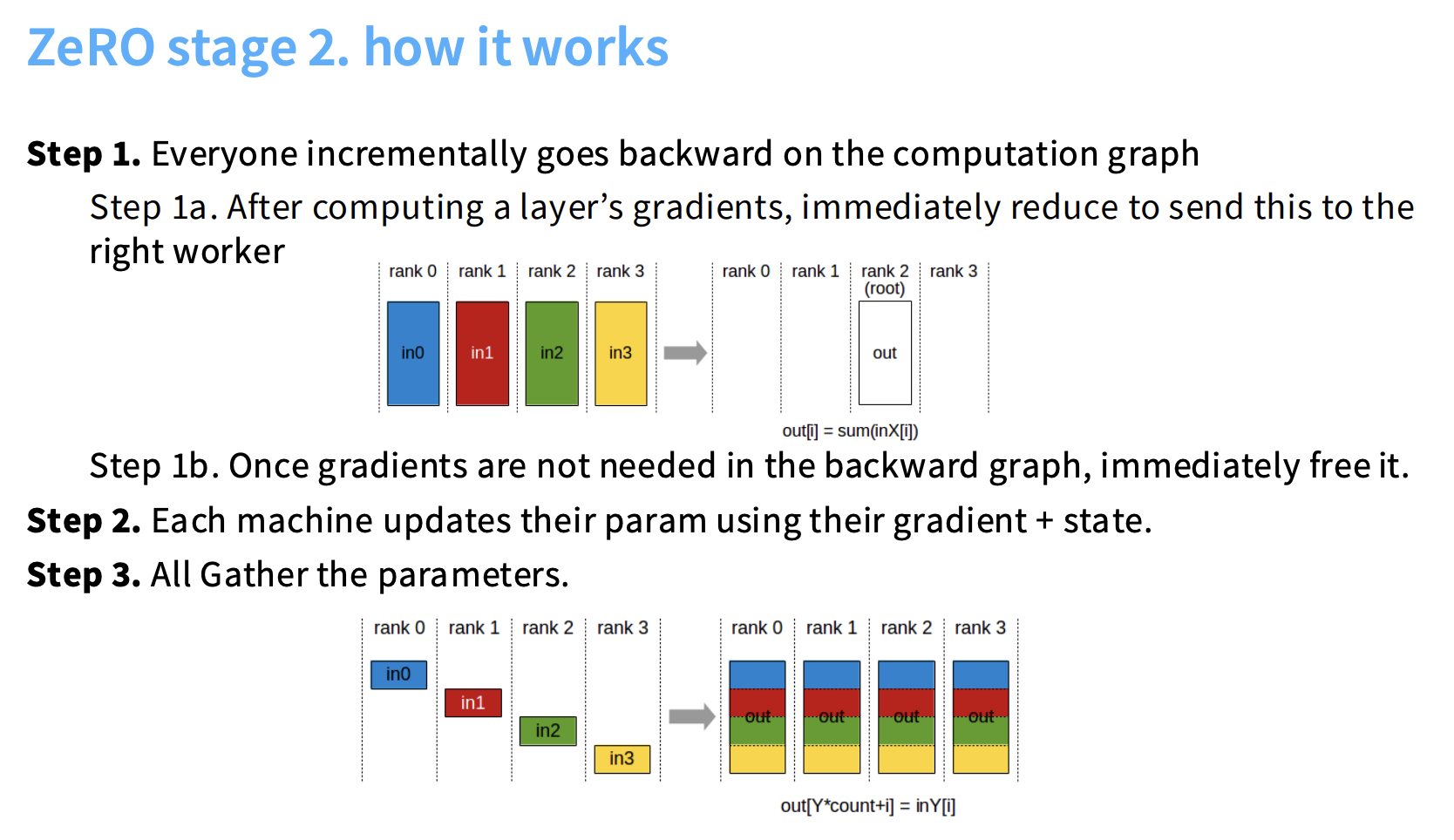
Further reduce memory by sharding gradients in addition to the optimizer state.
High-Level Idea
- Sharding: Both optimizer state and gradients are sharded.
- Challenge: A full gradient vector cannot exist in memory.
- Solution: Execute backward pass incrementally and free gradients immediately after use.
Operational Steps
- Incremental Backward Pass: Each GPU backpropagates layer-by-layer.
- Immediate Reduction: After each layer, gradients are reduced and sent to the GPU responsible for that parameter shard.
- Immediate Freeing: Gradients are freed once no longer needed, preventing buildup of full gradient tensors.
- Update and All-Gather: Updated parameters are gathered across GPUs.
Key Outcome
- Memory Scaling: Enables extremely large models (e.g., 24.6B params on 8×A100 80GB).
- Communication Cost: ≈
2 × #params(similar to Stage 1). - Trade-Off: Minor extra synchronization overhead (layer-wise communication).
🔹 What stays the same
Each process (GPU) still:
- Has the full model parameters.
- Computes forward and backward passes on its own batch (like DDP).
- Keeps its assigned optimizer shard (from Stage 1).
🔹 What changes (vs. Stage 1)
Now, gradients are also partitioned after the backward pass —
so each GPU stores only the gradients for the parameters it is responsible for updating.
Let’s illustrate:
| GPU | Model Parameters | Gradients | Optimizer State Responsibility |
|---|---|---|---|
| GPU 0 | ✅ full model | 🔹 Layers 0–2 only | Layers 0–2 |
| GPU 1 | ✅ full model | 🔹 Layers 3–5 only | Layers 3–5 |
| GPU 2 | ✅ full model | 🔹 Layers 6–8 only | Layers 6–8 |
| GPU 3 | ✅ full model | 🔹 Layers 9–11 only | Layers 9–11 |
🏃♂️ Forward & Backward Pass
Forward:
Each GPU computes forward on its batch — same as DDP.
Backward:
Each GPU initially computes full gradients for the model (same as before),
but then ZeRO immediately shards them across GPUs using Reduce-Scatter.
So, after backward, GPU0 holds only the gradients for Layers 0–2, GPU1 for Layers 3–5, etc.
This already saves memory because each GPU keeps only a slice of gradients.
-
Forward Pass Each process runs the forward pass normally (same as DDP).
-
Backward Pass (Gradient Computation) Each GPU computes local gradients for all model parameters — exactly like in DDP.
However, ZeRO hooks into the autograd engine so that as soon as a layer finishes its backward computation:
Those gradients are Reduce-Scattered to all GPUs.
The local copy of the full gradient is deleted immediately.
So while a single layer is computing backward, that layer’s gradients exist in full. But across the full model, you never have all layers’ gradients in memory at once.
⚙️ Parameter Update
Each GPU updates only its assigned parameters,
using the gradients and optimizer state shards it owns.
Example:
- GPU0 updates Layers 0–2.
- GPU1 updates Layers 3–5.
- etc.
📤 Parameter Synchronization (All-Gather)
After updating:
- GPUs perform All-Gather to share updated parameter shards.
- Every GPU reconstructs the full model for the next forward pass.
4.4 ZeRO Stage 3 (FSDP): Parameter Sharding
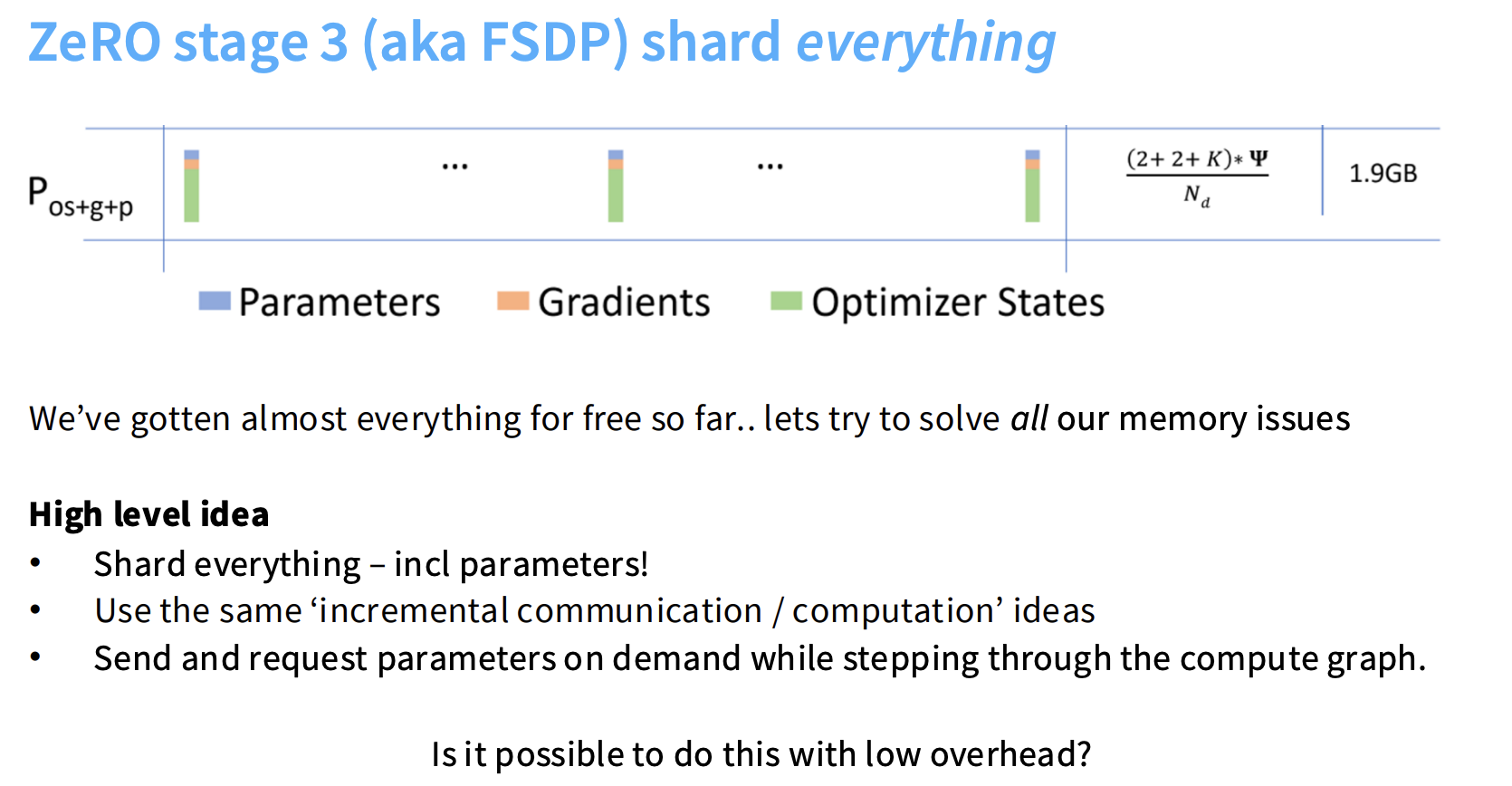
Achieve maximum memory efficiency by sharding parameters, gradients, and optimizer states.
High-Level Idea
- Sharding: Every model component (parameters, gradients, optimizer state) is distributed.
- On-Demand Fetching: Parameters are fetched via All-Gather just before computation and freed afterward.
- Overlapping: Communication is overlapped with computation to hide latency.
Simplified Operational Steps
- Forward Pass (On-Demand All-Gather):
- GPU gathers needed weights for the current layer.
- Performs computation.
- Frees gathered weights.
- Repeat for Each Layer:
All-Gather → Compute → Free.
- Backward Pass:
- Reverse process using
All-Gather(for weights),Reduce-Scatter(for gradients), and immediate freeing.
- Reverse process using
🧠 Concept Summary
| Component | DDP | ZeRO-1 | ZeRO-2 | ZeRO-3 / FSDP |
|---|---|---|---|---|
| Model Params | Full copy | Full copy | Full copy | ✅ Sharded |
| Gradients | Full | Full | ✅ Sharded | ✅ Sharded |
| Optimizer States | Full | ✅ Sharded | ✅ Sharded | ✅ Sharded |
| Memory Saving | 🔴 Low | 🟡 Medium | 🟢 High | 🟢🟢🟢 Maximal |
| GPU | Holds Parameters for | Gradients | Optimizer States |
|---|---|---|---|
| GPU 0 | Layers 0–2 | Layers 0–2 | Layers 0–2 |
| GPU 1 | Layers 3–5 | Layers 3–5 | Layers 3–5 |
| GPU 2 | Layers 6–8 | Layers 6–8 | Layers 6–8 |
| GPU 3 | Layers 9–11 | Layers 9–11 | Layers 9–11 |
🏃♂️ Forward Pass
Each GPU owns only a shard of parameters, but every GPU computes the forward pass for the entire model for its mini-batch. To do this, before computing a layer, every GPU must have the full parameters of that layer, because the forward of that layer depends on all weights.
So the flow is:
- Layer 0:
- Each GPU calls the All-Gather for layer 0’s parameters.
- Now all GPUs have the complete layer 0 weights.
- Each GPU performs the forward pass of layer 0 on its batch.
- After computing, each GPU can reshard/free the parameters of layer 0.
- Layer 1:
- Output of layer 0 (activations) is the input.
- Each GPU calls the All-Gather for layer 1’s parameters.
- Forward pass of layer 1 happens on every GPU, using its mini-batch activations.
✅ Memory is used only for one layer’s full params at a time.
🔁 Backward Pass
Backward is also sequential but leverages gradient sharding:
- Step 1: Gradient Computation
- Each GPU has its own mini-batch activations stored (or recomputed).
- To compute the gradient of layer n, the GPU needs the full parameters for that layer (All-Gathered).
- Compute the local gradient for that GPU’s shard.
- Step 2: Reduce-Scatter (Gradient Sharding)
- Each GPU does not keep the full gradient. Instead:
- Immediately after computing a layer’s gradients Reduce-Scatter distributes the gradients to the GPUs that “own” those parameters.
- Each GPU ends up with gradient shards only for its parameters.
- Each GPU does not keep the full gradient. Instead:
- Step 3: Optimizer Update
- Each GPU updates only the parameters it owns using:
- Its sharded gradients
- Its sharded optimizer state (m, v for Adam)
- Other GPUs do not update these parameters.
- Each GPU updates only the parameters it owns using:
- Step 4: Parameter Reshard / Free
- After update, parameters are resharded and old full copies are freed.
FSDP also overlaps communication and computation in backward using backward prefetching hooks. ✅ This prevents any GPU from holding full gradients at once.
- Gradient Computation / Local Gradients
- After backward, each GPU has a local, full gradient for that module (because parameters were unsharded for forward).
- Reduce-Scatter
- Immediately, the gradients are Reduce-Scattered across ranks: each GPU retains only the gradient shard for its parameter partition. The others are discarded or freed. :contentReference[oaicite:10]{index=10}
- Reshard or Free
- Full parameter copies loaded for backward are again freed or reshared as soon as possible.
- Optimizer Update
- Each GPU updates its shard of parameters using its shard of gradient + optimizer state (m, v shards). No full gradient or full optimizer state is ever needed.
4.5 Compare to Layer Parallelism
🔹 What ZeRO / FSDP Does ZeRO shards memory across GPUs, but it does not parallelize computation of layers.
- Optimizer Sharding (ZeRO Stage 1–3): Each GPU holds only the optimizer state for its parameter shard.
- Gradient Sharding (ZeRO Stage 2–3): Gradients are split across GPUs according to the parameter shards.
- Parameter Sharding (ZeRO Stage 3 / FSDP): Each GPU holds only a portion of parameters at any time.
Key point: All GPUs still compute forward and backward for all layers sequentially for their mini-batch.
🔹 Why It’s Not Layer Parallelism Layer parallelism (like pipeline parallelism) means:
- Different GPUs compute different layers in parallel.
- GPU0 computes layer 0, GPU1 computes layer 1 simultaneously, etc.
ZeRO / FSDP does not do this:
- GPUs compute layers in the same order for their mini-batch.
- Layer computations are sequential, not spread across GPUs.
🔹 What ZeRO / FSDP is
- Memory parallelization: spreads parameters, gradients, optimizer state across GPUs.
- Communication-efficient: uses Reduce-Scatter / All-Gather to share only what’s necessary per shard.
- Data Parallel + Sharding: multiple GPUs still process different mini-batches, like normal data parallelism.
✅ So ZeRO is shard-based memory parallelism, not true layer parallelism.
🧱 5. Model Parallelism (MP)
Splits parameters across GPUs. Instead of syncing weights, communicates activations.
🚇 5.1 Pipeline Parallelism (PP)
Pipeline parallelism (PP) is a fundamental strategy used in training large language models (LLMs) and is categorized as a form of model parallelism.
Model parallelism splits the model’s parameters across GPUs and communicates activations between them — unlike data parallelism, which splits the batch data.
⚙️ Core Concept and Mechanism
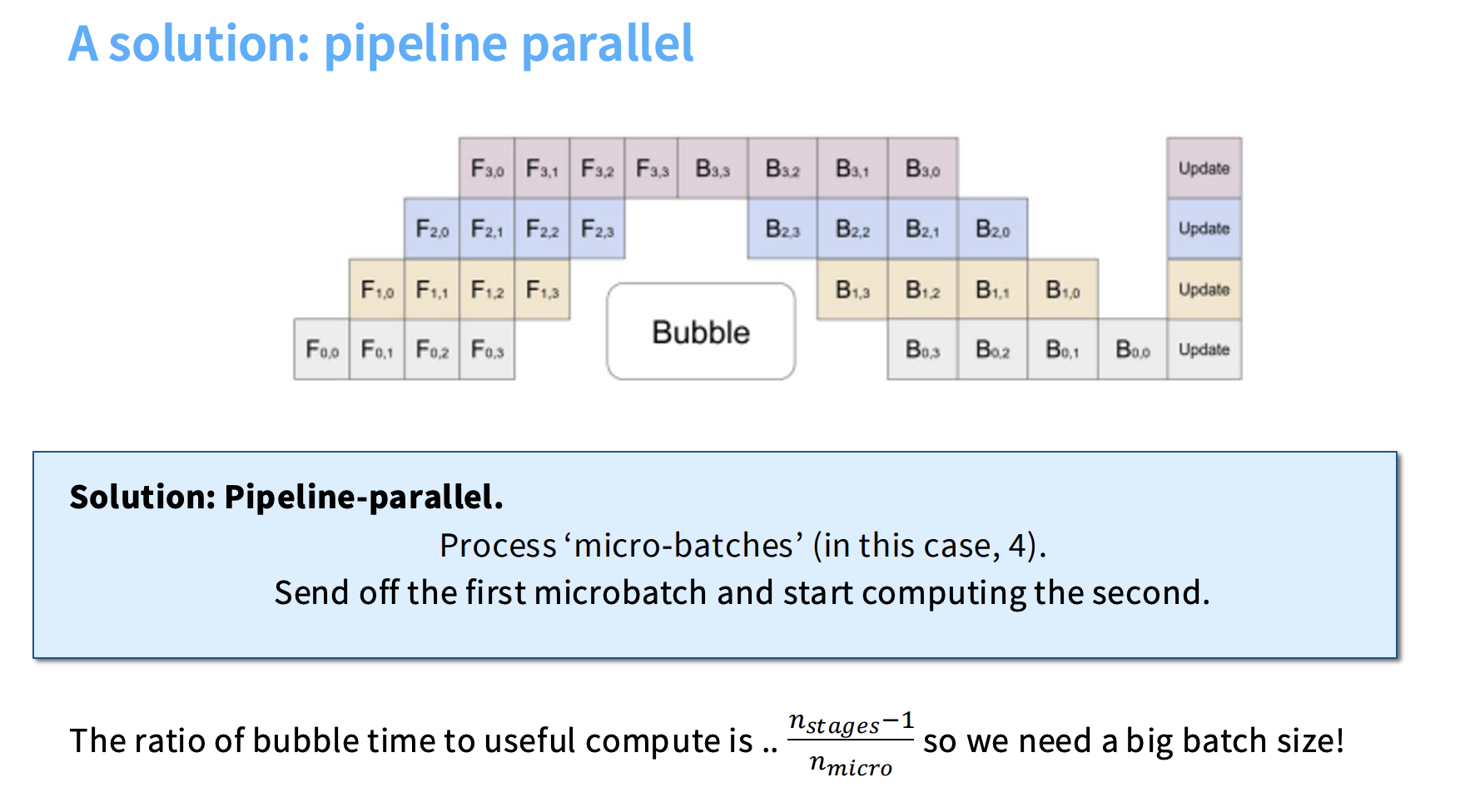
Pipeline parallelism involves cutting the deep neural network along the depth dimension (layer-wise parallel).
-
Layer Distribution:
Instead of replicating the entire model on every machine, each GPU is assigned a subset of the model’s layers. -
Activation Communication:
During forward and backward passes, GPUs pass activations and partial gradients between adjacent stages (GPUs). -
Addressing Utilization Issues:
A naive implementation of layer-wise parallelism results in poor GPU utilization — GPUs are active only 1/N of the time (where N = number of GPUs) while waiting for other stages. -
Micro-batches (Pipelining):
PP mitigates idle time by using micro-batches.
Once GPU 1 finishes the forward pass of micro-batch 1, it sends activations to GPU 2 and immediately starts micro-batch 2.
This overlaps communication and computation, improving utilization.
📈 Advantages and Communication Properties
Pipeline parallelism is chosen for its memory efficiency and communication behavior:
-
Memory Scaling:
PP achieves linear memory scaling for parameters and enables models to fit when single-GPU memory is insufficient.
It uses less memory than Distributed Data Parallel (DDP). - Activation Reliance:
PP’s communication depends solely on activations (b × s × h):b: batch sizes: sequence lengthh: hidden/residual dimension
Communication is point-to-point between GPUs.
- Use on Slower Links:
PP works well across inter-node networks because its activation-based communication is typically lighter than FSDP or Tensor Parallelism.
⚠️ Disadvantages and Performance Constraints
Despite memory benefits, PP introduces performance complexity and synchronization overheads:
-
The Bubble:
PP suffers from idle time known as the “pipeline bubble”.
The ratio of bubble time (overhead) to useful compute is approximately:$[ \frac{n_{micro}}{n_{stages} - 1} ]$
where
n_stages: number of pipeline stagesn_micro: number of micro-batches
-
Batch Size Dependency:
Performance depends heavily on large batch sizes, which are required to keep the pipeline full and minimize bubbles.
PP effectively consumes batch size as a limited resource. -
High Implementation Complexity:
PP is challenging to implement efficiently and often requires low-level modifications to autograd and queue scheduling.
It’s typically rated “NO” for ease of use.
🧠 Advanced Techniques — Zero Bubble Pipelining (DualPipe)
To reduce idle time, advanced scheduling strategies like Zero-Bubble Pipelining (DualPipe) have been developed.
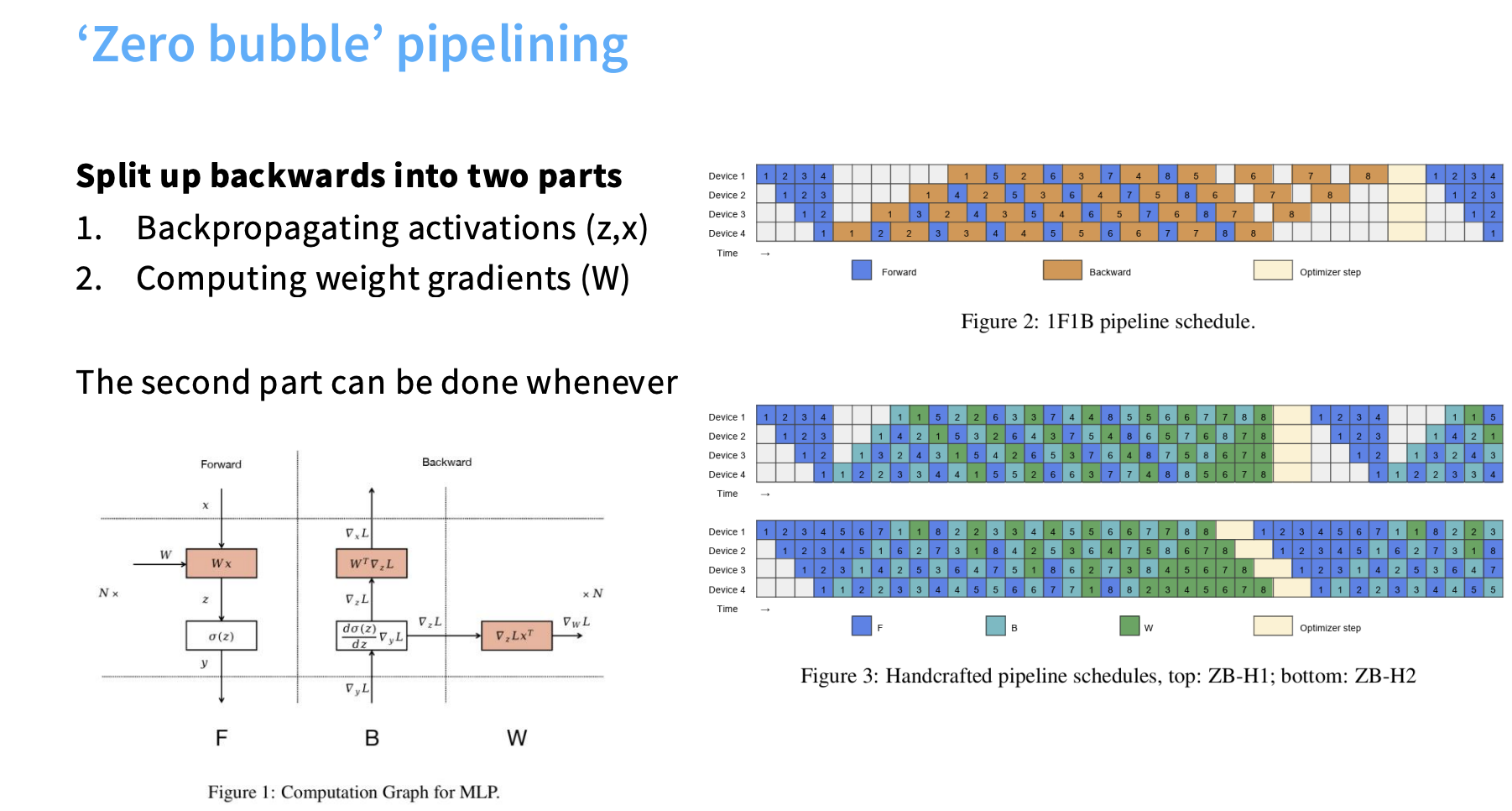
- Goal: Fill the idle pipeline time with useful work.
- Key Idea: Split the backward pass into two components:
- Activation backpropagation (
z,x) - Weight gradient computation (
W)
- Activation backpropagation (
- Rescheduling:
Since computingWgradients is independent of activation dependencies, it can be rescheduled to execute during otherwise idle periods — effectively hiding the bubble.
🧩 Strategic Usage in Large-Scale Training
Modern large-scale training combines PP with other parallelization techniques — often called 3D parallelism (Data + Tensor + Pipeline).
- Model Fitting:
- PP is typically deployed across nodes (inter-node) after maximizing Tensor Parallelism within a node (e.g., 8 GPUs).
- This ensures the model and activations fit into memory.
- Combinations in Practice:
- DeepSeek V3: 16-way PP + Expert Parallelism + ZeRO Stage 1
- Yi Model: PP + ZeRO Stage 1 + Tensor Parallelism
- Llama 3: PP during pretraining and long-context fine-tuning
✅ In short:
Pipeline Parallelism is layer-wise model parallelism that reduces memory per GPU and overlaps compute via micro-batching, but requires careful scheduling to avoid pipeline bubbles and ensure high utilization.
🧮 5.2 Tensor Parallelism (TP)
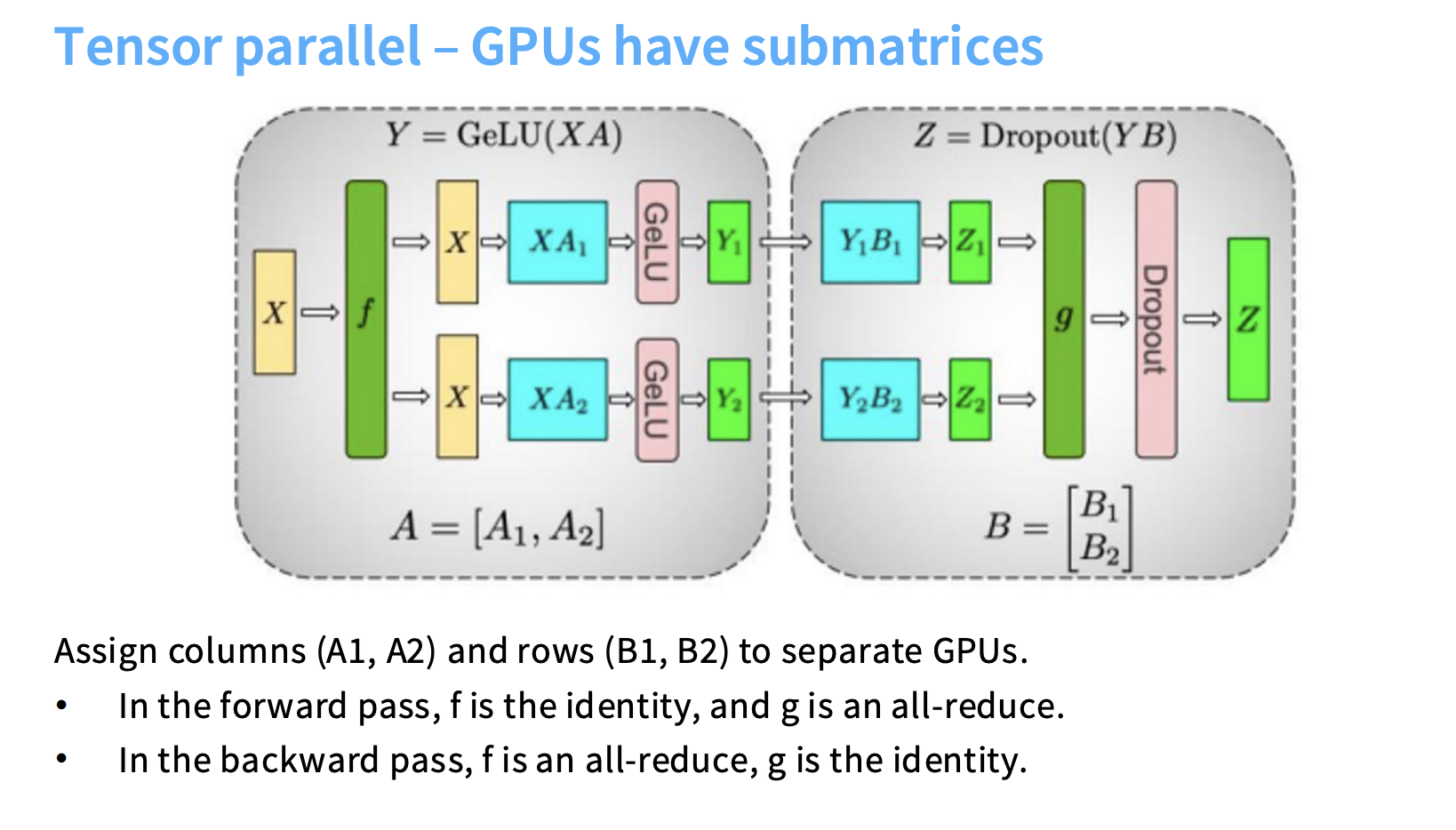
Tensor Parallelism (TP) is a form of model parallelism that focuses on parallelizing the computation within individual layers, especially large matrix multiplications. Unlike Pipeline Parallelism (PP), which splits the model by depth (layer-wise), Tensor Parallelism splits the model by width (tensor-wise).
-
Matrix Decomposition:
Matrix multiplication can be decomposed into smaller submatrices, allowing distributed computation across GPUs. -
Layer Distribution:
GPUs each hold a slice of the weight tensor.
For example, a weight matrixAcan be split into[A₁, A₂, ...].
🧠 Forward Pass Example (MLP Layer)
If an operation is $( Y = X \cdot A )$:
- The input
Xis copied to all GPUs. - Each GPU computes its local partial result:
- GPU₁ →
Y₁ = X · A₁ - GPU₂ →
Y₂ = X · A₂
- GPU₁ →
- The partial results are combined using an All-Reduce to get the final output
Z. - A synchronization barrier ensures all GPUs are aligned per layer.
In this setting:
- Forward pass: $( f = \text{identity} )$, $( g = \text{All-Reduce} )$
- Backward pass: $( f = \text{All-Reduce} )$, $( g = \text{identity} )$
🔁 Backward Pass
During backpropagation:
- Gradients are computed locally per GPU for their submatrix of
A. - Then an All-Reduce is performed to synchronize the partial gradients before the next layer backward step.
This ensures correctness while maintaining layer-wise tensor splitting.
✅ Advantages (Pros)
-
No Pipeline Bubble
TP does not suffer from idle time — all GPUs participate in each layer’s computation simultaneously. -
Batch Size Independence
TP works efficiently even with small batch sizes and doesn’t rely on large batches like PP. -
Low Implementation Complexity
Easier to integrate — typically requires modifying linear layers, not full computation graphs.
❌ Disadvantages (Cons)
- High Communication Cost
Each layer’s partial outputs require All-Reduce, introducing heavy communication overhead:
$[ \text{Cost} \approx 8 \cdot b \cdot s \cdot h \cdot \frac{n_{\text{devices}}}{n_{\text{devices}} - 1} ]$ where:- $( b )$: batch size
- $( s )$: sequence length
- $( h )$: hidden dimension
- Bandwidth Dependency
Efficient TP requires high-bandwidth, low-latency interconnects (e.g., NVLink).
Performance drops drastically over slower network links.
🧩 Strategic Usage
| Deployment | Strategy |
|---|---|
| Intra-node | Use TP within a single node, where GPUs have NVLink or NVSwitch. |
| Inter-node | Avoid or limit TP across nodes (slow interconnects). |
| Optimal GPU count | Typically up to 8 GPUs per node. Beyond that, communication dominates. |
| 3D Parallelism | Combine TP (intra-node) with PP or ZeRO (inter-node) for scaling across clusters. |
- Within each node → Tensor Parallel up to 8 GPUs.
- Across nodes → Use Pipeline Parallelism (PP) or ZeRO-3/FSDP to scale further.
🧾 Summary Table
| Aspect | Tensor Parallelism (TP) | Pipeline Parallelism (PP) |
|---|---|---|
| Split Dimension | Width (within layers) | Depth (between layers) |
| Communication | Heavy (All-Reduce) | Light (point-to-point) |
| Bubble (Idle Time) | None | Present (unless zero-bubble) |
| Batch Size Requirement | Small | Large |
| Implementation | Easier | Complex |
| Best Placement | Intra-node | Inter-node |
| Memory Savings | Parameters + Gradients | Parameters + Activations |
| Combined With | SP, PP, ZeRO | TP, ZeRO |
- Tensor Parallelism splits individual layers across GPUs.
- Every GPU computes partial results that are combined via All-Reduce.
- No idle time, but high communication bandwidth required.
- Works best within nodes with NVLink (≤8 GPUs).
- Often combined with Pipeline Parallelism (depth) and ZeRO/FSDP (memory sharding) in 3D parallelism setups.
⚡ 5.3. Activation Parallelism
Activation Parallelism is a crucial strategy for training large language models (LLMs), specifically designed to manage and reduce activation memory, which can become a major bottleneck in large-scale training.
As models grow and sequence lengths increase, activation memory becomes a serious limitation.
While Model Parallelism techniques like Pipeline Parallelism (PP) and Tensor Parallelism (TP) achieve linear scaling for parameters, gradients, and optimizer states, they do not fully address the memory consumed by activations.
Activation memory usage is dynamic:
- It grows during the forward pass.
- It peaks during the backward pass.
- It is freed afterward.
Managing this peak usage is essential to fit larger models and increase batch sizes.
The Straggler Term
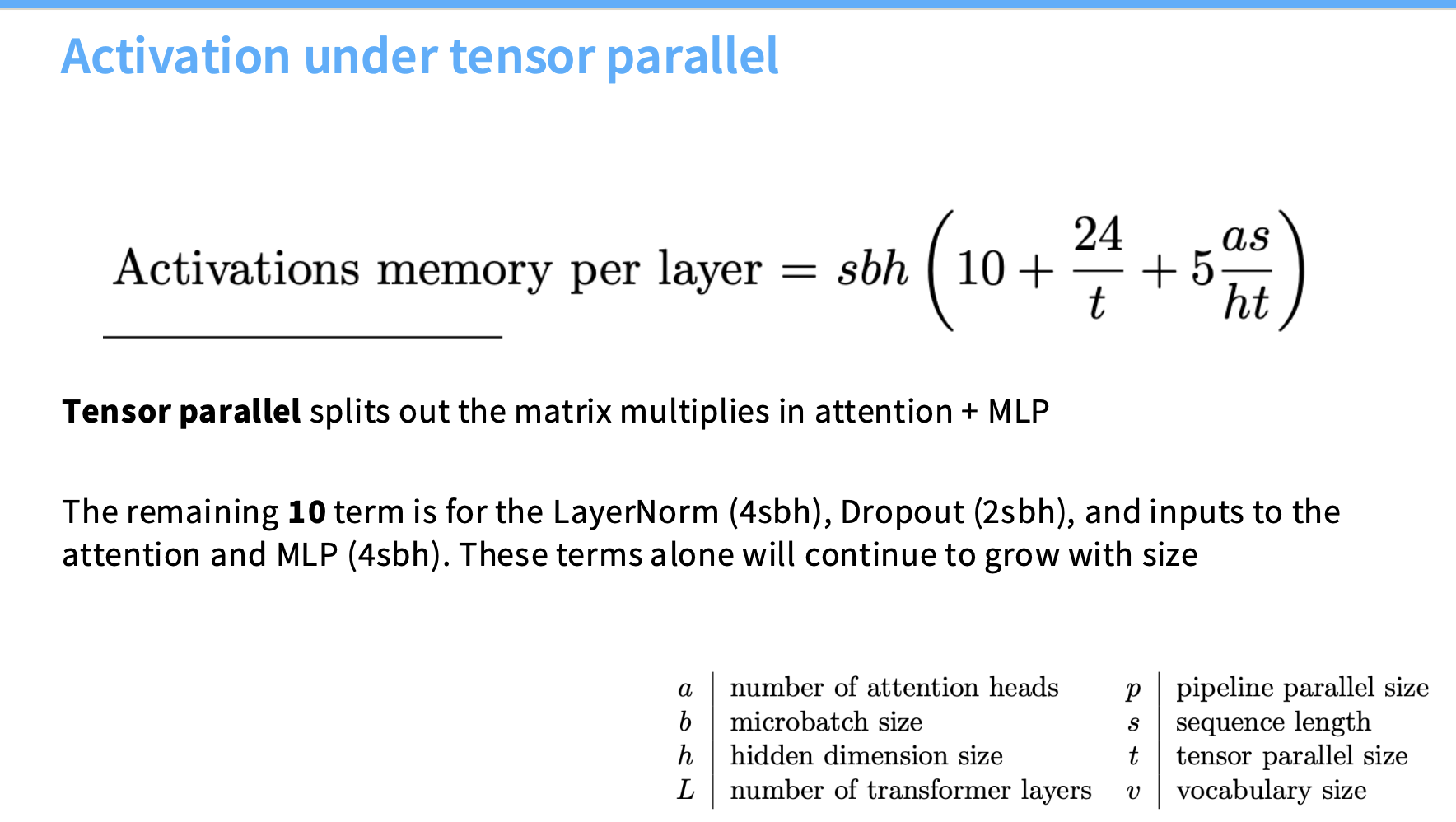
Even with TP, splitting matrix multiplications in the Attention and MLP blocks, a large unreduced activation memory term remains:
$[ \text{Straggler Term} \approx 10 \cdot s \cdot b \cdot h ]$
Where:
- $( s )$: sequence length
- $( b )$: batch size
- $( h )$: hidden/residual dimension
Source of Unreduced Memory
This unreduced activation memory comes from non-matrix multiplication components such as:
- LayerNorm: $( 4sbh )$
- Dropout: $( 2sbh )$
- Inputs to Attention and MLP layers: $( 4sbh )$
These are pointwise operations not parallelized by Tensor Parallelism.
⚙️ Implementation via Sequence Parallelism (SP)
Sequence Parallelism (SP) is the main implementation method for activation parallelism.
🔍 Core Observation
Pointwise ops like LayerNorm and Dropout operate independently across the sequence dimension.
This means:
Each token’s computation does not depend on others — perfect for sequence-wise sharding.
✂️ Sharding Mechanism
SP splits these operations along the sequence axis:
- If a sequence has 1024 tokens, and you have 4 GPUs,
→ each GPU processes 256 tokens for all pointwise ops.
This reduces activation memory per GPU by a factor of 4 (in this case).
🎯 Goal: Linear Scaling
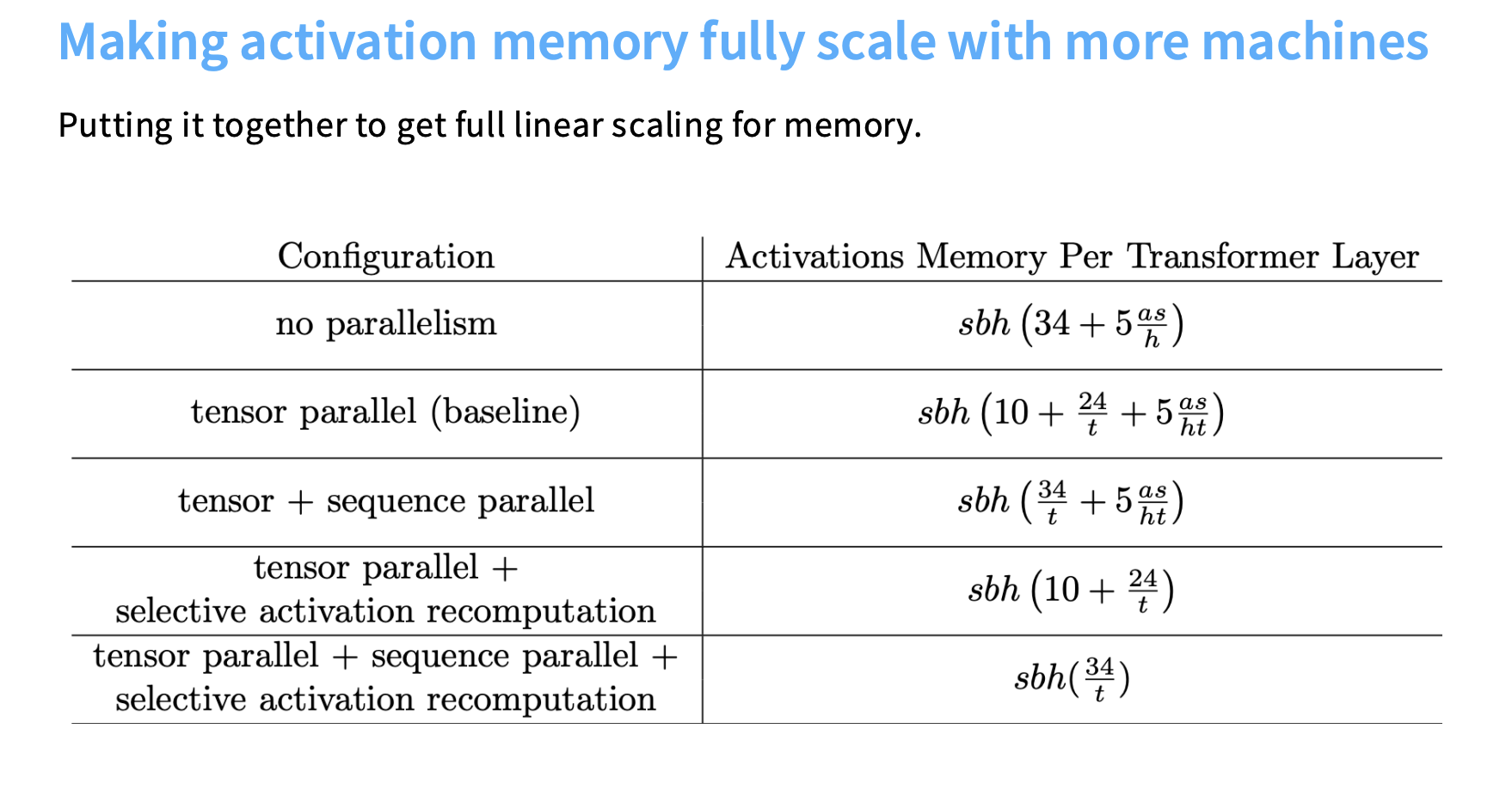
By combining Sequence Parallelism (SP) with Tensor Parallelism (TP), the system achieves linear scaling in activation memory — now all components (parameters, gradients, activations) scale with the number of GPUs.
🔁 Sequence Parallelism Communication Primitives
To coordinate the sequence sharding, SP uses collective communication primitives:
| Component | Forward Pass | Backward Pass |
|---|---|---|
| g | All-Gather | Reduce-Scatter |
| ḡ (g-bar) | Reduce-Scatter | All-Gather |
- All-Gather: Combine partial results from all GPUs (used before operations that need the full sequence).
- Reduce-Scatter: Distribute and sum gradients or activations across GPUs (used after backward).
⚡ Related Technique: Activation Recomputation
Activation Recomputation (or checkpointing) complements SP to further reduce memory.
💡 Key Idea
Instead of storing all activations, recompute some during the backward pass when needed — trading compute for memory.
✅ Benefits
- Reduces memory required for quadratic attention terms.
- Enables larger batch sizes, which improves pipeline parallelism efficiency by hiding bubbles.
⚖️ Trade-Off
- Slightly more computation (extra forward passes).
- But total throughput increases, since training becomes more memory efficient.
🔺 6. Combining Strategies — 3D Parallelism
3D Parallelism (sometimes extended to 4D or 5D) is the standard best practice for efficiently training extremely large language models (LLMs).
It combines multiple parallelization techniques to balance memory, compute, and bandwidth constraints.
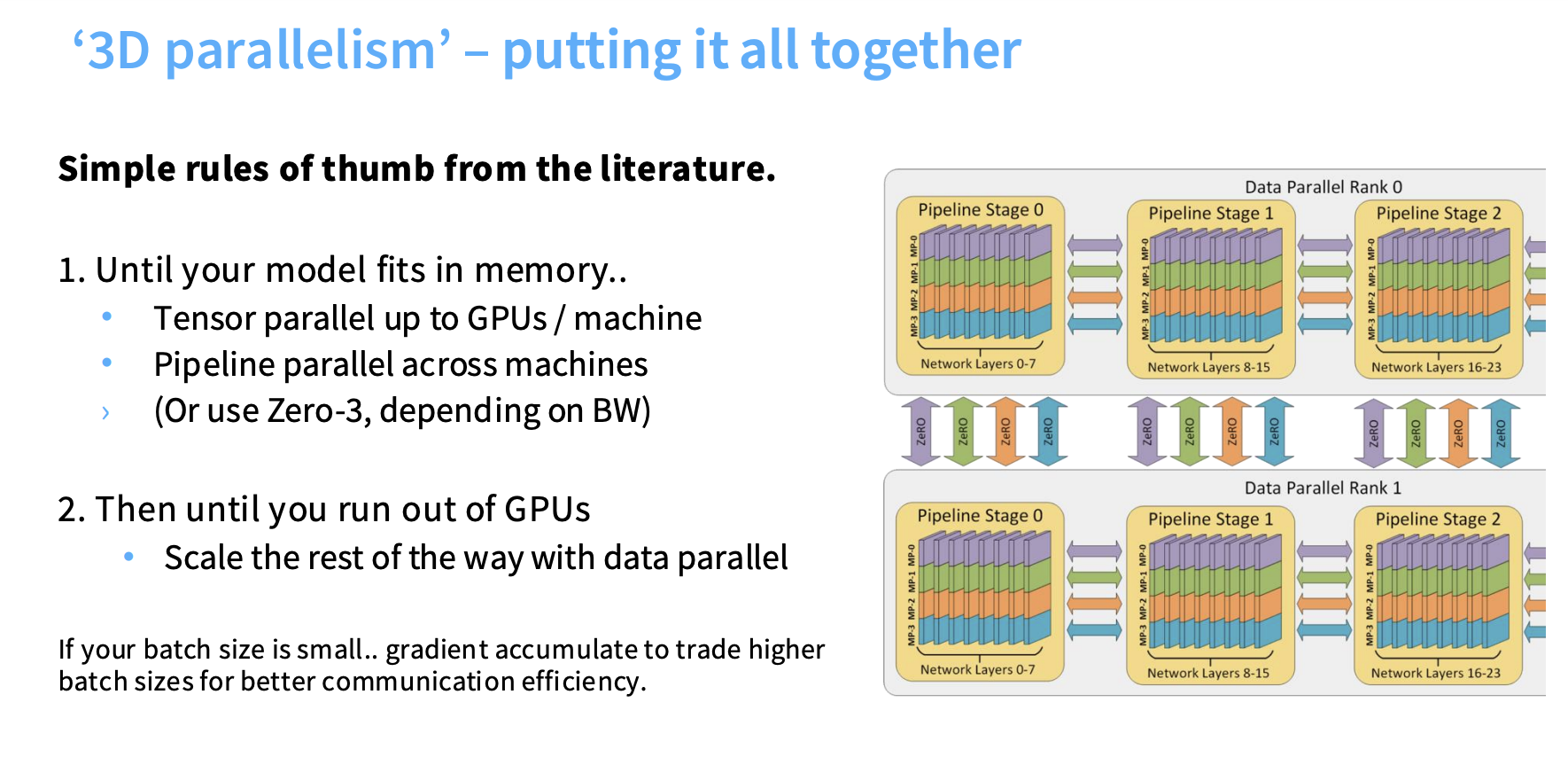
The general strategy is driven by two goals:
- Make the model fit into memory.
- Scale compute to fully utilize all available GPUs.
⚙️ Simple Rules of Thumb for Combining Parallelism
The approach follows a staged strategy, prioritizing bandwidth-hungry methods on fast interconnects first, and then scaling outward.
🧠 Stage 1: Fitting the Model in Memory (Model Parallelism)
The first priority is ensuring that the model parameters and activations fit into memory.
This is achieved through Model Parallelism.
1️⃣ Maximize Tensor Parallelism (TP) Within Each Node
- Rule: Use Tensor Parallelism (TP) up to the number of GPUs per machine (e.g.,
TP=8). - Reasoning:
TP relies on low-latency, high-bandwidth interconnects (e.g., NVLink) since it performs large All-Reduce operations per layer.
These connections exist within a single node, making TP ideal for intra-node scaling. - Benefit:
- Linear memory scaling for parameters, gradients, and optimizer states.
- No pipeline bubble.
- Does not consume batch size.
- Add-on: Sequence Parallelism (SP)
- Applied on top of TP to achieve full linear memory scaling for activations, especially with long sequences.
- Splits LayerNorm and Dropout operations along the sequence axis.
2️⃣ Scale Across Machines Using Pipeline Parallelism (PP) or ZeRO-3 (FSDP)
- Rule: Once TP is maxed out within the node, if the model still doesn’t fit, use Pipeline Parallelism (PP) or ZeRO Stage 3 (FSDP) across nodes.
- Reasoning:
- PP works well on slower network links because it only communicates activations (
b × s × h) point-to-point,
rather than large collective operations. - FSDP (ZeRO-3) shards parameters, gradients, and optimizer states, giving linear memory scaling for all static components.
- PP works well on slower network links because it only communicates activations (
- Trade-offs:
- PP: High dependency on large batch sizes to hide synchronization overhead (the “bubble”).
- FSDP: Avoids bubbles, but incurs 3× parameter-size communication cost per step.
🚀 Stage 2: Scaling Compute (Data Parallelism)
Once the model fits in memory, the next step is to fully utilize compute using Data Parallelism (DP).
- Rule: Scale out with Data Parallelism (DP) — typically ZeRO Stage 1 (Optimizer Sharding).
- Reasoning:
DP scales compute by splitting batches across machines.
ZeRO-1 is “free” in bandwidth-limited setups (same communication cost as naive DDP) while reducing optimizer memory. - Why Last?
- DP works well even with low-bandwidth links.
- It efficiently brings more GPUs into play to increase total throughput.
⚖️ Managing Resources and Efficiency
🧮 Batch Size as a Resource
- Global batch size is limited and must be managed carefully:
- PP consumes batch size to hide the pipeline bubble.
- DP consumes batch size for scaling compute.
- TP has no impact on batch size.
🔁 Activation Recomputation
- Purpose: Reduces memory by recomputing activations during backward pass (used in Flash Attention).
- Effect:
- Frees activation memory → allows larger batch sizes.
- Larger batches improve throughput by masking communication overheads, especially for PP.
- Trade-off: Adds compute (extra FLOPs), but often yields net throughput gains.
⚙️ Optimal Configuration
Empirical results show:
Maximize Tensor Parallelism (TP=8) first,
then balance Pipeline Parallelism (PP) and Data Parallelism (DP)
for the best linear scaling of total FLOPs.
🌍 Real-World Examples of 3D Parallelism
| Model | Techniques Used | Notes |
|---|---|---|
| DeepSeek V3 | PP (16-way), Expert Parallelism (64-way), ZeRO-1 | Expert parallelism adds another dimension. |
| Yi | ZeRO-1, TP, PP | Balanced approach across all dimensions. |
| LLaMA 3 (405B) | TP=8, SP, PP, DP | Ordered by required bandwidth; DP tolerates longest latency. |
| Gemma 2 | ZeRO-3, TP + SP (Model Parallelism), DP | FSDP + sequence sharding for efficiency. |
In current best practices, Activation Parallelism (SP) is often combined with Tensor Parallelism to form a single Model Parallel dimension, as seen in the parallelism utilized by models like DeepSeek and Gemma 2, which used MP=TP+SP
🧩 Summary Table
| Dimension | Method | Scales | Communication | Notes |
|---|---|---|---|---|
| Tensor Parallelism (TP) | Split within layer | Intra-node | All-Reduce | Fastest, no batch cost |
| Sequence Parallelism (SP) | Split activations | Intra-node | Reduce/All-Gather | Complements TP |
| Pipeline Parallelism (PP) | Split layers | Inter-node | Point-to-point | Needs large batches |
| Data Parallelism (DP) | Split batches | Inter-node | All-Reduce | Easiest scaling |
| ZeRO / FSDP | Shard params/opt | Inter-node | All-Gather | Full memory savings |
✅ Takeaway
3D Parallelism =
→ Tensor + Sequence Parallelism (fit model intra-node)
→ Pipeline or ZeRO/FSDP (fit model inter-node)
→ Data Parallelism (scale compute)
Together, they form the foundation of modern large-scale model training, enabling models with hundreds of billions of parameters to be trained efficiently across thousands of GPUs.