
🎭 The Actor–Critic Method: Bridging Policy-Based and Value-Based Reinforcement Learning
The Actor–Critic (AC) method is a foundational algorithm in Reinforcement Learning that elegantly combines the strengths of Policy-Based and Value-Based methods.
It uses two neural networks — the Policy Network (Actor) and the Value Network (Critic) — trained together in a feedback loop.
The actor learns how to act, and the critic learns how good the action was.
🧩 1. Dual-Network Structure
The Actor–Critic framework introduces two interconnected approximations:
🎬 Policy Network (Actor)
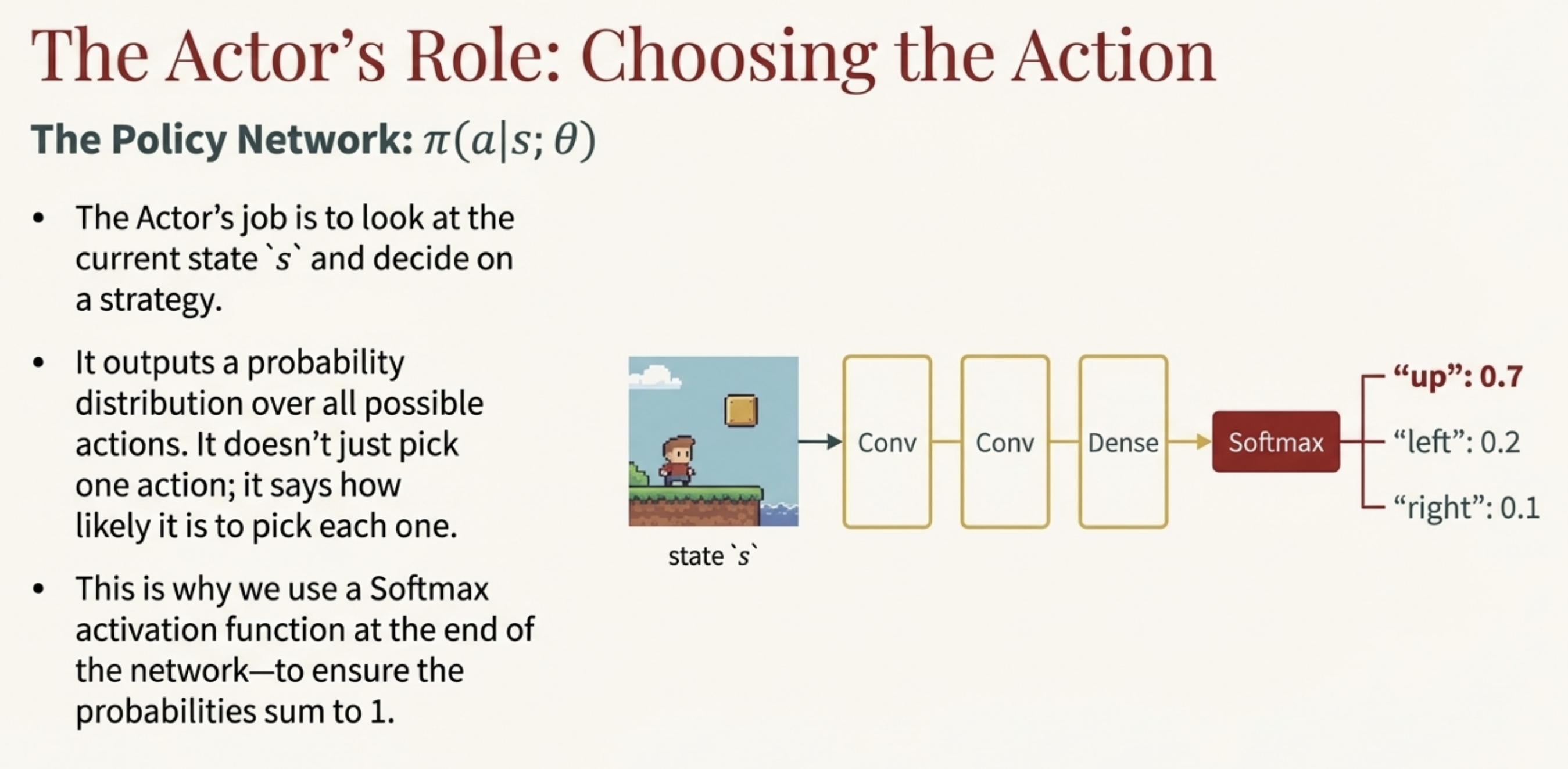
- Role: Approximates the optimal policy $\pi(a \mid s)$; determines how the agent behaves.
- Notation: $\pi(a \mid s; \theta)$, where $\theta$ are the actor’s trainable parameters.
- Input/Output:
- Input: current state $s$ (e.g., a screenshot of Super Mario).
- Output: probability distribution over the action set $A$.
- Uses Softmax activation to ensure probabilities sum to one:
\(\sum_{a \in \mathcal{A}} \pi(a \mid s; \theta) = 1\)
- Example Output:
- $\pi(\text{“left”} \mid s) = 0.2$
- $\pi(\text{“right”} \mid s) = 0.1$
- $\pi(\text{“up”} \mid s) = 0.7$
🧠 Value Network (Critic)
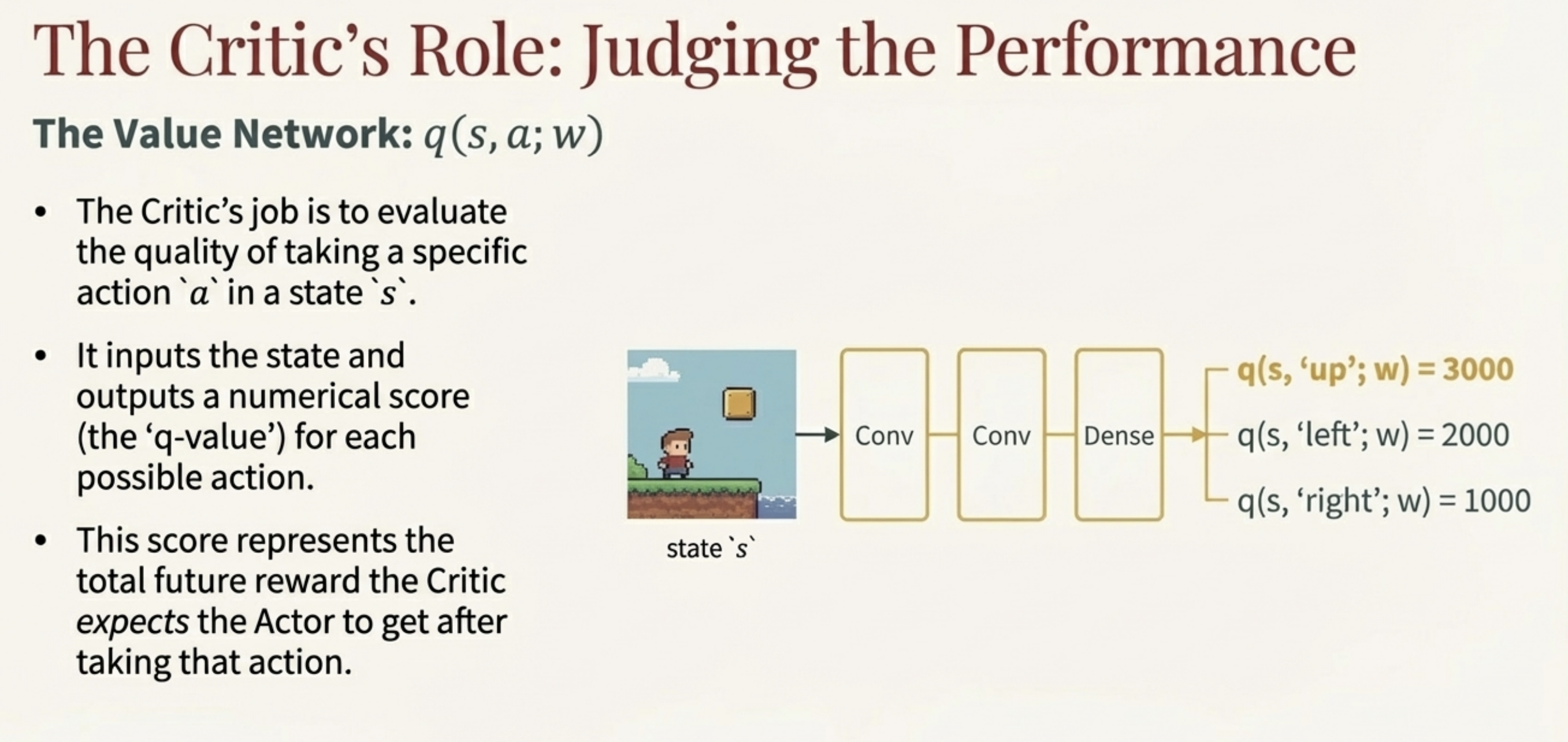
- Role: Approximates the Action-Value Function $( Q_\pi(s,a) )$, which measures how good an action is given the current state.
- Notation: $( q(s,a; w) )$, where $( w )$ are the critic’s trainable parameters.
- Input/Output:
- Input: the current state $( s )$.
- Output: predicted Q-values for all possible actions.
- Example Output:
$( q(s, “left”; w) = 2000 )$,
$( q(s, “right”; w) = 1000 )$,
$( q(s, “up”; w) = 3000 )$
The State-Value Function can be approximated by combining both networks: $[ V(s; \theta, w) \approx \sum_{a} \pi(a|s; \theta) \, q(s,a; w) ]$
🔁 2. Training Iteration: One Step of the Actor–Critic Algorithm
Each iteration consists of two key update phases — first the Critic, then the Actor — based on a single environment interaction.
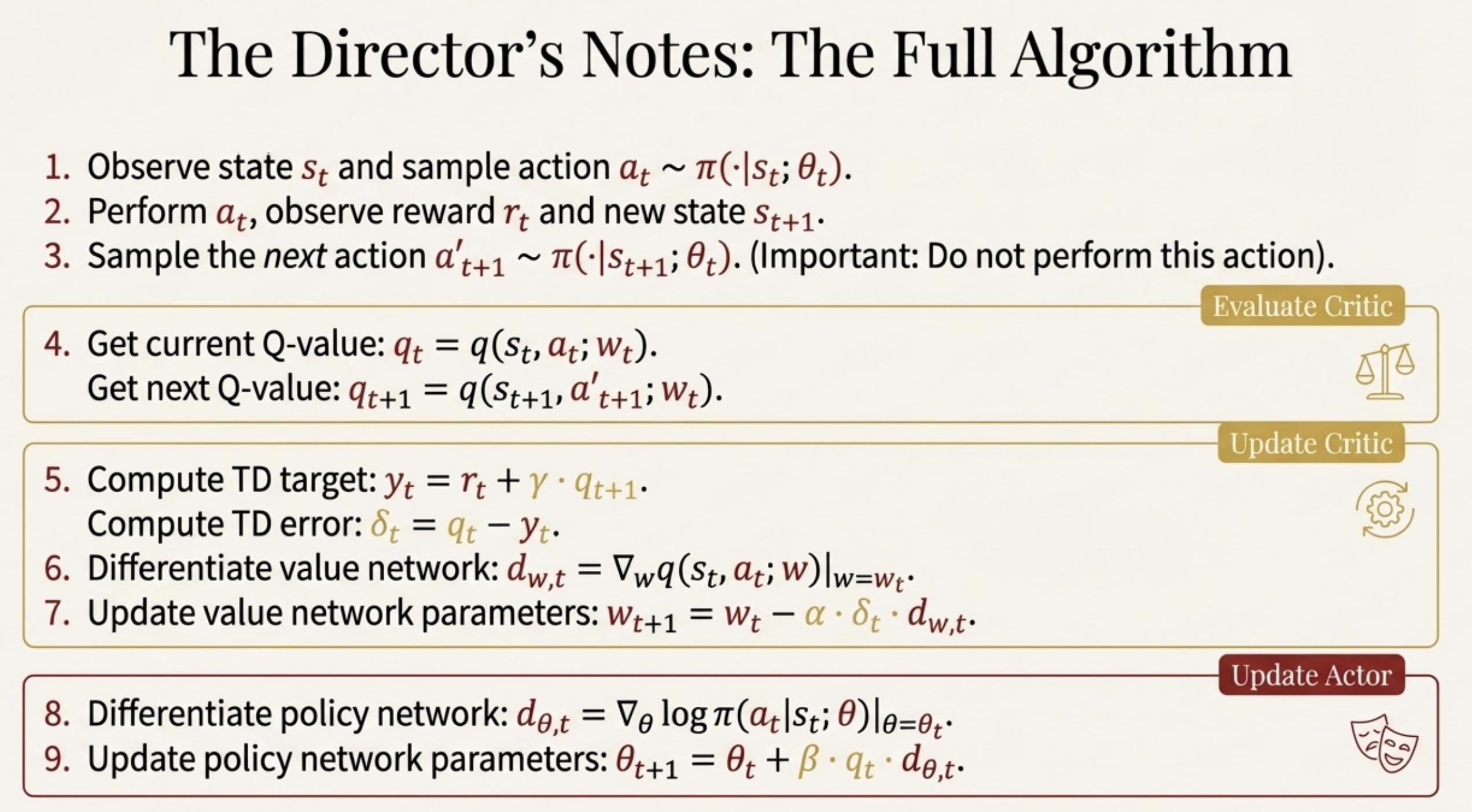
🧭 A. Interaction and Data Gathering
- Observe State and Sample Action:
- Observe the current state $( s_t )$.
- The Actor samples an action according to the current policy:
\(a_t \sim \pi(\cdot \mid s_t; \theta_t)\)
- Perform Action:
- Execute $( a_t )$ in the environment.
- Observe reward $( r_t )$ and next state $( s_{t+1} )$.
- Sample Next Action (for TD target):
- For learning only (not executed), sample a next action:
\(a_{t+1}' \sim \pi(\cdot \mid s_{t+1}; \theta_t)\)
- For learning only (not executed), sample a next action:
⚖️ B. Update the Value Network (Critic) via Temporal Difference (TD) Learning
The Critic learns to better estimate future returns.
-
Evaluate Critic:
\(q_t = q(s_t, a_t; w_t)\) \(q'_{t+1} = q(s_{t+1}, a'_{t+1}; w_t)\) -
Compute TD Error (δₜ):
Measures how far the prediction is from the target return: \(\delta_t = q_t - \left(r_t + \gamma \cdot q'_{t+1}\right)\) where $( \gamma )$ is the discount factor. -
Differentiate Critic:
Compute the gradient of the Q-function with respect to $( w )$:
\(d_{g,t} = \frac{\partial q(s_t, a_t; w)}{\partial w}\) -
Update Critic Parameters (Gradient Descent): \(w_{t+1} = w_t - \alpha \cdot \delta_t \cdot d_{g,t}\) $( \alpha )$ is the Critic’s learning rate.
This update helps the critic produce more accurate estimates of $( Q_\pi(s,a) )$.
🎯 C. Update the Policy Network (Actor) via Policy Gradient
The Actor learns to choose actions that increase the critic’s estimated value.
-
Differentiate Actor:
Compute the gradient of the log-policy with respect to $( \theta )$:
\(d_{\pi,t} = \frac{\partial \log \pi(a_t \mid s_t; \theta)}{\partial \theta}\) -
Update Actor Parameters (Gradient Ascent):
The policy parameters are updated toward actions the critic deems better: \(\theta_{t+1} = \theta_t + \beta \cdot q_t \cdot d_{\pi,t}\) $( \beta )$ is the Actor’s learning rate.
The product $( q_t \cdot d_{\pi,t} )$ represents the stochastic policy gradient estimate $( g(a_t, \theta_t) )$.
⚙️ 3. The Actor–Critic Feedback Loop
The two networks learn from each other:
- The Actor produces actions and learns from the Critic’s evaluations.
- The Critic evaluates those actions and improves using the rewards from the environment.
- Over time:
- The Actor becomes better at selecting rewarding actions.
- The Critic becomes better at judging those actions.
This tight feedback loop allows continuous learning during interaction — faster and smoother than pure Monte Carlo methods like REINFORCE.
📈 4. Summary of the Full Algorithm
🔁 Actor–Critic Update Steps (Q-Critic vs V-Critic)
| Step | Operation | Network | Learning Type |
|---|---|---|---|
| 1 | Observe state $s_t$ | — | — |
| 2 | Sample action $a_t \sim \pi(\cdot \mid s_t; \theta_t)$ | Actor | — |
| 3 | Execute $a_t$, observe $s_{t+1}$ and $r_t$ | Environment | — |
| 4 | Sample next action $a_{t+1}’ \sim \pi(\cdot \mid s_{t+1}; \theta_t)$ | Actor | — |
| 5 | Compute TD error $\delta_t = r_t + \gamma q’_{t+1} - q_t$ | Critic | Supervised (TD) |
| 6 | Update $w_{t+1} = w_t + \alpha_c \, \delta_t \, \nabla_w q(s_t, a_t; w_t)$ | Critic | Gradient Descent |
| 7 | Compute $d_{\pi,t} = \frac{\partial}{\partial \theta} \log \pi(a_t \mid s_t; \theta_t)$ | Actor | Policy Gradient |
| 8a | Q-Critic (SARSA style): $\theta_{t+1} = \theta_t + \beta_a \, q_t \, d_{\pi,t}$ | Actor | Gradient Ascent |
| 8b | V-Critic (A2C style): $\theta_{t+1} = \theta_t + \beta_a \, \delta_t \, d_{\pi,t}$ | Actor | Gradient Ascent |
-
Q-Critic (SARSA style)
Uses $q_t = Q(s_t, a_t; w_t)$ directly to weight the policy gradient.
→ High variance but simple: no baseline subtraction. -
V-Critic (A2C style)
Uses the TD error $\delta_t = r_t + \gamma V(s_{t+1}) - V(s_t)$ as a low-variance estimate of the Advantage.
→ This acts like a baseline, promoting actions that are better than expected.
Actor-Critic Training Loop (render-safe diagram)

Observe s_t
   |
   v
Actor pi(a|s; theta) -> sample a_t
   |
   v
Execute a_t in environment
   |
   v
Receive r_t, s_{t+1}
   |
   +--> Critic estimate (V-critic or Q-critic)
   |      |
   |      v
   |   Compute TD error delta_t
   |      |
   |      v
   |   Update critic params w
   |
   +--> Update actor params theta using policy gradient weighted by value/advantage
   |
   v
Next step: s_t <- s_{t+1}, repeat
# One iteration (generic Actor-Critic)
s_t = env.state()
a_t = sample_from_policy(pi_theta, s_t)
r_t, s_tp1 = env.step(a_t)

if critic_type == "V":
    delta_t = r_t + gamma * V_w(s_tp1) - V_w(s_t)
    w = w + alpha_c * delta_t * grad_w(V_w(s_t))
else:  # Q-critic (SARSA-style)
    a_tp1 = sample_from_policy(pi_theta, s_tp1)
    delta_t = r_t + gamma * Q_w(s_tp1, a_tp1) - Q_w(s_t, a_t)
    w = w + alpha_c * delta_t * grad_w(Q_w(s_t, a_t))

theta = theta + alpha_a * delta_t * grad_theta(log_pi_theta(a_t, s_t))
🧠 5. Intuitive Understanding
- Actor (Policy Network): Learns the strategy — which actions to take.
- Critic (Value Network): Learns to evaluate that strategy by predicting how rewarding each action is.
- Together: The Actor adjusts its behavior based on the Critic’s feedback; the Critic adjusts its judgment based on real rewards.
This design makes Actor–Critic methods more sample-efficient and stable than pure policy gradient methods, and more flexible than value-based methods like DQN.
In short:
The Actor–Critic method unifies decision-making and evaluation.
The Actor improves its policy using gradients guided by the Critic’s value estimates,
while the Critic refines its judgment using real environmental rewards —
creating a closed loop of continuous, mutually beneficial learning.
6. Inputs and Outputs of the Actor–Critic Networks
In the Actor–Critic framework, two neural networks work together:
the Policy Network (Actor) and the Value Network (Critic).
Each serves a distinct role — the Actor decides what to do, and the Critic evaluates how good that decision was.
🎭 Policy Network (Actor)
The policy network, parameterized by $\theta$, approximates the policy function $\pi(a|s; \theta)$.
It controls the agent’s behavior, producing a probability distribution over actions for a given state.
| Function | Input | Output | Details |
|---|---|---|---|
| Input | State $s$ | — | The input is the current environment state, which can be a high-dimensional signal (e.g., an image or sensor data). |
| Output | Probability distribution over actions | — | The network outputs a probability distribution $\pi(a \mid s; \theta)$ over all possible actions $a \in \mathcal{A}$. These probabilities sum to 1: $\sum_{a \in \mathcal{A}} \pi(a \mid s; \theta) = 1$. |
| Sampling | — | Action $a_t$ | During interaction, the agent samples an action from this distribution: $\boldsymbol{a_t \sim \pi(\cdot \mid s_t; \theta)}$. |
| Learning Rule | — | Updated $\theta$ | The Actor is updated using the policy gradient to increase the expected state-value $V(s; \theta, w)$ and favor actions with higher estimated returns. |
🧩 Typically, a Softmax activation function is applied in the final layer to ensure the outputs form a valid probability distribution.
⚖️ Value Network (Critic)
The value network, parameterized by $w$, approximates the action-value function $Q_\pi(s, a)$, denoted as $q(s, a; w)$.
Its role is to judge how good the Actor’s chosen action was, providing a training signal.
| Function | Input | Output | Details |
|---|---|---|---|
| Input | State $s$ | — | The network receives the same state $s$ observed by the Actor. |
| Output | Action-values $q$ | — | The Critic outputs estimated Q-values for every possible action: $q(s, \text{“left”}; w)$, $q(s, \text{“right”}; w)$, etc. |
| Usage | — | TD Target | These values are used to compute the Temporal Difference (TD) target, which evaluates how much the Actor’s decision improved the expected future reward. |
| Learning Rule | — | Updated $w$ | The Critic is trained using TD learning (e.g., minimizing $(r_t + \gamma q(s_{t+1}, a’; w) - q(s_t, a_t; w))^2$) to make its predictions closer to observed rewards. |
Over time, the Critic’s Q-value predictions become more accurate, stabilizing policy updates.
🔗 Relationship Between Actor and Critic
The Actor and Critic interact mathematically through the approximate state-value function, defined as:
\[V(s; \theta, w) = \sum_{a \in \mathcal{A}} \pi(a \mid s; \theta)\, q(s, a; w)\]- The Actor provides the action probabilities $\pi(a \mid s; \theta)$.
- The Critic provides the corresponding action-value estimates $q(s, a; w)$.
- Together, they form an expectation of the return from state $s$ under the current policy.
This coupling allows the Actor to learn from the Critic’s feedback —
increasing the probability of actions that lead to higher predicted returns and reducing the probability of poor ones.
🧭 Summary
| Network | Parameters | Input | Output | Learning Type | Purpose |
|---|---|---|---|---|---|
| Actor (Policy Network) | $\theta$ | State $s$ | Probability distribution $\pi(a \mid s; \theta)$ | Policy Gradient | Chooses actions and updates toward higher-value behaviors |
| Critic (Value Network) | $w$ | State $s$ | Action-values $q(s, a; w)$ | TD Learning | Evaluates the Actor’s performance and provides feedback |
Together, the two networks form the foundation of Actor–Critic Reinforcement Learning, blending the strengths of policy optimization and value estimation.
🧩 V-Critic vs. Q-Critic and Policy Updates with a Baseline
In reinforcement learning, different Actor–Critic variants use different forms of the Critic — either estimating the state value function $V(s)$ or the action value function $Q(s, a)$.
These lead to two main styles of Actor–Critic algorithms: V-Critic (A2C/A3C-style) and Q-Critic (SARSA-style).
💡 Policy Update with a Baseline
The policy update with a baseline is an essential refinement to the standard Actor–Critic algorithm.
It improves training stability by focusing updates on actions that perform better than average, rather than on all actions proportionally to their raw Q-values.
Standard Policy Update (Without Baseline)
In the basic Actor–Critic framework, the policy parameters $\theta$ are updated proportionally to the action-value estimate $q_F = q(s_F, a_F; w_F)$.
-
Compute policy gradient:
\[d_{\pi, F} = \frac{\partial \log \pi(a_F \mid s_F; \theta)}{\partial \theta}\] -
Perform stochastic gradient ascent:
\[\theta_{F+1} = \theta_F + \beta \, q_F \, d_{\pi, F}\]
Here, $q_F$ acts as a scaling factor, weighting how strongly each sampled action should influence the policy update.
Adding a Baseline to Reduce Variance
The problem with using $q_F$ directly is that it can introduce high variance — even “average” or bad actions can cause large gradient updates.
To address this, we introduce a baseline $b(s)$, typically the state-value function $V(s)$.
This transforms the update rule to use the Advantage Function:
Then the policy gradient becomes:
\[\nabla_\theta J(\theta) = \mathbb{E}\!\left[\nabla_\theta \log \pi(a \mid s; \theta) \, (Q(s, a) - V(s))\right]\]Policy Update with Baseline (Advantage-Based TD Error)
In the notation used in the sources:
- $q_F = q(s_F, a_F; w_F)$ — Critic’s Q-value estimate
- $\delta_F = q_F - (r_F + \gamma q_{F+1})$ — Temporal Difference (TD) error
- $\delta_A$ — advantage-based TD error (when using a baseline)
Then the policy update with a baseline becomes:
\[\theta_{F+1} = \theta_F + \beta \, \delta_A \, d_{\pi, F}\]where:
\[\delta_A \approx r_F + \gamma V(s_{F+1}) - V(s_F)\]This update means:
- If the observed return is better than expected ($\delta_A > 0$), increase the probability of taking that action.
- If it’s worse than expected ($\delta_A < 0$), decrease it.
🧠 Why It Works
Subtracting the baseline does not bias the gradient because the expectation of the baseline term is zero:
\[\mathbb{E}\!\left[\nabla_\theta \log \pi(a \mid s; \theta) \, b(s)\right] = 0\]This ensures that:
- The policy update remains unbiased (still points in the right direction).
- But it becomes lower variance, improving stability and convergence speed.
💡 Intuition:
Using a baseline turns the raw Q-value signal into a relative measure — “Was this action better than usual?”
The Actor is only rewarded when actions exceed the Critic’s expectations, leading to more stable and meaningful learning updates.
Do We Need Both V and Q Networks?
In general, you don’t need both — it depends on whether your Critic learns V(s) or Q(s,a).
✅ 1️⃣ V-Critic (A2C / A3C / PPO style) — Yes, you need a Value Network $V(s)$
In this setup:
- The Critic learns $V(s; w_V)$ — the expected return from a given state.
- The Actor learns $\pi(a \mid s; \theta)$ — how to choose actions.
- The Advantage is computed as:
\(A(s, a) = r_t + \gamma V(s_{t+1}) - V(s_t)\) - You do not need a Q-network here — the value network provides the baseline.
So the system has:
- One Actor Network (policy)
- One Critic Network (value function $V$)
✅ 2️⃣ Q-Critic (SARSA / Classic AC style) — No, you only need a Q Network $Q(s, a)$
In this setup:
- The Critic learns $Q(s, a; w_Q)$ — the expected return for each state–action pair.
- The Actor uses the Q-values directly for updates:
\(\theta \leftarrow \theta + \alpha_a \, Q(s_t, a_t) \, \nabla_\theta \log \pi(a_t \mid s_t; \theta)\) - There’s no explicit baseline, but this approach typically has higher variance.
💡 3️⃣ Hybrid or Advanced Versions
Some modern algorithms (like DDPG, SAC) include both:
- A Q-network to learn action-specific values.
- A V-network (or soft value) to stabilize learning, e.g.: \(V(s) = \mathbb{E}_{a \sim \pi} \!\left[ Q(s, a) - \alpha \log \pi(a \mid s) \right]\) This formulation is commonly used in continuous-action reinforcement learning.
🧭 Summary
| Algorithm Type | Critic Learns | Networks Needed | Advantage Computed From |
|---|---|---|---|
| A2C / A3C / PPO | $V(s)$ | Actor + Value | $A = r + \gamma V(s’) - V(s)$ |
| Classic AC / SARSA | $Q(s,a)$ | Actor + Q | $A = Q(s,a)$ (no baseline) |
| DDPG / SAC | Both $Q(s,a)$ and $V(s)$ | Actor + Q + V | Uses both for stability |
In short:
You only need one Critic network — either $Q$ or $V$ — depending on the algorithm.
But if you want a baseline (Advantage-based learning), then yes — that means adding a V-network alongside your Actor.
V-Critic (A2C / A3C Style)
V-Critic methods use the state-value function $V(s; w)$ as the Critic’s prediction target.
The idea: instead of estimating $Q(s, a)$ for every action, the Critic learns how good it is to be in a given state — averaged over the policy’s actions.
Advantage Actor–Critic (A2C/A3C) uses this setup.
- Critic’s role:
\(\text{TD Target: } \quad y_t = r_t + \gamma V(s_{t+1}; w)\)
\(\text{TD Error: } \quad \delta_t = y_t - V(s_t; w)\)
- Input: A state $s_t$
- Output: A scalar $V(s_t)$ — the expected future return from that state under current policy $\pi$
- Training Target (TD target): \(y_t = r_t + \gamma V(s_{t+1}; w)\)
- TD Error (Advantage Estimate): \(\delta_t = y_t - V(s_t; w) = r_t + \gamma V(s_{t+1}) - V(s_t)\)
- Update Rule: \(w \leftarrow w + \alpha_c \, \delta_t \, \nabla_w V(s_t; w)\)
- Actor’s update rule: \(\theta \leftarrow \theta + \alpha_a \, \delta_t \, \nabla_\theta \log \pi(a_t \mid s_t; \theta)\)
Here, the TD error $\delta_t$ acts as an advantage estimate, measuring how much better or worse the chosen action performed compared to expectation.
Interpretation:
- The Critic doesn’t evaluate individual actions, only the overall quality of a state.
- To train it, you sample states from trajectories generated by the current policy $\pi$.
- Then compare what the Critic predicted ($V(s_t)$) versus what actually happened ($r_t + \gamma V(s_{t+1})$).
✅ Works well for continuous actions
✅ Enables advantage-based learning (lower variance)
❌ Doesn’t directly tell which action is best — relies on the Actor to explore and learn from $\delta_t$ feedback.
✅ Used in:
A2C (Advantage Actor–Critic), A3C (Asynchronous A2C), PPO, etc.
These methods are efficient and stable because they use state-based feedback rather than raw returns.
🧠 Intuition:
- The V-Critic provides a baseline expectation for the state’s value.
- The Actor adjusts its policy based on how much better or worse an action performed relative to this baseline.
Q-Critic (SARSA-Style Actor–Critic)
In Q-Critic methods, the Critic directly approximates the action-value function $Q(s, a; w)$.
-
Critic’s role: \(\text{TD Target: } \quad y_t = r_t + \gamma Q(s_{t+1}, a_{t+1}; w)\) \(\text{TD Error: } \quad \delta_t = y_t - Q(s_t, a_t; w)\)
- Input: A state $s_t$ and an action $a_t$
- Output: A scalar $Q(s_t, a_t)$ — the expected future return from taking $a_t$ in $s_t$
- Training Target (TD target): \(y_t = r_t + \gamma \max_{a'} Q(s_{t+1}, a'; w)\)
- TD Error: \(\delta_t = y_t - Q(s_t, a_t; w)\)
- Update Rule: \(w \leftarrow w + \alpha_c \, \delta_t \, \nabla_w Q(s_t, a_t; w)\)
-
Actor’s update rule: \(\theta \leftarrow \theta + \alpha_a \, \delta_t \, \nabla_\theta \log \pi(a_t \mid s_t; \theta)\)
This approach resembles SARSA, since it uses the actual next action $a_{t+1}$ (sampled from the policy) in its TD target rather than the maximum Q-value over all actions.
✅ Used in:
Classical Actor–Critic formulations and SARSA-based policy gradient hybrids.
Interpretation:
- At each step, the network learns how good each action is in the current state.
- Given a new state, it outputs a vector of Q-values for all actions — and the Actor (or greedy policy) picks the action with the highest Q.
✅ Works well for discrete action spaces
❌ Hard to apply to continuous actions, because you’d have to take $\max_a$ over infinitely many $a$.
🧠 Intuition:
- The Q-Critic gives action-specific feedback.
- The Actor learns which actions are directly responsible for the observed reward signal.
⚖️ Comparison: V-Critic vs. Q-Critic
| Type | Critic Learns | TD Target | Update Type | Used In |
|---|---|---|---|---|
| V-Critic (A2C/A3C) | $V(s)$ | $r_t + \gamma V(s_{t+1})$ | Advantage-Based | A2C, A3C, PPO |
| Q-Critic (SARSA-style) | $Q(s,a)$ | $r_t + \gamma Q(s_{t+1}, a_{t+1})$ | Action-Based | SARSA, Classic AC |